B2B Sales
How AI Tracks Sales Training Progress
Mar 13, 2026
Explains how AI analyzes calls, emails, and CRM data to measure skill adoption, deliver real-time coaching, and link training to revenue.
AI is transforming how sales training is measured by focusing on skills application, behavior analysis, and performance outcomes. Traditional methods like completion rates and surveys fail to show whether training improves sales reps' real-world skills. AI bridges this gap by analyzing calls, emails, and CRM data to provide actionable insights, real-time feedback, and measurable results.
Key Takeaways:
Training Gaps: 87% of sales content is forgotten within 30 days without reinforcement.
AI Benefits: Tracks skills like empathy, questioning, and objection handling through tone and language analysis.
Metrics Used:
Baseline: Starting points like win rates and deal size.
Behavioral: Early signs of skill adoption (e.g., talk ratios, question rates).
Performance: Long-term results like revenue growth and pipeline velocity.
ROI Impact: Companies using AI for sales coaching see up to 353% ROI and 24% higher profit margins.
Real-World Applications:
AI platforms like Coach Pilot provide roleplay simulations, live call feedback, and performance dashboards.
Example: Oracle increased new opportunities per rep from 2.78 to 6.02 using AI tools.
AI ensures every interaction becomes a learning opportunity, making sales training more effective, immediate, and measurable.
How AI is Shaping the Future of Sales Training
Key Metrics for Tracking Sales Training Progress
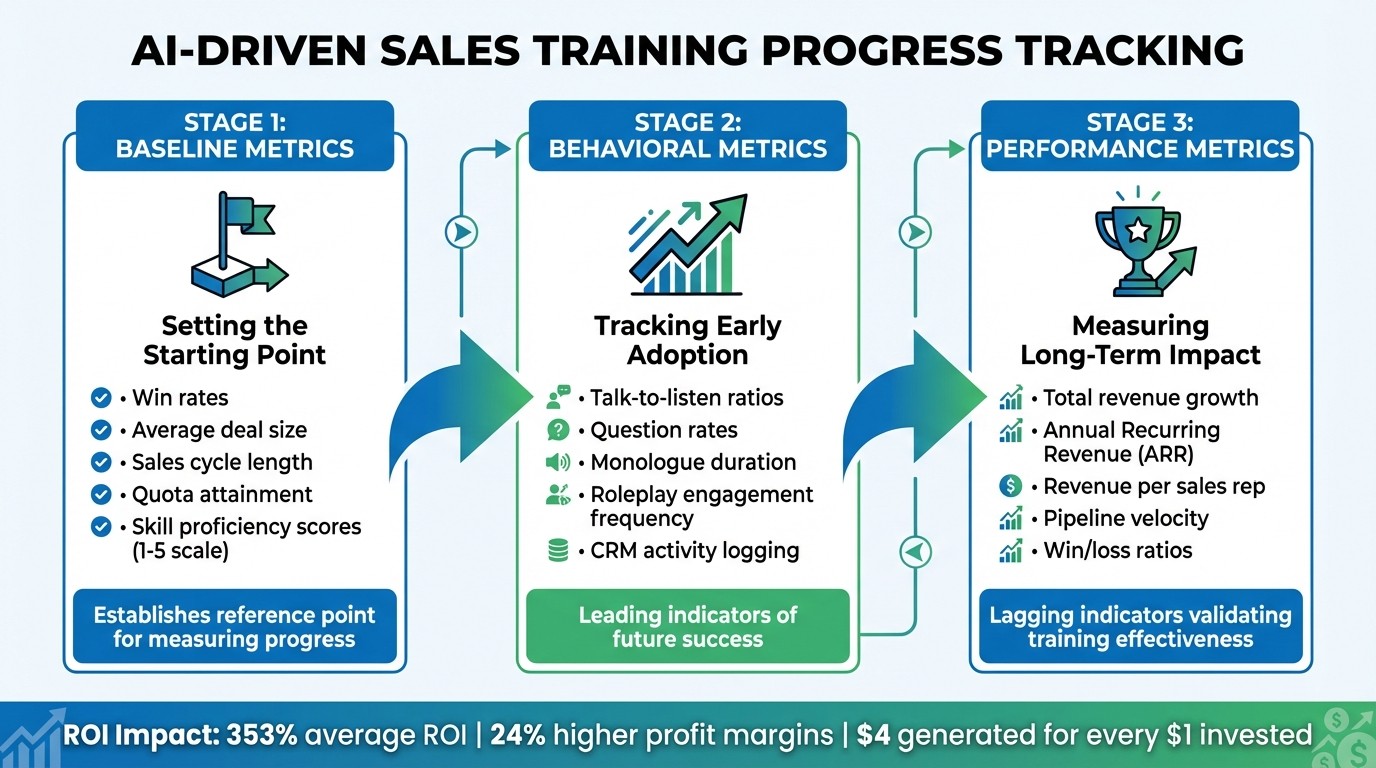
Three-Stage AI Sales Training Metrics Framework: Baseline, Behavioral, and Performance Tracking
To bridge the gap between training and execution, AI leverages three types of metrics to track progress. These metrics assess whether sales reps are applying their training effectively to achieve results. They fall into three categories: baseline metrics to establish starting points, behavioral metrics to monitor early adoption, and performance metrics to measure long-term outcomes. Each plays a crucial role in linking training efforts to real-world performance.
Baseline Metrics: Setting the Starting Point
Before training kicks off, AI establishes a baseline by pulling historical CRM data on win rates, average deal size, sales cycle length, and quota attainment [3][6]. These benchmarks provide a clear reference to measure progress.
AI also uses scorecards to evaluate reps' proficiency (on a 1-5 scale) in key skills like discovery questioning and objection handling [6]. These assessments, often conducted through AI-scored roleplays, pinpoint areas where reps need improvement even before training begins [9]. This process is vital for "closed-loop measurement", which ties specific training activities directly to revenue outcomes [3]. For example, improving a win rate from 20% to 23% requires knowing where you started [8].
"Before launching your coaching program, determine the current performance levels for each metric. This baseline data will serve as a reference point to quantify the impact of coaching over time." - Bardeen [6]
Once this starting point is established, AI moves on to tracking how new behaviors emerge during training.
Behavioral Metrics: Tracking Early Adoption
During training, AI focuses on leading indicators - the behaviors that hint at future success. Conversation intelligence tools analyze sales calls to monitor talk-to-listen ratios, question rates, monologue duration, and adherence to sales methodologies like MEDDPICC [7][8]. For instance, if training emphasizes discovery questions, AI can quickly verify whether reps are adopting this skill.
Engagement with AI-driven roleplay simulations offers another layer of insight. The system tracks how often reps practice, the number of attempts they make, and the time they dedicate to refining their skills [7]. Additionally, AI examines CRM activity, such as whether reps are logging next steps or updating deal stages, to ensure training is translating into consistent execution [10].
Performance Metrics: Measuring Long-Term Impact
Once reps adopt new behaviors, AI shifts its focus to lagging indicators that validate the training's long-term effectiveness [12][13]. These metrics include total revenue growth, increased Annual Recurring Revenue (ARR), and revenue per sales rep [11][12]. AI also measures improvements in sales cycle length and pipeline velocity, which reflect how well reps are handling discovery and overcoming objections [12][7].
Additional metrics, like average deal size and win/loss ratios, assess whether training has improved reps' ability to articulate value and negotiate effectively [12][7]. Companies that systematically track these outcomes often see an average 353% ROI, generating over $4 in revenue for every $1 invested [12]. Furthermore, organizations that prioritize these metrics report 24% higher profit margins compared to those that don't [12].
Real-world examples demonstrate the impact of tracking these metrics. At Oracle, AI roleplay training boosted new opportunities per rep per month from 2.78 to 6.02, while new logos per rep per month increased from 0.49 to 1.04 [11]. Similarly, AT&T recorded a 45% reduction in employee turnover and a 34% improvement in sales performance, achieving a 250% ROI within just one year through its training program [12].
How AI Tools Enable Real-Time Tracking
AI has revolutionized how sales training is monitored, turning static sessions into dynamic, feedback-driven experiences. By leveraging real-time metrics, these tools create a continuous loop of learning and improvement.
AI-Powered Roleplay and Simulations
AI-based roleplay platforms simulate real-world scenarios, featuring virtual buyer personas that adapt based on a rep's performance [1][16]. For example, a sales rep might encounter a skeptical CFO avatar that changes its objections dynamically, offering a risk-free space to refine skills like objection handling and empathy [1]. After each session, the system evaluates key competencies and provides immediate feedback [2][16].
Take Oracle NetSuite's adoption of Second Nature's AI roleplay platform in January 2026. This move led to a significant boost in performance: new opportunities per rep per month jumped from 2.78 to 6.02, while new customer acquisitions rose from 0.49 to 1.04 [5]. The flexibility of self-paced practice, without scheduling conflicts, played a big role in these improvements [1]. Interestingly, top-performing sellers engage in roleplay six times more often than their peers [7].
Conversation Intelligence for Live Calls
While simulations provide practice, real-time AI tools step in during live sales calls. These tools capture audio, transcribe it in under 700 milliseconds, and deliver actionable suggestions on the spot [14]. They monitor metrics like talk-to-listen ratios, speech pacing, filler words, and response pauses (referred to as "patience") [15][16]. Additionally, they integrate with company knowledge bases, offering instant access to critical resources like pricing details or technical specs during conversations [14].
"Real-time AI sales coaching changes this dynamic entirely. Instead of post-call analysis, modern tools provide guidance while the conversation is happening." – SalesGhost [14]
This shift to live coaching ensures reps get the help they need exactly when they need it. For example, in March 2026, Precina used Salesforce Agentforce to onboard clinicians for patient intake calls. The AI provided real-time feedback on compliance, accuracy, and empathy, enabling the company to scale its outreach for managing type-2 diabetes patients without relying on resource-heavy manual training [17].
Performance Analytics Dashboards
AI brings all training data together in centralized dashboards, giving managers a clear view of team progress. These dashboards highlight skill gaps - like difficulty handling pricing objections - and recommend targeted training modules [16]. They also track indicators like reduced filler words or improved response times, which signal growing confidence [10].
What’s more, these dashboards directly link training activities to revenue outcomes. For instance, when an AI roleplay session leads to a closed deal, sales enablement transforms from a cost center into a revenue driver [10]. Yet, only 37% of reps feel that CRM data is fully utilized for coaching insights [2]. AI bridges this gap by automatically updating deal stages, next steps, and competitor mentions from call transcripts [1]. This not only saves reps time but also gives managers complete visibility into skill development across their teams.
Coach Pilot: An AI-Driven Solution for Sales Enablement
Coach Pilot combines real-time tracking with behavioral insights to deliver actionable strategies that bridge the gap between training and execution. Unlike many AI tools that focus solely on analyzing past sales calls, Coach Pilot takes a forward-thinking approach. It suggests precise next steps, such as identifying stakeholders, highlighting key talking points, and pinpointing ideal follow-up times. By replacing static PDF playbooks with a dynamic "Living Playbook" integrated into daily workflows, the platform provides round-the-clock guidance for every stage of the sales process[18].
Custom Sales Playbooks and Immersive Training
The journey starts with capturing a company’s specific strategies - its sales processes, messaging, deal stages, objection handling, and proof points. This data is then used to train a custom AI coach that mirrors the expertise of top-performing sales reps. For instance, in May 2024, Rebecca Veksler, Co-Founder of Four Rooms, saw her team triple monthly sales and secure 14 new deals after adopting Coach Pilot[18]. Similarly, Connor Bell, a Business Development Manager at HubSpot, used the platform over an 11-week period to achieve a 50% increase in new opportunities and close 12 additional deals, boosting quarterly sales revenue by 38%[18].
This tailored approach ensures that AI-powered coaching is ready to provide immediate, actionable support during live sales interactions.
AI-Driven Coaching and Feedback
Embedded into tools like Microsoft Teams and ChatGPT for Teams, Coach Pilot delivers real-time advice during live deals. It automatically captures critical deal details and updates CRM systems, freeing up an average of 19.5 hours per week for sales reps by reducing administrative tasks[18]. Linh Podetti, CEO of Virtual Outsourced Angels, shared her experience:
"The AI is exceptional, and the weekly live coaching is even more helpful. We can bring in real-life problems and have the coaches give specific examples and solutions to help guide us and remove any roadblocks."[18]
In addition to AI guidance, weekly live coaching sessions help teams tackle complex challenges. For example, in May 2024, Naum Sekulovski, a Business Development Manager at Food By Us, used this combination of AI and live coaching to secure 13 new contracts in just 9 weeks, driving a 45% increase in sales revenue[18].
Sales Performance Analytics for Progress Tracking
Coach Pilot’s analytics connect training efforts directly to revenue growth. Teams have reported a 7.8x increase in pipeline growth within the first 90 days, along with a 39% improvement in quota attainment by shifting from generic outreach to personalized, value-focused communication[18]. In December 2024, Stephen Luxmoore, Founder and CEO of Your HR Team, saw a 32% boost in client acquisitions, signing 8 contracts in just 9 weeks. These results highlight how the platform tracks both behavioral changes and measurable outcomes, ensuring that training efforts translate into real sales improvements[18].
Conclusion
AI has reshaped the landscape of sales training. Instead of relying on incomplete metrics, organizations now have tools to track real behavioral changes. The move from one-off training sessions to ongoing, real-time coaching has created a system where every call becomes a learning opportunity. With AI analyzing 100% of calls - compared to the mere 1–2% that managers can manually review - teams gain the insights needed to transform training into a revenue-driving engine [13]. This shift prioritizes actionable insights over basic completion metrics, as highlighted earlier.
The numbers speak volumes about AI's role in boosting efficiency and effectiveness. AI-powered coaching can cut onboarding time by up to 40%, while reps who train with AI simulations close deals 22% faster than those who don't [2]. Yet, despite these benefits, 70% of salespeople still lack formal training [2][3]. The disparity between trained and untrained teams isn't just about performance; it represents a critical difference in long-term competitive advantage.
Mamta Tainwala from Strategy & Trends captures this sentiment perfectly:
"AI sales training is not about replacing human judgment with algorithms. It is about giving every rep on your team access to... consistent, personalized, data-driven coaching." [1]
Coach Pilot exemplifies this philosophy by offering custom playbooks, immersive training experiences, and integrated AI coaching to bridge the gap between strategy and execution. The platform uses real-time metrics to provide actionable guidance at every step of the sales process.
The evidence is undeniable: The real question is whether your team will harness these tools to drive measurable progress and long-term success - or continue relying on outdated methods, where 87% of training content is forgotten within 30 days [4][2].
FAQs
What data does AI use to track sales training progress?
AI keeps tabs on sales training progress by diving into various data points. It looks at performance metrics, how well skills are being applied, engagement levels, call analysis, behavioral shifts, quota achievements, and revenue impact. By analyzing these areas, AI helps gauge how effective the training is and how it influences overall sales results.
How do I set a baseline before rolling out AI coaching?
To get started, focus on tracking and analyzing key sales performance metrics. These include behavior change, quota attainment, win rates, sales cycle length, and skill application. Begin by gathering and examining your current data to create a solid baseline. This baseline will serve as a reference point for comparing future results after introducing AI coaching.
For a more thorough evaluation, consider using established frameworks like the Kirkpatrick model. This approach ensures a deeper understanding of how training impacts performance over time.
How long until AI coaching shows revenue impact?
AI coaching has the potential to drive noticeable revenue growth in as little as 90 days. Within this timeframe, many businesses experience boosts in productivity, quicker skill acquisition, and higher win rates. These outcomes show how AI can speed up advancements in sales training and overall performance.
Related Blog Posts

Remove the guesswork from winning more deals.