B2B Sales
AI in Sales Onboarding: Automating Workflows Explained
Mar 13, 2026
How AI automates sales onboarding—cutting ramp time, automating CRM tasks, providing real-time coaching, and improving quota attainment and retention.

AI is transforming sales onboarding by addressing inefficiencies, reducing ramp-up time, and improving productivity for new hires. Traditional onboarding processes often overwhelm new employees with information and administrative tasks, leading to high turnover and missed revenue opportunities. Companies integrating AI into their workflows are seeing measurable improvements, including faster training times, higher quota attainment, and lower administrative burdens.
Key takeaways from AI-powered sales onboarding:
Faster Productivity: AI reduces onboarding time by up to 50% and helps new hires achieve quota 28% faster.
Automated Tasks: Repetitive tasks like CRM data entry are automated, saving 30%-40% of administrative time.
Personalized Training: AI tailors learning paths to individual skill gaps, boosting retention and application of knowledge.
Real-Time Coaching: AI provides live feedback during sales calls, helping reps improve performance on the spot.
Performance Tracking: Managers gain objective insights into progress, identifying areas for targeted coaching.
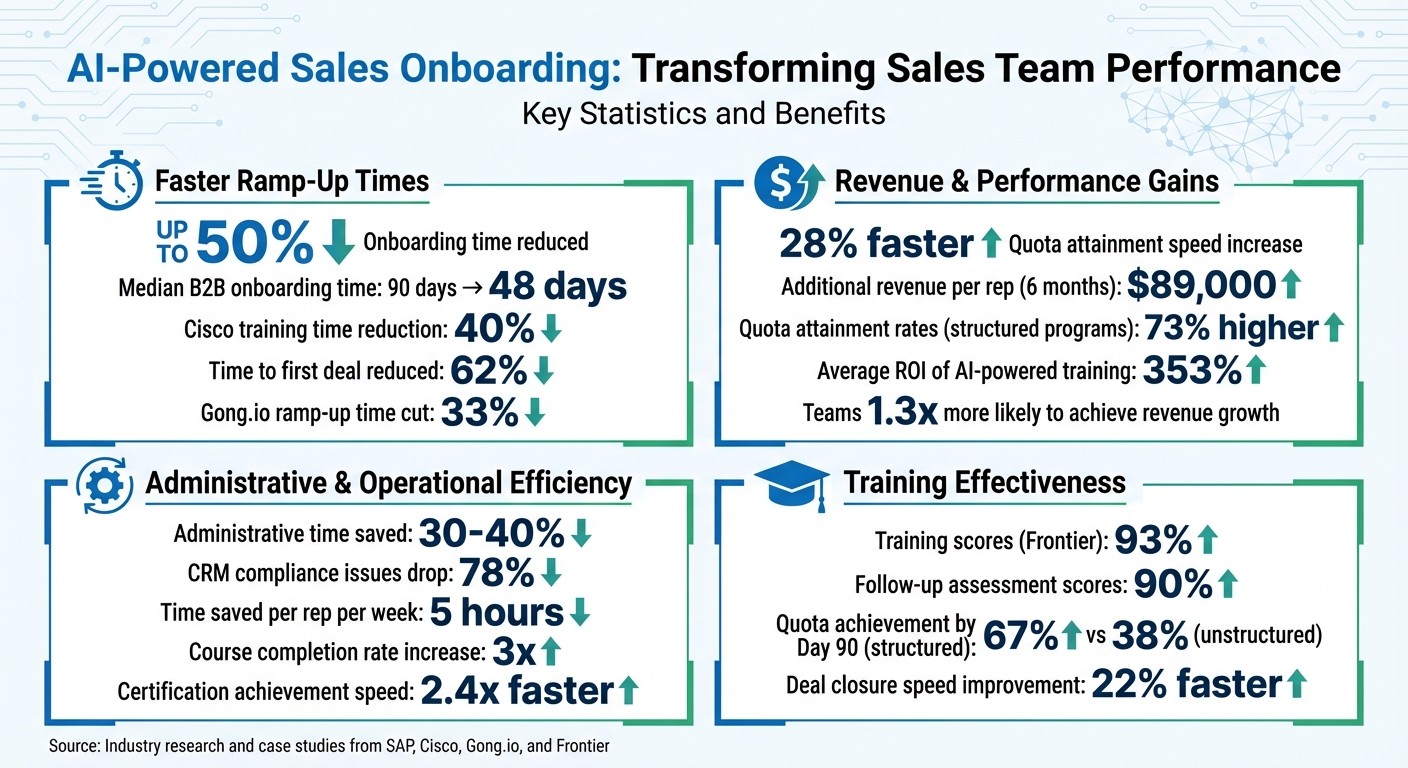
AI-Powered Sales Onboarding: Key Performance Metrics and Benefits
Your AI Onboarding Assistant for Sports Sales
Benefits of Automating Sales Onboarding with AI
AI isn’t just about speeding up onboarding - it’s about making the entire sales process more efficient and effective. Companies using AI-assisted onboarding have seen their median onboarding time for B2B sales teams shrink from 90 days to just 48 days [6]. For growing sales teams chasing ambitious revenue goals, this isn’t just helpful - it’s essential.
Improving Workflow Efficiency
AI takes over the repetitive, time-consuming tasks that often bog down sales teams. For example, it can automatically capture and log every email, call, and meeting into your CRM, cutting administrative work by 30% to 40% [3]. Instead of spending hours manually creating contacts or searching for email templates, new hires can focus on building their selling skills. AI even generates account briefs and prospect research, giving reps more time to engage with prospects.
Managers also benefit significantly. AI tools can review call recordings, score them against your playbooks, and provide objective feedback - all without requiring hours of manual effort [8]. At Cisco, implementing AI-driven onboarding reduced training time by 40% while improving readiness for closing deals [6]. Plus, CRM compliance issues - a common challenge in traditional onboarding - drop by 78% when automated tools handle data capture [3]. These efficiencies not only speed up the onboarding process but also create a more consistent and effective training experience.
Standardizing Training Delivery
Traditional onboarding can feel like a lottery. A rep in one office might get hands-on guidance from a top performer, while another rep elsewhere gets less support due to an overloaded manager. AI solves this by delivering a uniform training experience across the board, ensuring every rep learns the same methods and messaging [8][4].
"Automation isn't just nice to have - it's essential for scaling excellence." - Hyperbound [8]
The proof is in the numbers. Companies with structured onboarding programs report 73% higher quota attainment rates for new hires [8]. Frontier, a telecommunications company, saw reps score 93% in training and 90% in follow-up assessments after adopting a standardized AI-driven training platform [5]. AI also combats the “information dump” problem - where reps forget 84% of training within 90 days - by using tools like spaced repetition and automated quizzes [9]. Reps receive instant, personalized feedback after every interaction, reinforcing best practices and helping them ramp up faster. This consistency directly boosts sales performance and shortens the time it takes for reps to become productive contributors.
Shortening Time to Productivity
Consider this example: In 2024, a Series A SaaS company with a small five-person sales team struggled as new Account Executives took over six months to hit quota, and only 33% of them stayed beyond that period. After implementing AI-powered call coaching and daily playbook prompts, the company cut ramp time by 40%, generating an additional $89,000 in revenue per rep within six months and achieving 100% retention of new hires [9].
AI personalizes training by analyzing individual skill gaps through CRM and call data, tailoring the learning experience to each rep’s needs instead of applying a generic curriculum [6]. SAP saw 28% faster quota attainment across teams in North America and EMEA after adopting this approach [6]. Similarly, Gong.io used its AI platform to analyze top-performing call recordings, enabling new hires to learn directly from successful sales patterns. This cut ramp-up time by 33% [6]. Reps who completed a 30-day structured AI-driven onboarding program achieved 67% of their quota by Day 90, compared to only 38% for those in less organized programs [9].
Platforms like Coach Pilot (https://coachpilot.com) showcase how AI-driven solutions can integrate custom playbooks, immersive training, and real-time coaching, delivering results that transform sales onboarding into a measurable success.
Components of AI-Driven Sales Onboarding Workflows
Sales onboarding gets a major boost with three key elements: personalization, data integration, and performance tracking. Platforms like Coach Pilot bring these together to create streamlined onboarding processes, offering tailored learning and actionable insights. These components build on earlier benefits, delivering both efficiency and customized experiences for sales teams.
AI-Powered Personalization
AI takes the guesswork out of onboarding by tailoring training to a rep's experience, role, and skill gaps. For example, seasoned Account Executives can skip beginner modules and dive straight into advanced deal strategies, while new SDRs focus on foundational skills like lead qualification. SAP provides a great example: their AI-driven system matched reps to content based on their prior experience and role-specific KPIs. The result? A 28% faster quota attainment across North America and EMEA teams within a year [6].
This system also delivered training in 5-minute micro-learning segments, which significantly improved retention [10]. Personalized learning paths powered by AI have been shown to increase course completion rates by 3x compared to traditional methods [2]. Additionally, AI-driven simulations adapt their difficulty levels based on performance, enabling users to achieve certification 2.4x faster than traditional role-play scenarios [6].
Real-Time Data Integration
Real-time data integration ensures that onboarding stays relevant to actual sales scenarios. AI tools connect seamlessly with CRM, HRIS, and sales platforms, providing training that reflects real-world activities. For instance, if a rep logs a discovery call, AI can instantly suggest training on handling specific objections raised during the call.
Shopify implemented such an approach in 2025, using automated follow-ups and guided checklists synced with their systems. This strategy reduced time-to-first-sale by 40% [2]. By integrating with sales tools, reps gain immediate access to verified contact data and personalized research. Apollo.io highlights the efficiency of this approach:
"The moment we select someone in our database, they're instantly added to a sequence and we can take action right away. We're effective and efficient with our outreach." [11]
Performance Tracking and Analytics
AI doesn't just train - it tracks. By monitoring interactions and scoring them against established playbooks, AI provides managers with objective insights into each rep's progress, eliminating the need for manual reviews. It identifies skill gaps, such as weak discovery questions or missed closing opportunities, and automatically recommends targeted training.
Frontier used real-time analytics to identify knowledge gaps and launched a focused 2-week coaching program. This effort led to a 93% training score and 90% success in follow-up assessments [5]. AI also supports milestone-based progression, advancing reps only after they meet performance benchmarks like booking 5 qualified meetings or delivering a full product demo [4]. These insights not only refine training but also help new hires reach full productivity faster.
Using AI Coaching in Onboarding Workflows
AI coaching reshapes onboarding by turning it into a continuous, real-time learning process during live sales activities. Instead of waiting for post-call reviews, new hires get guidance exactly when they need it - right in the middle of their conversations. This real-time approach tackles the "Coaching Gap", where traditional methods leave 90% of prospect interactions without guidance, as managers typically review less than 10% of calls [16].
By replacing reactive reviews with proactive micro-training, sales teams can see immediate skill reinforcement. The results speak for themselves: teams using AI-driven coaching are 1.3 times more likely to achieve revenue growth [13][14], and companies that embrace ongoing coaching see win rates jump by over 6 percentage points [13].
Real-Time Feedback During Sales Activities
AI coaching tools are designed to keep up with the fast pace of sales. These systems capture and transcribe live sales call audio almost instantly, using Natural Language Processing to analyze the context, intent, and flow of conversations [12]. Drawing from company resources like product guides, battle cards, and pricing sheets, the AI provides answers in under 700 milliseconds [12]. This "just-in-time" learning delivers targeted prompts and micro-lessons exactly when sales reps need them [13][15].
For example, if a new hire dominates a discovery call, the AI tracks their talk ratio and sends an alert if they exceed a 70% threshold [12][15]. Or, if a prospect raises a pricing objection, the system suggests an appropriate response based on the company’s battle cards. This approach, often called "Invisible Shadowing", allows AI to monitor multiple live calls at once, flagging only the calls that require a manager’s intervention. This enables a single manager to effectively oversee up to 20 reps at the same time [16].
The benefits extend beyond better coaching - AI-assisted onboarding significantly reduces the time it takes for new hires to become productive, cutting ramp time by 30% to 50% [16]. Platforms like Coach Pilot seamlessly integrate AI coaching into sales workflows, replacing static training manuals with dynamic "Living Playbooks." These playbooks use spaced learning techniques to provide real-time, context-sensitive prompts, helping new hires build lasting habits more effectively [13].
"AI sales coaching, when executed well, delivers three outcomes: Time recovered... Behavior reinforced... Outcomes measured."
– Sanchit Garg, Cofounder & CEO, Zime [13]
Customized Skill Development
AI coaching doesn’t stop at real-time feedback - it also focuses on refining individual skills through personalized practice. Instead of offering generic advice, the AI analyzes every sales interaction to identify specific moments where a new hire may have missed key buying signals or mishandled objections [17]. This level of analysis uncovers recurring issues, like skipping budget discussions or rushing through discovery, that human reviews often overlook. The result? Tailored coaching that targets each rep’s unique challenges.
New hires can also sharpen their skills in a risk-free environment. AI-powered simulations let them practice handling tough scenarios, like pricing objections or competitive comparisons, with immediate, specific feedback after each attempt [17]. This repeated practice builds confidence, ensuring they’re better prepared for real conversations. As Mamta Tainwala from Sybill explains:
"Confidence in sales comes from preparedness. A rep who has practiced handling the 'your competitor is cheaper' objection fifteen times in simulated environments will handle it very differently the first time a real prospect says it." [17]
Beyond coaching sessions, the system encourages self-improvement. Reps can query their performance data directly, asking questions like, "Where am I losing deals?" or "How’s my objection handling?" This gives them actionable insights without waiting for managerial feedback [17]. Advanced AI tools even analyze buyer sentiment and engagement during calls, helping reps fine-tune their emotional tone and delivery based on non-verbal cues [17]. By integrating these features into automated workflows, AI coaching streamlines the entire onboarding process, setting new hires up for long-term success.
Measuring AI-Driven Sales Onboarding Success
To gauge the success of AI-driven onboarding, it's crucial to focus on metrics that reflect execution, knowledge transfer, and business outcomes. As Ameya Deshmukh, VP of Talent Acquisition, points out:
"The best KPIs for onboarding automation measure two things at once: execution quality (did tasks happen on time, correctly, and consistently?) and business impact (did new hires become productive faster and stay longer?)." [18]
AI analytics make this process more precise by linking training activities directly to measurable outcomes. Instead of relying solely on subjective feedback from managers, AI platforms integrate with CRM systems to connect training milestones with key metrics like pipeline growth, win rates, and deal velocity [19]. This approach helps identify which parts of the onboarding process are effective and which are not.
Time-to-Productivity Metrics
Time-to-productivity stands out as a key indicator of onboarding success. It measures how quickly new hires reach full operational output and start contributing to revenue. While the average sales rep takes about 3.5 months (or 105 days) to achieve full productivity, companies using AI and structured onboarding programs often reduce this to just two months [22].
AI helps shorten this timeline in several ways. For example, it provides real-time call feedback, eliminating delays from traditional review processes. Automated administrative tasks save reps up to five hours a week, allowing them to focus more on customer-facing activities [22]. Additionally, adaptive learning paths address individual skill gaps rather than forcing all hires through the same generic content. Cisco's use of the AI-driven platform Qstream in 2022 led to a 40% reduction in onboarding time, while also improving knowledge retention and readiness to close deals [6].
Tracking role-specific milestones is essential for accurate measurement. For example:
For SDRs, track the time to their first qualified meeting.
For Account Executives, monitor the time to their first opportunity created or first closed deal.
Measure "Time to Day 1 Ready", which captures the period from offer acceptance to when a new hire has full system access, equipment, and a schedule for their first week [18].
Tools like Coach Pilot integrate AI coaching into workflows, providing real-time visibility into each rep's progress toward these milestones.
Knowledge Retention and Application
Traditional onboarding often measures knowledge with quiz scores or course completions, but these metrics don’t show whether new hires can apply what they’ve learned in real-world situations [19]. AI analytics bridge this gap by assessing the difference between knowing and doing.
For example, AI-powered tools analyze conversations to check if reps are using techniques taught during training, such as asking discovery questions or handling objections. If certain techniques aren’t being applied, the system flags those reps for further coaching [19].
AI also measures "Knowledge Lift", which compares pre- and post-training assessment scores, and evaluates performance in AI-driven roleplay exercises. In 2023, SAP personalized its onboarding with AI, tailoring training to individual experience levels and live sales scenarios. This led to 28% faster quota attainment for teams in North America and EMEA [6]. Reps who practiced with AI simulations also closed deals 22% faster than those who didn’t [19].
AI can even quantify soft skills like empathy, active listening, and tone during simulated customer interactions [19][6]. This creates a more complete picture of how effectively new hires are applying their training under real-world conditions.
Revenue and Performance Impact
Ultimately, the success of any onboarding program comes down to its impact on revenue. AI-driven onboarding should lead to measurable improvements in deal quality and overall sales performance. Key metrics include Time to First Closed-Won, Ramp Win Rate Delta, and Quota Attainment at 30, 60, and 90 days [20][11].
Eric Zines, Principal Analyst at Forrester, highlights the importance of focusing on competency:
"What sales leaders can do better to reduce attrition is to increase onboarding quality and time by focusing on trying to measure time to competency." [21]
For example, Gong used its conversation intelligence platform in 2023 to analyze high-performing reps' calls. New hires trained with these insights reduced their ramp-up time by 33% compared to previous cohorts [6]. These gains were driven by improved training processes and real-time feedback.
AI also enables predictive success modeling, which correlates onboarding activities with long-term retention and performance outcomes [7][18]. This allows managers to identify and address issues - like skill gaps or motivation problems - before they escalate. When applied effectively, AI-powered sales training delivers an average ROI of 353% [19].
Best Practices for Implementing AI in Sales Onboarding
Introducing AI into sales onboarding can transform how teams operate. But the key to success lies in connecting AI tools to clear business objectives, ensuring data accuracy, and driving adoption among sales reps. Companies that approach AI as a fundamental shift in their processes, rather than just a tech upgrade, tend to see the biggest benefits.
Aligning AI with Business Goals
Before jumping into AI implementation, it’s critical to pinpoint the specific challenges you want to address. For instance, are you struggling with pipeline generation or dealing with long sales cycles? Research from 2023 revealed that 61% of sales reps face difficulties in generating pipeline, highlighting the need for better enablement tools [5]. AI should address these pain points directly, not just automate tasks for the sake of it.
Start by assessing your current processes. Look at metrics like win rates, sales cycle length, and where new hires encounter obstacles during onboarding [5]. If you’re entering new markets or launching products, consider how AI can streamline those efforts [23]. For example, if your team struggles with discovery calls, AI tools can analyze conversations and provide real-time feedback to improve performance. As Tara Furiani, CEO of Not the HR Lady, puts it:
"We've shifted the perception of training from being a 'box to check' to a strategic advantage" [5].
Tie AI usage to metrics that matter to leadership - such as deal velocity, faster pipeline movement, or revenue growth [5]. When AI-driven onboarding leads to quicker quota attainment or shorter sales cycles, getting buy-in becomes much easier. A great example is IBM’s Watson AI, which reduced internal sales onboarding time from 12 weeks to just 6 weeks, delivering measurable results [6].
With clear goals in place, the next step is to ensure your data infrastructure can support AI effectively.
Maintaining Data Accuracy and Integration
AI systems are only as effective as the data they rely on. If your CRM data is incomplete or inconsistent, the insights AI generates won’t be trusted by your team [25]. Start by conducting a data audit. Clean up duplicate entries, standardize pipeline definitions, and ensure critical fields are consistently filled.
Your AI tools must integrate seamlessly with your CRM - whether you’re using Salesforce, HubSpot, or Dynamics 365 [25]. This involves bi-directional synchronization, where AI can both pull data for analysis and push insights back into the CRM in real time. This keeps the CRM as the single source of truth. Make sure your infrastructure supports this, including server-side scripts, webhook listeners, and token-authenticated APIs [24].
Set up a central data repository where AI tools can access and update information [23][24]. This eliminates data silos and ensures everyone works from the same dataset. Gartner predicts that by 2026, 40% of enterprise applications will include task-specific AI agents, making smooth integration even more important [25].
Additionally, ensure your AI platform complies with regulations like GDPR or CCPA and restrict access to sensitive data [23]. Beyond legal requirements, this builds trust within your team, ensuring they feel confident in the system.
Once your data foundation is solid, the focus shifts to encouraging team-wide adoption.
Encouraging Team Adoption
Even the most advanced AI tools won’t succeed if your team doesn’t use them. Adoption begins with changing perceptions. Instead of viewing AI as a threat, position it as a tool that takes care of repetitive tasks, freeing up reps to focus on building relationships [23][24]. Many reps spend a significant amount of time on non-selling activities, so showing how AI gives them more time to sell can make its value clear.
Start with phased rollouts, such as pilot programs or observation modes, to build trust and gather feedback before full implementation [5][24]. This allows reps to see the system in action and provide input. Host weekly "AI in Action" sessions where team members can share success stories or tips on how AI helped close deals [23].
Group new hires into peer cohorts of at least three people. Research shows that reps onboarded with peers tend to ramp up faster due to shared accountability [4]. Incorporate milestone gates that require reps to demonstrate specific skills - like delivering a concise product overview - before moving to the next phase of onboarding [4]. This ensures they’re not just completing training modules but actively applying their knowledge.
Finally, treat AI training as an evolving process. Use real-time call transcripts and performance data to refine AI prompts and learning paths [24]. Encourage reps to review and adjust AI-generated outputs, as their feedback can help fine-tune the system over time [25]. Tools like Coach Pilot integrate AI coaching into sales workflows, offering real-time insights into each rep’s progress and identifying areas where additional support is needed.
Conclusion
AI-powered automation is reshaping sales onboarding, turning it into a scalable and tailored process that speeds up productivity. By swapping out traditional slide decks for interactive roleplays, automating CRM data entry, and providing real-time feedback, AI directly addresses the delays that often hinder new hires. Companies leveraging AI in onboarding have reported significant improvements: ramp time reduced by up to 50%, time to first deal cut by 62%, and quota attainment rates increasing by 73% [1][3][8].
The key shift is moving from simply "knowing" to actively "doing." As SmartWinnr aptly puts it:
"New hires do not fail because they cannot memorize slides. They struggle because the first real conversation arrives before they are not truly ready" [1].
AI simulators and automated feedback systems provide new hires with unlimited, risk-free practice opportunities. This ensures they’re ready for real-world interactions, bridging the gap between theoretical knowledge and practical execution.
Scalability is another standout benefit. Unlike traditional onboarding, which requires more trainers as teams expand, AI handles tasks like grading, tracking, and content delivery automatically. This frees up managers to focus on strategic coaching. As Hyperbound explains:
"The goal of automation is not to replace human coaching but to amplify it" [8].
Additionally, AI minimizes administrative tasks by 30% to 40%, seamlessly capturing calls, emails, and meetings [3]. It also identifies individual skill gaps and creates personalized learning paths that adapt in real time, moving beyond the outdated one-size-fits-all approach. These capabilities transform onboarding into a dynamic, results-driven process that aligns with modern sales needs.
For organizations looking to adopt AI, the roadmap is straightforward: align tools with business objectives, ensure clean data integration, and support team adoption with phased rollouts and continuous training. Platforms like Coach Pilot integrate AI coaching directly into sales workflows, offering real-time insights and tailored guidance to help teams close the gap between planning and execution. By embracing these AI-driven solutions, companies can accelerate onboarding, empower their sales teams, and set the stage for sustainable revenue growth. When executed effectively, AI onboarding not only speeds up ramp time but also lays the groundwork for long-term success.
FAQs
What should we automate first in sales onboarding with AI?
Start by streamlining repetitive and time-consuming tasks such as filling out forms, scheduling training sessions, and handling documentation. These tasks often eat up a big chunk of the onboarding process. By automating workflows for things like data collection, system updates, and introductory training modules, you can cut down ramp-up times. This means new hires can spend less time on administrative tasks and more time diving into their roles and connecting with clients.
How do we connect AI onboarding to our CRM without messy data?
To keep your AI onboarding process smooth and your CRM data clean, rely on automated data capture and enrichment tools. These AI-powered solutions can log and update customer interactions automatically, cutting down on manual input and minimizing errors. By linking AI-driven workflows to your CRM, you can handle repetitive tasks effortlessly, ensure accurate data, and gain better visibility into your pipeline. This approach keeps your onboarding process efficient and well-structured.
How can we prove AI onboarding improves revenue and ramp time?
AI-powered onboarding can dramatically improve revenue and reduce ramp time by helping new sales reps reach full productivity much faster - often slashing the time by 50-62%. For example, cutting onboarding from 90 days to 48 days could save approximately $340,000 per rep in unrealized quota. Research also highlights that it can increase quota attainment rates by up to 79% and speed up the time to close the first deal by over 50%, resulting in noticeable revenue growth.
Related Blog Posts

Remove the guesswork from winning more deals.