B2B Sales
Sales Cycle Length Benchmarks for B2B Teams
Apr 4, 2026
Benchmarks for B2B sales cycle lengths by deal size and industry, common bottlenecks, and proven tactics to cut cycle time.

The length of your sales cycle matters. It affects revenue forecasts, resource allocation, and quota attainment. Since 2022, B2B sales cycles have grown 22% longer due to larger buying committees (now averaging 6.8 stakeholders), stricter compliance, and more CFO involvement. Yet, 62% of companies lack benchmarks to evaluate their performance.
Here’s the quick breakdown:
SMB Deals: Close in 14–30 days, typically involving one decision-maker.
Mid-Market Deals: Take 30–90 days, with 2–3 stakeholders and formal reviews.
Enterprise Deals: Stretch to 90–180+ days, requiring committee input, legal, and security reviews.
Industry Variations: Software deals average 90 days; pharmaceuticals take 153 days due to regulatory hurdles.
Key bottlenecks include proposal delays, negotiation stalls, and compliance hurdles. Solutions like engaging multiple stakeholders, using AI tools, advancing the future of sales enablement, and creating Mutual Action Plans can reduce cycle times by 20–30%.
Understanding these benchmarks helps pinpoint inefficiencies and improve your sales strategy.
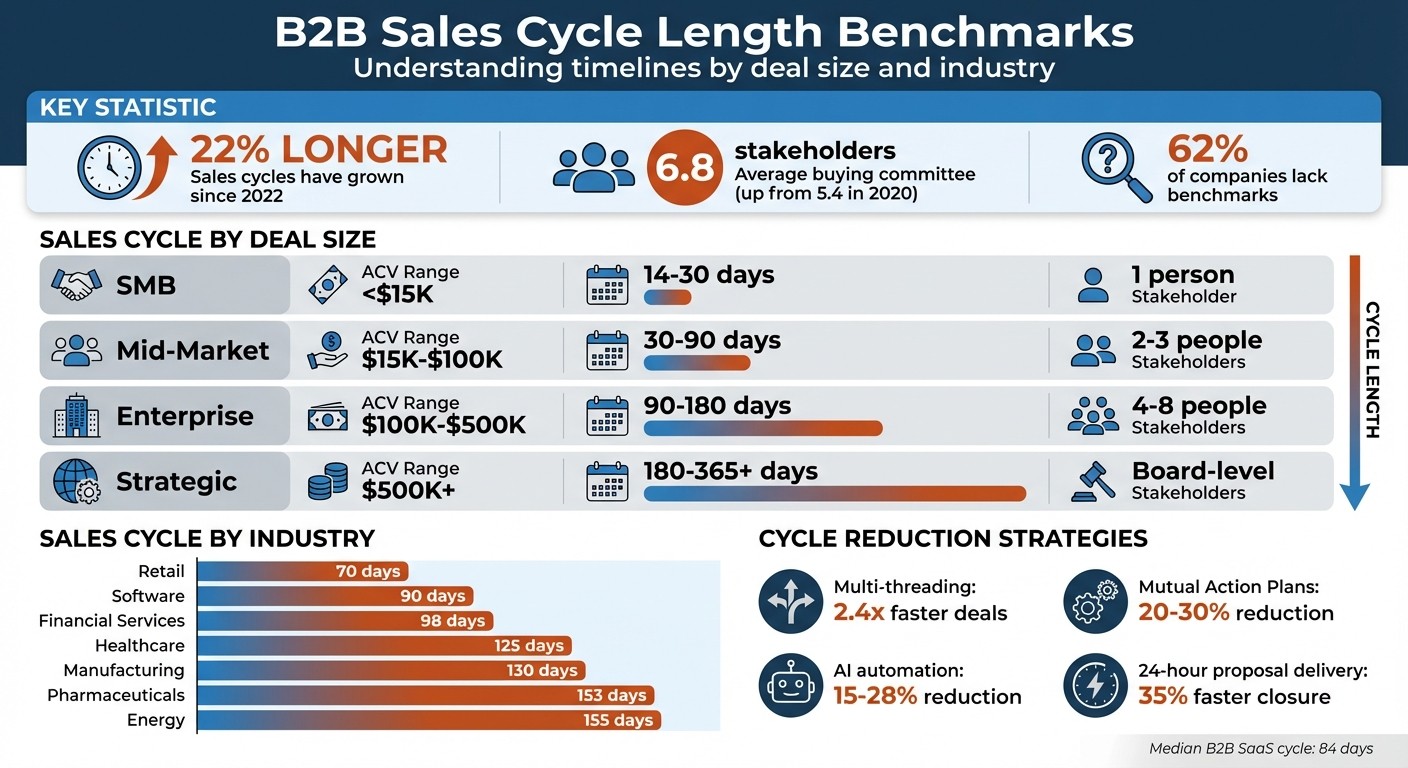
B2B Sales Cycle Benchmarks by Deal Size and Industry
Sales Cycle Benchmarks by Deal Size
Deal Size Categories Explained
The size of a deal has a direct impact on how buyers make decisions. SMB deals (Annual Contract Value, or ACV, under $15,000) are typically straightforward, involving just one decision-maker with minimal approval steps. Mid-market deals (ACV between $15,000 and $100,000) usually involve 2–3 stakeholders and require formal budget reviews and procurement processes. On the other hand, Enterprise deals (ACV over $100,000) often require input from committees, go through Request for Proposal (RFP) processes, and include detailed legal and security reviews [4][5].
Interestingly, doubling the value of a deal can increase decision complexity three- or even fourfold [5]. With this context in mind, let’s dive into the sales cycle benchmarks for each deal type.
Average Cycle Length for Each Deal Size
The time it takes to close a deal varies widely based on its size. SMB deals typically close within 14–30 days, while mid-market deals take anywhere from 30–90 days. For enterprise deals, the timeline stretches to 90–180+ days. When it comes to very large enterprise deals - those exceeding $1 million ACV - the sales cycle can last an extensive 12–24 months [7]. Although the median B2B SaaS sales cycle is about 84 days, this average doesn’t fully capture the variation between segments.
Deal Segment | ACV Range | Median Cycle Length | Typical Stakeholders |
|---|---|---|---|
SMB | <$15,000 | 14–30 days | 1 (End user/Manager) |
Mid-Market | $15,000–$100,000 | 30–90 days | 2–3 (Dept. Head, Finance) |
Enterprise | $100,000–$500,000 | 90–180 days | 4–8 (Committee, IT, Legal) |
Strategic | $500,000+ | 180–365+ days | Board-level / Executive |
Each of these benchmarks can help pinpoint inefficiencies. For instance, SMB deals generally move quickly due to their straightforward nature and urgency. Mid-market deals, however, involve more formal processes, such as budget approvals and procurement reviews. Enterprise deals, with their longer timelines, often face additional hurdles like security compliance (which can extend the process by 35%), legal reviews (adding about 18 days), and procurement approvals (which tack on roughly 21 days) [7].
Common Bottlenecks by Deal Size
Different deal sizes come with their own challenges and potential delays:
SMB deals: These often hit snags early in the process. Deals might enter the pipeline before being fully qualified, or proposals may be sent before a strong economic case has been made [5].
Mid-market deals: A common issue here is single-threading. A deal that initially progresses with one contact often stalls when additional stakeholders - such as someone from Finance, IT, or another department - join the process and bring new evaluation criteria [5][8]. Engaging multiple stakeholders early (multi-threading) can speed up the process by as much as 2.4 times [4]. If a mid-market deal stretches beyond 55 days, it could signal problems with early-stage qualification or establishing value [5].
Enterprise deals: These face more institutional hurdles. The Negotiation to Close stage, which involves legal reviews, procurement approvals, and increased scrutiny from CFOs (up 40%), can account for 35–40% of the total cycle time [4]. Security questionnaires and vendor risk assessments can also add 2–4 weeks [4]. To counteract these delays, starting security reviews earlier and using Mutual Action Plans (to co-develop timelines with buyers) can cut cycle time by 20–30% [4][5].
Guy Rubin - 2024 B2B Sales Benchmarks
Sales Cycle Benchmarks by Industry
Sales cycles don’t follow a one-size-fits-all pattern - industry-specific factors heavily shape the timelines for closing deals. Teams can navigate these complexities by following a structured B2B sales playbook that aligns with buyer needs.
Industry Benchmarks and Patterns
The time it takes to close a deal varies significantly by industry. For example, retail companies close B2B deals in about 70 days, while pharmaceuticals deals stretch to an average of 153 days - over twice as long. Other industries fall somewhere in between, with software averaging 90 days, financial services around 98 days, healthcare approximately 125 days, and manufacturing taking about 130 days. Deals in the energy sector often extend to 155 days, while government contracts can range from 120 days to well over a year, thanks to complex procurement requirements.
Breaking the sales process into stages reveals even more variation. For instance, the proposal stage in software deals typically lasts about 30 days, while manufacturing proposals can stretch to 45 days due to factors like technical evaluations and supply chain reviews. Similarly, the negotiation phase in pharmaceuticals averages 42 days - almost double the 25 days seen in software. Even the closing stage differs significantly, with financial services averaging 24 days compared to 38 days in pharmaceuticals.
Industry | Initial Contact | Proposal | Negotiation | Closing | Total |
|---|---|---|---|---|---|
Software | 14 days | 30 days | 25 days | 21 days | 90 days |
Financial Services | 16 days | 28 days | 30 days | 24 days | 98 days |
Healthcare | 22 days | 35 days | 40 days | 28 days | 125 days |
Manufacturing | 18 days | 45 days | 35 days | 32 days | 130 days |
Pharmaceuticals | 28 days | 45 days | 42 days | 38 days | 153 days |
Source: Focus Digital/Trembi 2025-2026 Benchmarks [6][9]
These numbers highlight how each industry’s unique challenges influence the overall sales process.
What Drives Industry Differences
Several factors explain why sales cycles vary so widely across industries.
Regulatory requirements play a huge role in extending timelines. Industries like healthcare and pharmaceuticals must navigate rigorous compliance checks, legal reviews, and security assessments before deals can close [8]. Similarly, financial services deals often require additional steps, such as SOC 2 and GDPR compliance reviews, which can add two to four weeks to the process, especially for mid-market transactions [4].
Product complexity and capital investment also have a major impact. Manufacturing deals, for example, involve intricate supply chains and large financial commitments, which naturally slow decision-making [8]. On the other hand, software and SaaS companies benefit from subscription-based pricing models that reduce perceived risk, enabling quicker decisions.
Finally, decision-making structures vary widely. Manufacturing deals often involve around seven stakeholders, compared to just three for e-commerce deals [3]. The more people involved, the longer it takes to reach a consensus, further extending the sales cycle.
Sales Cycle Breakdown by Stage
Breaking down your sales cycle step-by-step helps pinpoint where time is being lost and where you can make meaningful changes. In B2B sales, the process typically moves through four main stages, each with its own timeline and challenges.
Discovery to Demo
This first stage - spanning from initial contact to scheduling a demo - takes different amounts of time depending on the deal size: 3–5 days for SMBs, 5–10 days for mid-market deals, and 10–20 days for enterprise opportunities [4]. The biggest hurdle? Scheduling. Coordinating calendars, especially for teams across time zones, can slow things down [4].
Some companies have found ways to speed this up. For instance, Frontify’s sales team cut their account research time by 90% - from 60 minutes to just a few - by using real-time account signals. This change shortened their overall sales cycle by 31% and boosted their win rate by 35% [10]. Similarly, Analytic Partners reduced their account research time from 3 hours to just 15 minutes, allowing them to move faster on a $1M+ Fortune 500 deal [10]. Streamlining this stage can eliminate early bottlenecks and push deals forward faster.
Once demos are scheduled, the next challenge is turning those meetings into tailored proposals.
Demo to Proposal
The time it takes to move from demo to proposal varies: 1–3 days for SMBs, 5–15 days for mid-market deals, and 15–30 days for enterprise opportunities [4]. Delays here often stem from internal misalignment - like unclear buyer needs or missing input from key stakeholders. Yet, sending a proposal within 24 hours of a demo can speed up deal closure by 35% [4]. Quick proposal delivery keeps the momentum going and ensures buyers stay engaged.
After the proposal is sent, the focus shifts to the negotiation phase, which brings its own set of challenges.
Proposal to Negotiation
This stage takes 3–7 days for SMBs, 10–20 days for mid-market deals, and 20–40 days for enterprise opportunities [4]. It’s also where deals are most likely to stall - 32% of all B2B deals hit a snag at this point [3].
"Across all industries, 32% of deals stall at the Proposal stage - more than any other stage."
– Alex Tanaka, Product Builder & Revenue Velocity Explorer [3]
What causes these delays? Budget concerns, comparison shopping, and decision paralysis are all major factors [3][4]. The growing size of buying committees doesn’t help either - today, the average B2B deal involves 6.8 stakeholders, up from 5.4 in 2020 [4]. One way to avoid stalls is to address budget expectations early. For example, discussing budget ranges during discovery can eliminate 30% of prospects who might otherwise get stuck later [3]. Tackling these issues upfront keeps deals moving forward.
Once negotiations begin, the final hurdles - like legal and procurement - determine how quickly a deal can close.
Negotiation to Close
The last stage of the cycle takes 2–5 days for SMBs, 10–20 days for mid-market deals, and 30–60 days for enterprise opportunities [4]. For larger deals, this phase often makes up 35–40% of the total cycle time [4], with legal and procurement reviews being the biggest time sinks.
Legal reviews alone can add 18 days, while procurement can tack on another 21 days [7]. Security compliance requirements add even more, increasing the sales cycle by 35% on average [7].
"Our compliance team requires 6–8 weeks just for legal review. When we tried to 'speed things up' by skipping steps, we saw our win rate drop from 19% to 11%."
– Michael Torres, Head of Sales at SecureBank Solutions [3]
Top-performing teams avoid these delays by running processes in parallel. For example, they start security reviews during the Discovery phase rather than waiting for a verbal agreement to initiate them [5]. This approach can create a 34-day difference between median and top-performing sales teams [5]. Managing this final stage well ensures deals close faster without sacrificing compliance or success rates. To maintain this momentum across the entire pipeline, many leaders use AI sales coaching to scale personalized feedback and improve revenue execution.
How to Shorten Your Sales Cycle
Speeding up your sales cycle means removing obstacles and simplifying processes. With B2B sales cycles growing by about 22% since 2022 [12], finding efficient ways to close deals faster - without sacrificing quality - has become more important than ever.
Using AI-Driven Sales Enablement
AI-powered tools can make sales teams more efficient by automating repetitive tasks and delivering key insights exactly when they’re needed. For example, signal-based selling leverages AI to monitor triggers like new funding, leadership changes, or hiring trends, helping sales reps reach out to prospects at the perfect time [12].
Platforms such as Coach Pilot take this a step further by offering tailored sales playbooks, targeted training, and AI-driven coaching directly within workflows. This real-time guidance helps reps improve win rates and make more accurate forecasts.
Automation also plays a big role in speeding up post-call tasks. AI tools can summarize meetings, pull out action items, and update CRM systems automatically, ensuring deals move forward without unnecessary delays [11]. Here’s a compelling stat: responding to a lead within five minutes makes them 21 times more likely to qualify compared to waiting 30 minutes [11]. Sales teams using AI automation have reported cutting their sales cycle by 15–28% [8].
While technology is powerful, engaging the right people in the process is just as crucial.
Engaging Multiple Stakeholders
Relying on a single point of contact can slow things down and increase risks. Engaging multiple stakeholders not only reduces these risks but can also speed up the process by as much as 2.4 times [4]. It allows for parallel approval processes, so departments like legal, IT, and finance can work simultaneously instead of one after another.
On average, today’s B2B buying committees include 6.8 stakeholders, up from 5.4 in 2020 [4]. Identifying key players early is essential. For instance, you’ll want to map out roles like the Economic Buyer (focused on ROI), Technical Buyer (concerned with security and integration), and User Buyer (focused on usability) [8]. Tailor your messaging to each stakeholder - CFOs need ROI metrics, while CTOs often require security certifications and API details [12].
Engaging multiple stakeholders can reduce the overall sales cycle by 25–35% [4], while also minimizing the chance of last-minute objections during final negotiations [13].
Creating Mutual Action Plans
A Mutual Action Plan (MAP) is a co-developed timeline that keeps both your team and the buyer aligned. It lays out key milestones - like security reviews, decision-making meetings, and go-live dates - and assigns responsibilities to ensure accountability and keep deals on track.
MAPs work best when introduced during the proposal stage [14]. Start with the buyer’s target go-live date and work backward to outline the necessary steps and deadlines.
Using MAPs can shorten sales cycles by 20–30% [4]. They also create opportunities to streamline internal approvals, allowing legal, security, and finance reviews to happen at the same time rather than one after another [14]. Sales teams that use Digital Sales Rooms to manage their MAPs have seen cycle times drop by as much as 28% [8].
Conclusion
Sales cycles vary significantly depending on deal size, industry, and stage. For instance, a $10,000 deal for a small business might close in just 20 days, while a $150,000 enterprise deal could take 120 days. These examples highlight the distinct buying dynamics of different segments.
"Your sales cycle length is not one number - it is many numbers disguised as one" [1]
Breaking down sales cycles into segments allows for smarter decision-making. Deal size often adds complexity in unexpected ways - a 2x increase in deal value might lead to a 3–4x jump in the complexity of the buying process [5]. Industry adds another layer of variation. Healthcare and government sectors, for example, often experience longer cycles due to regulatory hurdles, while SaaS companies can close deals faster thanks to simplified processes. Understanding these nuances is key to developing strategies that can shorten sales cycles.
Shortening sales cycles doesn’t mean sacrificing quality. Deals involving three or more decision-makers, for example, close 2.4x faster [4]. Tools like Mutual Action Plans can cut cycle times by 20–30% [4], and AI-powered sales automation has been shown to reduce cycle length by 28% [2]. These methods work by removing administrative delays and ensuring timely follow-ups.
The shift from guesswork to data-driven insights is critical. Platforms like Coach Pilot provide tailored playbooks, advanced training, and AI-driven coaching that help sales teams perform consistently. These tools not only improve win rates but also keep deals moving efficiently, aligning perfectly with the benchmarks discussed.
With B2B sales cycles growing 22% longer since 2022 [4] and buying committees now averaging 6.8 stakeholders [4], top-performing teams focus on understanding their benchmarks, identifying bottlenecks, and leveraging tools to maintain momentum. This approach ensures they stay ahead, even as sales processes become more complex.
FAQs
How do I calculate our sales cycle length the right way?
To figure out your sales cycle length, start by measuring the time between when an opportunity is created and when the deal is closed - whether it's a win or a loss. For a clearer picture, break down the data into segments like deal size, industry, or buyer type. Use your CRM to track the creation and closure dates, then calculate the average cycle length for each category. Finally, compare your findings to industry standards to spot any bottlenecks and fine-tune your process.
What’s the fastest way to find where deals are stalling in our cycle?
To spot where deals are getting stuck, break down your pipeline by factors like deal size, industry, or buyer type. This approach helps you pinpoint bottlenecks quickly. Real-time dashboards are another powerful tool, letting you track pipeline health and deal speed. Pay close attention to stages with slow conversion rates or noticeable delays. You can also streamline progress by automating workflows - like setting up follow-up triggers for deals that have stalled - making it easier to tackle issues and keep things moving.
How should I benchmark cycle length across SMB, mid-market, and enterprise deals?
To measure sales cycle length accurately, it's important to break deals down by their size and complexity. Here's a general guideline:
SMB deals (less than $15K ACV): These often close within 14 to 30 days.
Mid-market deals ($15K to $100K ACV): These usually take 30 to 90 days to finalize.
Enterprise deals (over $100K ACV): These can extend to 90 to 180+ days.
This segmentation allows you to set realistic goals and refine your approach. Each category has its own challenges, influenced by things like the number of stakeholders involved and the complexity of procurement processes.
Related Blog Posts

Remove the guesswork from winning more deals.