B2B Sales
Predictive Analytics in Account-Based Selling
Apr 3, 2026
How predictive analytics, intent data, and ML help prioritize accounts, shorten sales cycles, and boost win rates in ABM.

Predictive analytics is transforming account-based selling by helping sales teams target the right accounts at the right time. By analyzing historical data, real-time intent signals, and using machine learning, companies can forecast revenue, prioritize high-value accounts, and act on buying signals faster than ever. Here's what you need to know:
Boost Sales Accuracy: Predictive models reduce forecasting errors by 20–50% and improve win rates by 31%.
Prioritize Accounts: AI-driven scoring identifies accounts most likely to convert with up to 85% accuracy.
Shorten Sales Cycles: Companies see 27% faster sales cycles and 43% higher conversion rates.
Real-Time Insights: Intent data and dynamic scoring ensure sales teams act on high-priority opportunities within hours.
Improved Productivity: Sales teams save time, reduce manual effort, and focus on impactful tasks.
Predictive analytics combines historical trends, real-time buyer behavior, and machine learning to drive smarter decisions, shorten sales cycles, and increase revenue. The key? Clean data, consistent model updates, and integrating insights directly into sales workflows. Let’s dive deeper into how it works.
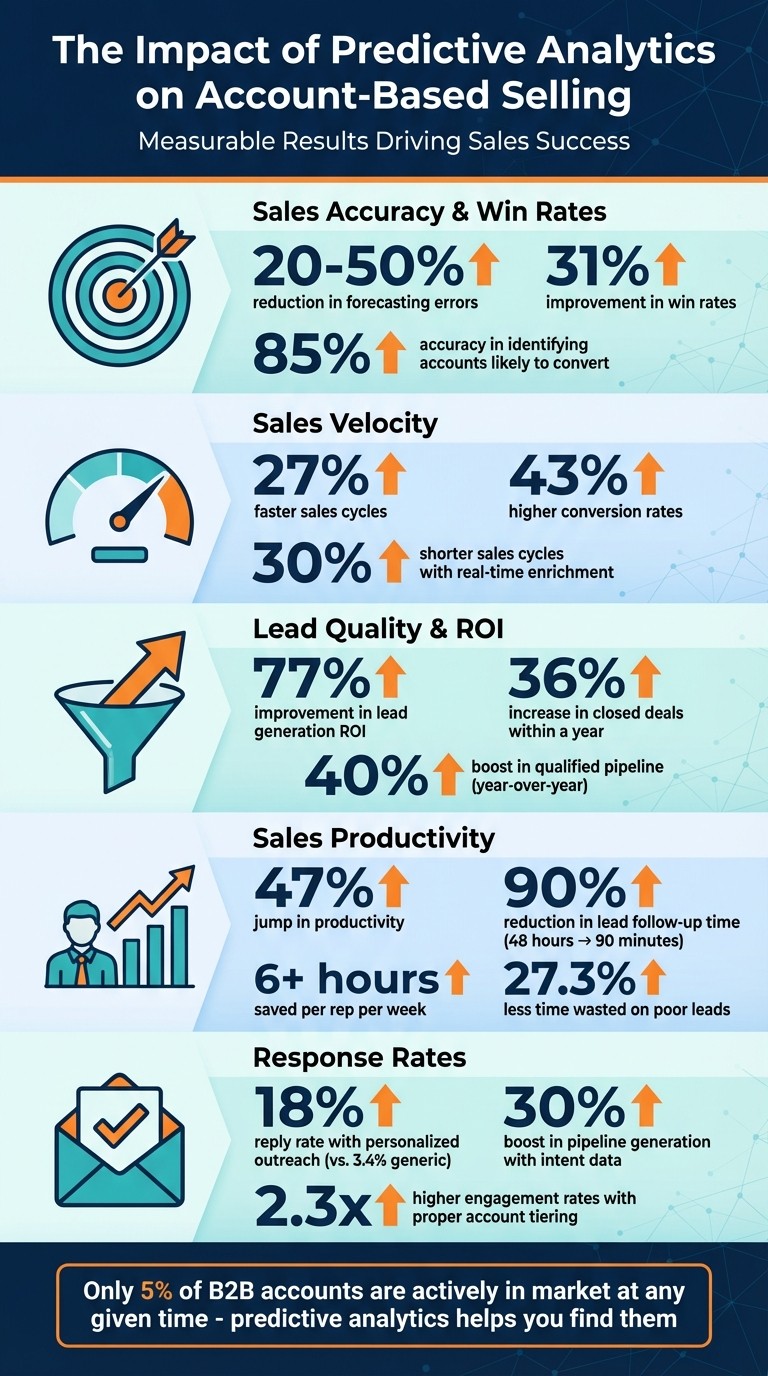
Predictive Analytics Impact on Account-Based Selling: Key Perform
Core Components of Predictive Models
Predictive models in account-based selling are built on three key elements: historical data, real-time intent signals, and machine learning algorithms. Together, these components help sales teams pinpoint which accounts are most likely to convert and determine the best time to engage.
Historical Data and Engagement Patterns
Historical data lays the groundwork for predictive models. To identify patterns that separate successful deals from missed opportunities, these models require 12–24 months of closed-won and closed-lost deal data [6][2]. This data includes firmographic details (like company size, industry, and revenue), technographic insights (such as the technology stack being used), and behavioral trends like website visits to pricing pages, email interactions, and product trial activity [6][7].
For accurate modeling, it's crucial to maintain clean CRM records. If over 40% of records are missing essential fields like industry or deal stage dates, data hygiene should be prioritized before building a model [6]. Additionally, a robust model typically needs at least 200 closed-won deals. Models built with fewer than 100 deals often "overfit", meaning they memorize the dataset instead of identifying meaningful patterns [6].
Another critical aspect is stakeholder data. Information about buying committees - such as the number of stakeholders involved, their roles, and their engagement levels - helps models understand the complexities of your sales cycles [8][2]. For teams working with 100–200 closed-won deals, starting with simpler models like logistic regression can help avoid overfitting [6].
While historical data forms the backbone, real-time signals add precision to these insights.
Intent Data and Real-Time Signals
Historical data tells you what worked in the past, but real-time signals reveal current buyer behavior. Intent data sheds light on the "dark funnel", the 67% of the B2B buying journey that happens before a prospect interacts with your company [8]. These signals track anonymous online activity, showing when accounts are researching solutions in your industry.
Advanced predictive models differentiate between "intent to learn" (early-stage research) and "intent to buy" (active vendor evaluation, such as pricing page visits or competitor research) [8]. This distinction is crucial because timing can make or break a deal. For instance, in 2026, Snyk’s 50-person Account Executive team reduced their email bounce rate from 35–40% to under 5% by refreshing their intent data every 7 days. This adjustment unlocked over 200 new opportunities per month [9].
Real-time signals also account for signal decay - the rapid drop in value of predictive signals over time. Sales teams leveraging intent data see a 30% boost in pipeline generation compared to those using static lists [10]. Personalized outreach, guided by these signals, achieves an 18% reply rate, far outperforming the 3.4% reply rate of generic cold outreach [9].
Combining different signal types - like third-party intent data (web-wide research) and first-party engagement (such as visits to your website) - enhances scoring accuracy [7]. To maximize results, fast-decaying signals like pricing page visits should be acted on within 1–4 hours [9].
Machine Learning and AI for Lead Scoring
Machine learning takes lead scoring to the next level by predicting outcomes rather than just logging activities. Traditional scoring systems assign fixed points for actions like downloading a whitepaper. In contrast, predictive scoring uses algorithms to analyze hundreds of variables - firmographics, behavioral data, intent signals - and weighs them based on their actual impact on revenue [6][7].
"Traditional lead scoring measures activity. P2B [Propensity to Buy] scoring predicts outcome. Those are fundamentally different things." – Michael Torres, Prospectory [6]
By integrating historical data with real-time signals, machine learning algorithms can assign optimal weight to different variables, identifying high-intent moments. For example, a pattern like four pricing page visits in seven days after a three-month hiatus signals strong buying intent [6]. These models continuously update account scores in real time, ensuring sales teams can act during critical high-intent windows [12][11][7].
Top predictive tools boast nearly 85% accuracy in identifying accounts likely to convert [7]. AI-driven lead scoring has been shown to increase closed deals by 36% within a year and slash lead follow-up time by 90%, reducing response times from 48 hours to under 90 minutes [12]. These models employ closed-loop systems, retraining quarterly with fresh data to adapt to market changes [6][11].
Building Ideal Customer Profiles with Predictive Analytics
Predictive analytics takes the concept of Ideal Customer Profiles (ICPs) to a whole new level by turning them into dynamic, real-time tools. Instead of relying solely on static criteria like industry or company size, predictive models combine three key data layers: static fit (40%), dynamic buying signals (35%), and relationship engagement (25%). This approach helps sales teams zero in on accounts that not only fit the profile but are also ready to buy. It’s a game-changer for identifying the attributes that truly drive success.
Identifying Key Attributes of Successful Accounts
To build a reliable model, you need data from approximately 200 closed-won deals to avoid overfitting [6]. These models analyze a mix of firmographic data, technographic insights, and behavioral patterns to uncover what separates high-value customers from the rest [14].
For example, compound signals - like accounts with over 1,000 employees using Salesforce - might reveal conversion rates three times higher than average [6]. In 2025, Analytic Partners shifted from broad outreach to laser-focused targeting, boosting their qualified pipeline by 40% year-over-year by concentrating on accounts with these high-value traits [14][15].
"We're no longer fishing. We know who the right customers are, and we can qualify them quickly. Salesmotion has had a direct impact on pipeline quality."
– Andrew Giordano, VP of Global Commercial Operations, Analytic Partners [14]
Equally important is defining the "Anti-ICP", or the characteristics of accounts that are more likely to churn, require excessive support, or stall during the sales process [13]. Knowing what to avoid is just as crucial as knowing what to pursue.
Once these key attributes are identified, the next step is enriching these profiles with real-time, account-level insights to refine the focus even further.
Enriching Profiles with Account-Level Insights
Predictive analytics goes beyond static data by leveraging unstructured information. Machine learning tools can analyze earnings calls to uncover executive priorities, track job postings for strategic initiatives, and monitor leadership changes - events that often signal technology evaluations within 6–12 months [14][15][16]. Trigger events like funding rounds, mergers, acquisitions, or C-suite hires provide clear indicators of active buying periods.
In 2026, Cytel streamlined its research process by consolidating five separate tools into a single intelligence platform under the leadership of Lyndsay Thomson, Head of Sales Operations. This change cut manual research time by 50% and reduced account planning preparation by 30% [15]. Similarly, Guild Education’s Director of Strategic Accounts, Derek Rosen, shared how automated signal monitoring saved each seller six hours per week [14][15].
With only 5% of B2B accounts actively in the market at any given time [15], real-time enrichment ensures sales teams can identify and act on these limited opportunities. Companies adopting this approach report 43% higher conversion rates and 30% shorter sales cycles compared to traditional, static outreach methods [14][16].
"Static data tells you a company fits your profile. Dynamic signals tell you that company needs you right now."
– Salesmotion [16]
Account Scoring and Prioritization
After building enriched customer profiles using the methods discussed earlier, the next challenge is deciding which accounts to prioritize. This is where predictive analytics steps in, assigning scores to accounts based on their likelihood to convert. Unlike outdated point-based systems that simply track activity, modern AI-driven scoring focuses on predicting outcomes. It takes the dynamic profiles you've created and turns them into actionable insights for prioritizing accounts.
AI-Driven Account Scoring Methods
Machine learning models analyze historical win/loss data to identify patterns that lead to success. Instead of relying on static rules like awarding points for email opens or downloads, these models assess conversion probability using three weighted factors: ICP fit (40%), buying signals (35%), and engagement (25%) [14][6].
These models are dynamic, updating scores in real time. For example, if a prospect visits your pricing page or a new VP of Sales joins a target account, the score adjusts automatically [1][6]. In B2B scenarios, the models aggregate signals from the entire buying committee, providing a complete picture of the account's readiness.
Take this example: A 200-person SaaS company using a propensity-to-buy model saw win rates triple, sales cycles shorten by 40%, and average deal sizes grow by 25% when they focused on the top 30% of accounts [6].
Effective scoring also includes negative signals - actions that decrease a score. For instance, a prospect visiting your careers page might indicate they're job hunting, or an account signing a multi-year deal with a competitor could signal low readiness [17][6]. Additionally, score decay ensures older engagement has less impact over time [17].
Focusing on High-Value Targets
Top-performing organizations use a tiered system to align account scores with specific sales strategies. Here's how it typically breaks down:
Tier 1 accounts: These are the top 10–15% of accounts (about 15–25 per rep). They receive highly tailored research and personalized value propositions.
Tier 2 accounts: These accounts get semi-personalized outreach triggered by specific signals.
Tier 3 accounts: These are placed in automated marketing nurture campaigns until their scores improve [14][6].
"With a lot of green-field accounts, I'm heavily leaning on the AI insights to tier my accounts and focus my time." – Rob Webster, Enterprise Account Executive, Synthesia [14]
Using refined scoring systems can significantly boost results. Businesses leveraging these models report a 77% improvement in lead generation ROI compared to those that don't [17]. Companies that cap Tier 1 accounts at 10% of their total pool see engagement rates 2.3 times higher than those that overfill this tier [14]. Additionally, emails personalized based on specific signals achieve an 18% response rate - 5.2 times higher than generic outreach [14].
To ensure sales teams act on these insights, it's essential to explain the reasoning behind each score. For example: "Score 82: VP of Sales hired + 3 pricing page visits in the past week" [6]. Providing this context helps sales reps quickly identify and act on high-priority opportunities.
Integrating Predictive Analytics into Sales Workflows
Refining account scoring is just the starting point; the real game-changer lies in turning those insights into actionable steps. Accurate account scores only matter if sales reps can act on them instantly. Embedding predictive insights directly into the tools and processes reps use daily is key. This approach eliminates the hassle of switching between platforms and ensures AI-driven recommendations lead to immediate and meaningful action.
A great example of this is integrating elements like deal probabilities, risk factors, and next-best actions into your CRM. For instance, triggering automatic outreach when lead scores surpass certain thresholds can make a huge difference [3]. Companies adopting these integrated workflows often experience efficiency gains of 10–15% and can cut pipeline waste by up to 30% [18][3].
In February 2026, Siemens undertook a global forecasting transformation, impacting over 4,000 sellers in 190 countries. Spearheaded by Thorsten Reichenberger, Head of Revenue Operations, the initiative unified opportunity management and improved data quality. This resulted in forecast submission rates exceeding 70%, all through a centralized "Seller Action Hub" that combined forecasting and engagement into one streamlined platform [2][22].
"With Outreach we get increased transparency. Now we are getting much easier, deeper insights into the structure in a way we've never had before." – Thorsten Reichenberger, Head of Revenue Operations, Siemens [2]
Similarly, another company cut its forecasting call times by 66% - dropping from 60 minutes to just 20 - by transitioning from manual spreadsheet tracking to an automated system. This upgrade allowed teams to work from the same real-time data, saving time and improving accuracy [20].
This kind of integration seamlessly connects insights to actions, paving the way for real-time coaching and tailored playbooks.
Real-Time AI-Driven Coaching
Providing context is essential when offering recommendations. Instead of simply marking a deal as "at risk", the system should explain the reasons, such as "No Executive Buyer identified" or "Inactive for 14 days" [18][19]. This level of detail helps reps understand exactly what steps to take, whether it's scheduling an executive alignment call or re-engaging a stalled contact.
Platforms like Coach Pilot embed actionable coaching directly into sales workflows by analyzing deal data in real time. This allows reps to access guidance without leaving their existing tools. By combining custom sales playbooks with real-time coaching, Coach Pilot ensures predictive analytics enhance performance during customer interactions. This kind of immediate, context-aware coaching works hand-in-hand with dynamic account scoring to keep sales teams ahead of the curve.
The most effective systems rely on a mix of human and AI collaboration rather than full automation. AI identifies critical signals - such as declining engagement or missing decision-makers - while human managers provide strategic insight and make final decisions [19]. This partnership emphasizes that AI is a tool to assist in decision-making, not replace it [19].
Once real-time coaching drives immediate actions, custom playbooks can further standardize these responses.
Custom Sales Playbooks and Workflow Alignment
Pairing predictive analytics with tailored sales playbooks takes things to the next level. These playbooks act as a natural extension of real-time coaching, ensuring that strategy translates into execution. By automating workflows triggered by predictive signals, sales teams can ensure the right actions happen at the right time, with minimal manual effort.
For instance, risk-based playbooks can automatically activate under specific conditions. If a deal is flagged as "Inactive > 14 days", the system might generate a task for a coaching alignment call [18]. Similarly, if a late-stage deal lacks an Economic Buyer, the workflow could prompt executive involvement [18]. This kind of automation ensures no critical steps are missed.
Coach Pilot excels at creating these tailored playbooks, aligning them with predictive insights. By developing workflows for various risk scenarios and deal stages, the platform ensures AI-driven signals lead to measurable actions. Integrating playbooks with real-time coaching bridges the gap between planning and execution, helping sales teams close deals faster and improve win rates.
Before rolling out these integrated workflows across your organization, start with a pilot program. Test predictive analytics on a specific segment - like mid-market new logos - for 60 days to demonstrate ROI. During this trial, run AI predictions alongside existing manual processes in "shadow mode" for 4–8 weeks to compare accuracy and build trust [18].
Overcoming Challenges and Maintaining Data Quality
Predictive analytics is revolutionizing account-based selling, but its effectiveness hinges on maintaining high-quality data and updating models regularly. Without clean data, predictive models falter. Consider this: 94% of businesses believe their customer data is inaccurate, and around 30% of customer information becomes outdated annually [23]. This data decay leads to inefficiencies, with B2B sales teams wasting over 27.3% of their time on poor leads [23]. On top of that, bad data costs organizations an average of $15 million every year [21]. Clearly, addressing these issues is critical to fully leveraging predictive analytics.
Addressing Data Quality Issues
Data quality problems often stem from outdated contact details, incomplete records, duplicate entries, and inconsistent formatting [23][24][25]. Even minor inconsistencies - like "VP Sales" versus "Vice President of Sales" - can disrupt segmentation efforts [24].
To tackle these challenges:
Enforce validation rules in your CRM to ensure critical data points are verified before deals progress. For instance, require confirmation of a budget and decision-maker before advancing to the proposal stage [24][25].
Integrate automated enrichment tools with your CRM to keep data up-to-date. These tools can pull real-time signals, such as job changes from social platforms, to refresh records [23][24].
Prioritize key fields by focusing on the 8-10 data points that drive qualification, like company size, tech stack, and decision-maker roles. Avoid enriching unnecessary fields that add no real value [24]. Companies using data integrity tools have reported a 25% improvement in forecast accuracy within 90 days[25].
Streamline research efforts with better data quality, saving high-performing teams 6+ hours per week per rep[24].
Organize quarterly "pipeline cleaning days" where the team updates outdated contacts and removes stale deals [25].
Create audit trails that link each data point to its source and update time (e.g., "ZoomInfo, updated 12/15/2024"). This transparency helps reps trust the data [24].
Gamify data integrity by introducing leaderboards that reward teams for maintaining accurate forecasts or the cleanest data records [25].
Continuous Model Refinement
The accuracy of predictive models depends on reliable data and consistent updates. As market conditions shift, models must adapt. Predictive models recalculate close probabilities and account scores frequently - sometimes daily or weekly - based on new engagement, velocity, and intent signals [18][5]. Without machine learning, only 7% of companies achieve forecasting accuracy of 90% or higher, but AI-driven forecasting can cut errors by 20% to 50% when properly maintained [2][5].
To refine your models effectively:
Test AI predictions in "shadow mode" for 4-8 weeks, running them alongside manual processes. This allows you to compare results, fine-tune thresholds, and build trust before making AI predictions your primary decision-making tool [18].
When sales leaders disagree with AI scores, require specific reason codes (e.g., "Competitor entry" or "Budget freeze"). Feeding these insights back into the model improves future accuracy [18][21].
Hold weekly check-ins to review AI predictions versus actual outcomes. Use these meetings to document successes and address any issues with the model's logic [21].
Pair AI's pattern recognition with human judgment for factors that aren't captured in CRM fields. This combination ensures more comprehensive decision-making [2].
Ensure your CRM data is at least 80% complete before relying on predictions. Standardize stage exit criteria and require "next steps" for all deals to maintain consistency [21][5].
Modern predictive platforms also provide detailed audit trails for every forecast adjustment. These trails show exactly which data updates or deal movements influenced changes in outcomes, helping RevOps teams understand model behavior and identify areas for improvement [5]. Additionally, keep an eye on "concept drift", where shifts in market conditions or buyer behavior can render old patterns irrelevant. Regular monitoring ensures your models stay aligned with current trends instead of relying on outdated data [2].
Conclusion
Predictive analytics is reshaping account-based selling by delivering measurable results. With AI-driven predictive tools, companies report a 31% boost in win rates, 27% faster sales cycles, and a 47% jump in productivity [4]. These tools also help reduce forecast errors by 20% to 50% [2] and achieve up to 85% accuracy in identifying accounts likely to convert [4].
The real value of predictive analytics lies in how it enhances daily sales activities. By providing clear insights into account readiness and potential risks, these tools allow sales teams to focus less on tedious data entry and more on impactful tasks like discovery calls and navigating deals effectively.
However, technology alone doesn’t close deals. That’s where solutions like Coach Pilot come in. By embedding AI-powered coaching directly into sales workflows, it offers custom playbooks and real-time guidance. This ensures predictive insights translate into actionable strategies, accelerating deal progression and enhancing the overall sales process.
FAQs
What data do I need to start predictive analytics for account-based selling?
To kick off predictive analytics for account-based selling, start by collecting historical data. This includes information on account behavior, engagement trends, market signals, and customer details. These data points are key for forecasting future account actions and identifying high-priority prospects.
How often should intent signals and account scores be refreshed?
To keep your data relevant and accurate, refresh intent signals and account scores every 10 to 15 days. Regular updates ensure your sales strategies are built on the latest information, helping you better anticipate account behavior and achieve stronger results.
How do I roll out predictive scoring without disrupting my sales team?
To roll out predictive scoring effectively, take a gradual approach and align it with your team's existing workflows. Begin with a small group, collect their feedback, and make adjustments as necessary. Make sure to clearly communicate the advantages, such as helping to prioritize high-value leads, while reassuring your team that this tool complements their decision-making rather than replacing it. Offer training and ongoing support to ensure they can seamlessly incorporate predictive scoring into their daily tasks.
Related Blog Posts

Remove the guesswork from winning more deals.