B2B Sales
AI Task Prioritization for Shorter Sales Cycles
Apr 3, 2026
How AI ranks leads and schedules next-best actions to shorten B2B sales cycles, improve close rates, and reduce admin time.

The future of sales enablement is being reshaped by AI by cutting down inefficiencies, helping reps focus on high-value tasks, and shortening sales cycles. The average B2B sales cycle drags on for 83 days, with sellers spending only 30% of their time selling. AI-driven tools solve this by analyzing real-time signals - like email engagement and buyer intent - to prioritize tasks and leads effectively. Companies using AI report:
31% faster sales cycles
23% higher close rates
10–20% increase in sales ROI
AI tools reduce wasted time, improve forecast accuracy, and help sales teams focus on deals most likely to close. With features like real-time lead scoring, automated follow-ups, and dynamic recommendations, AI transforms workflows and boosts productivity.
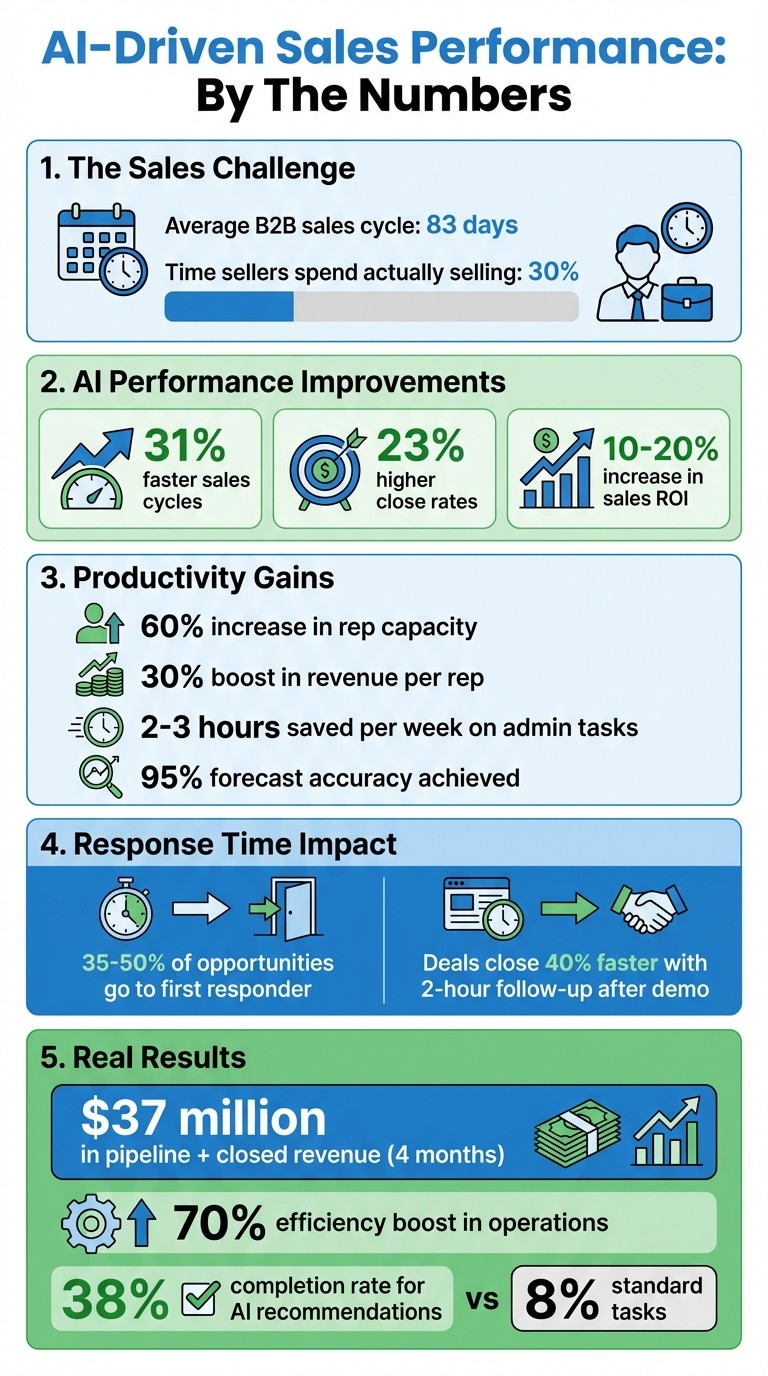
AI Impact on Sales Performance: Key Statistics and Benefits
How to Master Your Sales Calendar with AI: Stop Letting Your Day Run You
How AI-Driven Task Prioritization Works
AI-powered prioritization tools go beyond what traditional CRMs can handle by analyzing real-time signals like emails, calls, visits, and social media activity. These tools deliver actionable recommendations, helping sales teams focus on the prospects most likely to convert. This approach has been a game-changer for improving productivity in modern sales.
Real-Time Lead Scoring and Behavioral Analysis
AI systems evaluate prospects by comparing their behavior to patterns from successful past deals. They combine data from CRM systems, website activity, email engagement, social media interactions, and technographics to build a complete profile of each prospect [6]. Based on this information, each lead is assigned a conversion score (usually on a scale of 0–100), using your company’s historical data rather than generic industry metrics [6].
These systems also interpret behavioral and intent signals. For instance, they analyze how often and deeply a prospect interacts with your business. This helps separate casual browsers from serious buyers [6]. Some tools even use sentiment analysis on emails and calls to pick up on subtle cues, such as interest or hesitation. When a prospect visits a pricing page or even a competitor’s website, their score is updated in real time [6].
Context-Aware Task Sequencing
AI doesn’t just score leads - it also helps you prioritize your daily tasks. By examining customer context and conversation details that traditional CRMs might miss, it provides tailored "next-best action" recommendations based on what has worked in the past [2].
"AI-powered sales task prioritization means using AI to automatically analyze, rank, and schedule sales activities based on customer interaction data, deal urgency, and revenue potential."
– Hadley Mayse, Commercial Account Executive, Gong [2]
For example, if a prospect signals strong buying intent - like mentioning budget approval or repeatedly engaging with a proposal - the system updates their priority level immediately. It then creates tasks with suggested follow-up actions and deadlines [2]. This ensures commitments made during conversations are seamlessly added to your to-do list. Sales teams using this approach have seen a 60% increase in capacity and a 30% boost in revenue per rep [2].
Continuous Learning and Adaptation
AI systems don’t remain static - they constantly learn and improve. When a lead converts (or doesn’t), the system analyzes what worked or didn’t and adjusts its scoring model accordingly [6]. By reviewing thousands of past interactions, it identifies patterns, such as the importance of following up within two hours of a demo, and integrates these insights into future recommendations [2].
Within just 30 to 60 days, most sales teams notice significant productivity improvements as the AI fine-tunes itself to align with their specific workflow [2]. It also keeps up with market changes automatically, eliminating the need for frequent manual updates [6]. By aligning with your B2B sales playbook and focusing on critical milestones, these systems have helped companies achieve forecast accuracy rates of up to 95% [2].
Benefits of AI-Driven Task Prioritization
When sales teams incorporate AI into their workflows, they often experience measurable improvements in deal progression, time management, and revenue forecasting.
Shorter Sales Cycles
AI helps reduce sales cycles by an average of 31% by ensuring that sales reps concentrate on deals that are actively progressing [4]. For example, AI analyzes digital cues - like a prospect frequently opening a proposal or discussing budget approval during a call - and flags these as high-priority opportunities in real time [2]. One notable finding: deals close 40% faster when a follow-up email is sent within two hours of a demo [2].
AI also identifies potential risks, such as stakeholder turnover or communication gaps, preventing reps from wasting 40–60% of their time on deals with less than a 20% likelihood of closing [4]. In a Salesforce pilot conducted over four months in 2025, AI provided over 24,000 personalized recommendations via Slack. This resulted in $28 million in generated pipeline and $9 million in closed Annual Contract Value (ACV) [7]. By streamlining workflows and reducing administrative burdens, AI enables teams to operate more efficiently.
Less Administrative Work
AI minimizes time spent on repetitive tasks, shifting reps to a "review and approve" model for CRM updates. Instead of manually logging every interaction, reps can rely on AI-generated updates, saving two to three hours per week that can be redirected to selling [2][8]. This change has led companies to report a 60% boost in rep capacity and a 30% increase in revenue per rep [2].
AI recommendations also see higher engagement rates. While standard dashboard-based tasks have a completion rate of just 8%, AI-delivered recommendations achieve a 38% completion rate [7].
"By moving from passive dashboards to active agents, we didn't just predict success, we helped secure it."
– Ali Nahvi, Director, Product Innovation, Salesforce [7]
Better Forecast Accuracy
AI tackles the optimism bias often found in traditional forecasting. By continuously analyzing over 50 signals - such as email sentiment, meeting cadence, and stakeholder involvement - AI dynamically updates deal scores instead of relying on static CRM stages [4]. This approach has helped companies like Upwork achieve 95% forecast accuracy, while others have seen up to a 43% improvement in their forecasting precision [2][9].
Currently, only 20% of sales organizations deliver forecasts within 5% of their projections, while 43% miss their revenue targets by 10% or more [8]. AI platforms, which capture up to 99% of engagement data, provide a more reliable foundation for predictions [2]. Additionally, AI identifies "single-threaded" deals - those dependent on a single contact - and flags them as high-risk, giving managers the chance to intervene before the deal falls through [4][8].
Platforms like Coach Pilot take AI-driven task prioritization further by combining it with tailored sales playbooks, immersive training, and real-time coaching. This integration helps sales teams bridge the gap between strategy and execution, resulting in shorter sales cycles and more accurate forecasts.
Required Features for AI Prioritization Tools
To make the most of AI's ability to shorten sales cycles, your tools need to deliver on specific capabilities. The gap between tools that simply exist and those that genuinely improve your sales process lies in features that encourage reps to adopt them.
CRM System Integration
AI prioritization tools are only effective if they integrate smoothly with your current sales stack. Traditional CRMs often miss the mark by failing to capture most interactions [2]. For AI to truly add value, it needs bi-directional syncing with platforms like Salesforce and HubSpot. This ensures that conversation data flows automatically into the system, eliminating the need for reps to juggle multiple tools [2][3]. With this seamless integration, the CRM evolves from being just a storage space to an intelligent system that guides reps on what actions to take [11]. When these tools offer clear, actionable recommendations, they foster trust and encourage reps to rely on them.
Clear Scoring and Recommendations
A score alone isn't enough - it needs context. Reps must understand why AI flags a deal as urgent or at risk to trust its advice. The most effective tools analyze over 50 signals, such as email tone, stakeholder involvement, communication gaps, and budget timelines, to explain priority changes [4]. For example, instead of a vague "Deal Score: 72", a good tool provides specific insights like "Champion unresponsive for 12 days" or "Competitor contract expires in 30 days" [4]. This transparency builds confidence and motivates action. As Andrew Giordano, VP of Global Commercial Operations at Analytic Partners, states:
"The talking points are gold. If they're in Salesmotion, I know they're being discussed inside that business. That makes it easy to spark a real conversation, which is 90 percent of the battle" [10].
By providing clear, actionable insights, these tools empower reps to act quickly on automated alerts.
Automated Follow-Up and Alerts
In sales, timing is everything. Being the first to respond can secure 35–50% of opportunities [1]. This makes real-time alerts a game-changer. The best AI tools send instant notifications directly to Slack, email, or your CRM when high-intent signals occur - like a prospect visiting your pricing page or a champion going silent for two weeks [2][4]. These alerts don’t just highlight issues; they also suggest specific next steps, such as "schedule executive alignment", to prompt immediate follow-up [2][4]. By automating the hours reps typically spend on manual research and prioritization - estimated at 8–12 hours per week [10][4] - these tools allow sales teams to focus on selling. The payoff? A whopping 81% of weekly AI tool users report faster deal cycles [10].
How to Implement AI in Sales Operations
Introducing AI into your sales operations takes careful planning. To ensure AI-driven task prioritization leads to faster deal closures, focus on three key areas: defining your target audience, maintaining clean and accurate data, and preparing your team to trust and use the technology effectively.
Define Ideal Customer Profiles and Qualification Criteria
For AI to prioritize tasks effectively, it needs a clear understanding of what makes a lead valuable. Start by analyzing a year’s worth of lead data to identify traits of high-value customers who are less likely to churn. These traits might include factors like industry, company size, revenue range, or behaviors linked to successful deals. Then, translate traditional qualification frameworks (like BANT or MEDDIC) into rules your AI can follow. For example, leads could be flagged as "Sales Qualified" if they score 70+ points based on criteria such as budget authority, recent engagement, or a visit to your pricing page.
A real-world example: Ray White's Operations Department reported a 70% boost in efficiency in early 2026 after automating repetitive administrative tasks using AI-driven CRM workflows [12]. By clearly defining your ideal customer profile and setting straightforward qualification rules, your AI system will be better equipped to identify the most promising opportunities.
Maintain Data Quality and Completeness
AI’s performance hinges on the quality of the data it processes. Before rolling out AI, audit your CRM to eliminate duplicate entries and update outdated records. Connect your AI tool to all relevant data sources - CRM systems, marketing automation platforms, website analytics, and email tools - to create a unified and detailed profile for each buyer. This ensures your AI captures every interaction along the buyer’s journey.
As Elizabeth Gerbel, CEO, explains:
"Now we have a lot less data, but it's quality data." [12]
Additionally, establish a feedback loop to continuously feed outcomes, like closed deals or losses, back into the system. This helps refine scoring models and prevents inaccuracies over time. Companies using AI-powered scoring have seen targeting precision for ideal customer profiles improve from 52% to 78% when data quality was prioritized [13]. Once your data is clean and comprehensive, you can shift your focus to ensuring your team knows how to make the most of these insights.
Train Sales Teams on AI Usage
Even the most advanced AI tools are ineffective if your sales team doesn’t trust or understand them. While 96% of sales leaders believe AI will transform their organizations within two years, only 6% feel their teams are ready to use it effectively [13]. To address this, start by running the AI scoring system in "shadow mode" for 30–60 days alongside your current manual processes. This gives your team time to test the AI’s recommendations and build confidence in its accuracy.
Train your team to interpret AI signals - understanding what scores mean, why a lead might be flagged as "at risk", and when it’s appropriate to rely on human judgment. The Salesloft AI Agent Rollout Playbook emphasizes:
"You have to train employees on AI from day one. Treat it as any other technology they're expected to learn, then set expectations for AI use and give them time to train with it from the onboarding stage." [13]
Create an internal playbook of successful AI workflows and hold regular training sessions to review unusual cases and refine scoring thresholds. When your team sees how AI can handle repetitive tasks, freeing them to focus on relationship-building, the benefits become evident. For instance, Bureau achieved a 30% increase in deal conversion in 2025 after adopting AI-powered coaching and CRM automation [13].
To simplify this process, tools like Coach Pilot offer all-in-one solutions, including custom sales playbooks, immersive training, and real-time AI coaching, helping teams work more efficiently and close deals faster.
Conclusion: Faster Sales Cycles with AI
AI-powered task prioritization takes the guesswork out of sales by using data to focus on the most promising opportunities. By analyzing over 50 signals, it identifies the top 10–15% of prospects that deserve the most attention. The results speak for themselves: companies using AI for prioritization report a 31% reduction in sales cycle length and 23% higher close rates [4].
These improvements lead directly to shorter sales cycles and better outcomes. For instance, Guild Education's adoption of AI saved their sales team six hours per week on account research [5]. Beyond time savings, the system delivered 24,000 tailored recommendations with a 38% completion rate, contributing an impressive $37 million in combined pipeline and closed revenue over just four months [7].
The key to this transformation lies in data-driven decision-making. While traditional CRMs capture only 1% of interactions, AI analyzes the rest - conversations, email sentiment, and more - to sharpen deal focus [2][7]. This real-time adaptability helps sales reps concentrate on deals with real momentum rather than wasting time on low-probability leads. This is crucial, especially when 87% of deals marked as "90% likely" by reps fail to close within the predicted quarter [4].
AI tools like Coach Pilot take this a step further by providing actionable, real-time guidance. By integrating custom sales playbooks, immersive training, and AI-driven coaching, Coach Pilot offers precise recommendations for outreach and next steps. This alignment between strategy and execution results in faster deal closures, better forecast accuracy, and smarter decision-making across sales teams [14]. Ultimately, AI's ability to focus on high-impact tasks not only speeds up sales cycles but also delivers measurable revenue growth.
FAQs
What data does AI need to prioritize my sales tasks?
AI thrives on data to make smart decisions. It needs inputs like customer interactions, deal details, and sales activity records to effectively rank and prioritize tasks. This data can come from various sources, such as CRM systems, email threads, customer calls, and market signals. By processing this information, AI pinpoints the most critical tasks and promising leads, ensuring you concentrate on what truly drives faster sales cycles.
How do I get reps to trust AI recommendations?
Building trust starts with transparency. Be open about how AI works, involve sales reps in the process, and demonstrate how it enhances - rather than replaces - human coaching. Show that AI is designed to provide personalized guidance tailored to their needs, not to monitor or micromanage. Address any concerns about surveillance by framing AI as a tool that supports their growth and success, not as something intrusive. By fostering a collaborative and supportive environment, you can help reps feel more comfortable and confident in embracing AI's recommendations as part of their workflow.
How long does it take to see faster sales cycles with AI?
Organizations that use AI to simplify their sales cycles often notice noticeable progress in just a few months. Research indicates that by 2026, AI could cut prospecting and preparation time by more than half. This allows sales teams to dedicate more energy to high-priority tasks and leads, boosting overall efficiency.
Related Blog Posts

Remove the guesswork from winning more deals.