B2B Sales
Behavioral Analytics for Shorter Sales Cycles
Apr 4, 2026
Use behavioral signals to prioritize high-intent leads, remove friction, and shorten sales cycles while improving win rates.

Behavioral analytics helps sales teams close deals faster by analyzing how prospects interact with sales channels. This approach identifies high-intent actions - like repeated visits to pricing pages or sharing proposals with decision-makers - so teams can focus on leads most likely to convert. Companies using these insights have achieved:
31% shorter sales cycles
35% higher win rates
90% less time spent on account research
Long sales cycles hurt revenue, increase costs, and lower team morale. Behavioral analytics mitigates these issues by turning digital signals into actionable strategies. By tracking key behaviors, segmenting prospects, and removing friction points, sales teams can improve efficiency and close deals faster.
Key takeaways:
Use website activity, email engagement, and CRM data to identify buying signals.
Focus on behaviors that indicate readiness to buy, such as faster response times or engagement from multiple stakeholders.
Automate follow-ups and use AI tools to reduce delays and prioritize high-value leads.
This data-driven approach transforms sales processes, making them faster, more precise, and less resource-intensive.
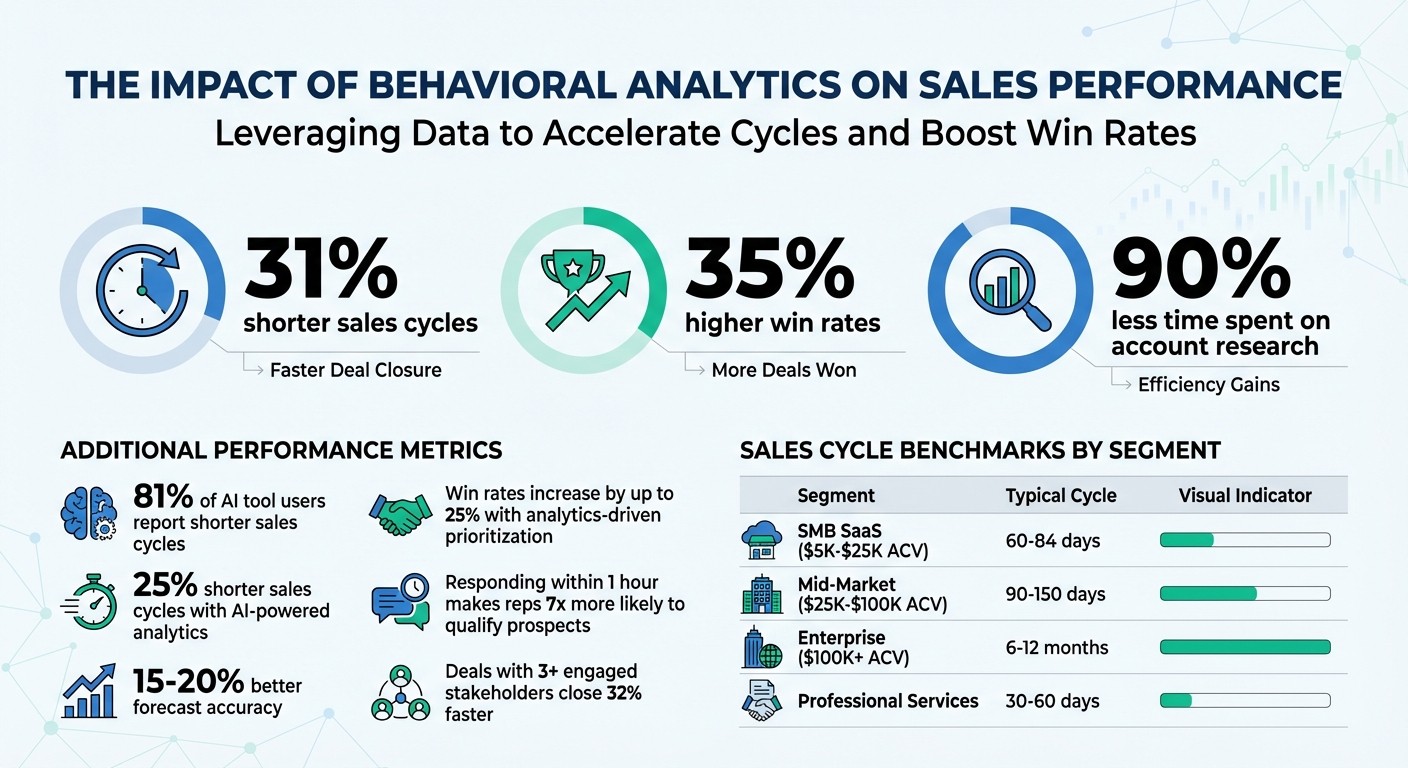
How Behavioral Analytics Reduces Sales Cycle Length and Improves Win Rates
Customer Behavior Analytics: Boosting Sales with Data-Driven Decisions
How Long Sales Cycles Hurt Business Growth
Long sales cycles can wreak havoc on your business, impacting not only your revenue but also the overall health of your organization. When high-value deals drag on longer than expected, revenue gets delayed, costs skyrocket, and teams face the risk of burnout [3].
Every extra week a deal stays in the pipeline increases your Customer Acquisition Costs (CAC), slows down cash flow, and makes forecasting less accurate [3][5]. Unreliable forecasts disrupt strategic planning, leaving your company scrambling to adjust [3][4]. These delays don’t just hit your bottom line - they also stretch internal resources thin, making it harder to identify and focus on high-value prospects.
"A lengthy sales cycle leaves the door wide open for competitors. Every extra day a deal spends in your pipeline is another chance for a rival to swoop in." - Salesmotion [3]
Extended sales cycles also come with added risks. The longer a deal takes to close, the more likely it is to collapse entirely due to factors like budget cuts, organizational changes, or even your internal champion leaving their role [1][5]. With B2B buying committees now averaging 6–10 stakeholders, even a minor shift can derail months of effort [3].
Difficulty Identifying High-Value Prospects
Another major challenge is spotting which prospects are actually worth pursuing. Without solid behavioral data, sales teams often waste time chasing leads that are unlikely to close. This misdirection diverts resources from opportunities with a higher chance of success. When reps rely on intuition instead of clear signals, differentiating between a serious buyer and someone casually browsing becomes nearly impossible.
This lack of clarity creates a frustrating cycle. Reps spend 5–10 hours each week on manual prospect research and CRM data entry - time that could be spent selling [6][3]. For example, in 2025, Analytic Partners managed to cut research time from three hours to just 15 minutes per account. This shift allowed their team to focus on qualified leads, resulting in a 40% year-over-year increase in their pipeline of qualified opportunities [1].
Team Morale and Resource Drain
Prolonged sales cycles don’t just waste time - they also take a toll on team morale. When reps invest months into nurturing deals that ultimately fall apart, it can lead to "signal fatigue" and burnout [3]. The emotional strain of losing a deal after weeks of effort makes it harder for teams to stay motivated and meet their goals.
The problem snowballs as productivity takes a hit. Reps get bogged down by the sheer amount of manual research required for each account, which slows their response times and risks losing a prospect’s interest [3]. Quick follow-ups are crucial: responding to a lead within an hour makes a rep seven times more likely to qualify that prospect [6]. But administrative tasks and chasing dead-end leads often prevent reps from acting on real buying signals.
Bottleneck | Time Added to Cycle | Primary Cause |
|---|---|---|
Poor Lead Qualification | 2–4 Weeks | Chasing bad-fit leads without budget or urgency [6] |
Single-Threadedness | 2–3 Weeks | Relying on a single champion who may ghost or leave [6] |
Unclear Pricing | 1–3 Weeks | Late-stage "sticker shock" and budget misalignment [6] |
Inadequate Follow-up | 1–2 Weeks | Slow response times allowing prospect interest to cool [6] |
Contract/Legal Review | 2–8 Weeks | Non-standard terms triggering lengthy legal back-and-forth [6] |
What Behavioral Analytics Is and How It Works in Sales
Behavioral analytics is all about tracking how prospects engage with your team throughout their buying journey [2]. Every digital interaction provides clues about where they are in their decision-making process.
Unlike traditional sales data - focused on static details like job titles or company size - behavioral analytics dives into what prospects are actually doing. For instance, a high-ranking executive who hasn’t engaged with your content isn’t as promising as a mid-level manager who downloads a technical guide, revisits your pricing page multiple times, and shares your proposal with colleagues. These actions clearly signal intent.
This shift from static data to dynamic, actionable insights helps sales teams move past guesswork. By identifying real-time behaviors that indicate interest and urgency, you can zero in on the prospects who are most likely to convert.
Data Sources for Behavioral Insights
Behavioral analytics pulls from a variety of digital touchpoints, each offering a glimpse into genuine buying intent:
Website activity: Look at which pages prospects visit and how often. For example, multiple visits to your pricing page or a demo request are strong indicators of interest, unlike a single visit to the homepage.
Email engagement: Go beyond open rates. Pay attention to clicks, reading time, and whether emails are forwarded internally. If a prospect shares your proposal with others, it’s often a sign of momentum in the deal.
CRM data: Track meeting attendance, response times, and whether new stakeholders are being added to discussions. A prospect who shifts from multi-day email responses to replying within 90 minutes is likely showing increased buying intent.
Basic Metrics vs. Behavioral Signals
It’s important to separate basic metrics from deeper behavioral signals. Basic metrics, like a single email open or a one-time blog visit, indicate general awareness but don’t reveal much about a prospect’s buying intent. These are great for marketing teams to nurture leads, but they don’t always justify immediate sales outreach.
Behavioral signals, however, tell a more compelling story. Actions like downloading a technical guide, revisiting the pricing page multiple times, or dramatically shortening response times are clear signs of interest. What really matters is the pattern of these actions - like reading a blog post, requesting a demo, and then exploring pricing details. Together, they paint a vivid picture of a prospect ready to buy.
Signal Category | High-Intent (Active Interest) | Low-Intent (General Awareness) |
|---|---|---|
Website | Pricing page views, demo requests, multiple feature page visits | Single homepage visits, one-off blog reads, brief careers page views |
Content | Downloads of case studies or technical specs; webinar attendance | Infographic views, newsletter subscriptions, social media follows |
Communication | Replies with specific questions and prompt responses | Single email opens or isolated link clicks |
By distinguishing between fleeting interactions and meaningful signals, your team can focus on the prospects most likely to accelerate the sales cycle.
Another important factor is signal decay - recent interactions carry more weight than older ones. This ensures your team prioritizes prospects actively showing intent now, rather than those who were interested weeks or months ago.
Using Behavioral Analytics to Shorten the Sales Cycle
Want to close deals faster? It all comes down to turning raw data into actionable insights. Here are three strategies to help you speed up the sales cycle.
Identifying Customer Behaviors That Predict Faster Closures
Certain behaviors can signal that a deal is moving forward. For example, if a prospect's response time drops from two days to just 90 minutes, it may indicate internal budget approvals or executive buy-in are in place [2]. Similarly, when new stakeholders - like executives or technical leads - start joining email threads or meeting invites, it’s a sign the deal is gaining momentum. Considering that modern B2B purchases often involve six to ten stakeholders [3], engaging multiple decision-makers early can prevent delays if your primary contact leaves.
Pay attention to shifts in the type of content prospects engage with. Moving from general awareness materials (like case studies) to technical resources (such as API specs or security whitepapers) often signals they’re ready to make decisions [2]. External events, such as new funding, mergers, acquisitions, or leadership changes, can also create urgency [3].
In fact, 81% of frequent AI tool users report shorter deal cycles because they can track these signals in real time [3]. Once you identify these behaviors, you can segment your prospects and tailor your approach accordingly.
Personalizing Sales with Behavioral Segmentation
Behavioral segmentation allows you to customize your sales strategy based on how prospects interact with your team and content. By grouping prospects by their buying stage, engagement style, or the benefits they’re seeking, you can ensure your messaging aligns with their needs [7][2].
For example:
High-engagement researchers: These prospects often download multiple resources before scheduling a demo. They’ll need detailed information upfront.
Fast-moving decision-makers: They might schedule demos right after viewing pricing pages and often seek quick access to senior executives to finalize contracts.
Committee buyers: These prospects involve several stakeholders early, requiring multi-stakeholder presentations and detailed action plans.
Price-focused evaluators: They spend significant time analyzing ROI and pricing details [2].
Using behavioral lead scoring can help prioritize your efforts. Assign higher scores to high-intent actions, like visiting pricing pages, compared to lower-intent behaviors, such as opening a single email. This ensures your team focuses on leads that are most likely to convert quickly [2]. Once you’ve personalized your outreach, behavioral analytics can help you identify and address bottlenecks in the sales process.
Removing Friction Points in the Sales Funnel
Behavioral analytics doesn’t just show who’s interested - it highlights where deals are getting stuck. Delays often come from manual research, complex stakeholder dynamics, or slow reporting processes [3][4].
For instance, engagement drop alerts can help you catch stalled deals before they go cold. AI tools can detect when email opens, response times, or website visits start to decline, signaling a potential loss of interest [2][4]. Additionally, identifying key decision-makers - like a CFO or CTO - who haven’t been involved allows you to refocus the conversation and keep the deal on track [4].
Multi-threading is another useful tactic. By building relationships with multiple stakeholders, you reduce the risk of losing momentum if your main contact leaves [3]. At Cacheflow, Adam Wainwright, Head of Revenue, introduced workflows driven by behavioral signals. This reduced meeting prep time by 60% (from 90 minutes to 30 minutes) and tripled average deal sizes, increasing them from $5,000–$7,000 to $18,000–$20,000 [1].
Automated follow-ups triggered by specific actions can also eliminate delays. For example, if a prospect visits a technical documentation page, an automated system could send them a security whitepaper or schedule a call with a technical expert. Mapping these behaviors to specific sales stages - like advancing a deal only after three stakeholders have engaged - ensures consistent progress [2].
Companies using AI-powered analytics report 15–20% better forecast accuracy and 25% shorter sales cycles [4]. Acting on these insights in real time is crucial for keeping prospects engaged and deals moving forward.
Platforms like Coach Pilot combine behavioral analytics with tailored sales playbooks, comprehensive training, and AI-driven coaching. This helps sales teams turn strategy into action, close deals faster, and improve forecast accuracy.
Tracking and Improving Sales Cycle Metrics
Breaking down behavioral analytics by deal size, industry, and customer type is an effective way to identify both strengths and areas that need improvement in your sales process [1]. This segmentation helps you understand where your team excels and where adjustments are necessary.
Key Performance Indicators to Monitor
Behavioral analytics can provide a clear picture of how prospects are engaging with your sales process, making these KPIs particularly valuable.
Stage-to-stage conversion velocity tracks how long it takes for opportunities to move through each stage, helping you identify bottlenecks [1][2]. For instance, if your Enterprise deals tend to stall during security reviews while SMB deals breeze through procurement, you'll know precisely where to focus your efforts.
It's also important to compare signal-informed deals - those where reps use behavioral and intent signals - with deals following the standard process. This comparison highlights the ROI of your analytics tools. One case study found that using real-time signals reduced research time by 90% and significantly shortened sales cycles [1].
Stakeholder expansion is another critical metric. Deals involving three or more engaged stakeholders close 32% faster and have 15–20% higher win rates [6]. Keeping track of how many active contacts your reps maintain per account can give you insights into deal health. Similarly, lead response time has a direct impact on conversion rates [8].
Pipeline velocity provides a comprehensive view of your sales process. It's calculated as (Opportunities × Deal Size × Win Rate) / Cycle Length [1][6].
"A 30% reduction in cycle length has the same revenue impact as a 30% increase in pipeline, but it compounds faster." - Semir Jahic, CEO & Co-Founder, Salesmotion [1]
Here's a snapshot of sales cycle benchmarks based on segment:
Segment | Avg. Cycle Length (2025 Benchmarks) | Main Bottleneck |
|---|---|---|
SMB SaaS ($5K–$25K ACV) | 60–84 days | Procurement/Legal |
Mid-Market ($25K–$100K ACV) | 90–150 days | Multi-stakeholder alignment |
Enterprise ($100K+ ACV) | 6–12 months | Security/Compliance review |
Professional Services | 30–60 days | Pricing negotiation |
By refining these metrics, you can directly connect behavioral insights to increased sales efficiency.
Testing and Refining Your Approach
Once you've established your key metrics, the next step is to test and refine your strategies to ensure continuous improvement.
Start by backtesting scoring models using 12–24 months of data, and run A/B tests on messaging and demo formats to optimize your pipeline [6][11]. For example, Bill Groody, VP of Sales at BloomNation, analyzed the habits of top-performing reps and coached underperformers to adopt strategies like longer discovery sessions and setting clear next steps. This approach reduced their average sales cycle by 50% [9].
Enforce pipeline criteria that rely on behavioral signals. For instance, deals shouldn't move from Discovery to Demo unless reps log evidence of BANT or MEDDIC qualification in your CRM [6]. This ensures that only qualified opportunities move forward, keeping your metrics accurate.
Set up CRM alerts for drops in prospect engagement lasting five days [2]. Automated alerts like these keep deals moving, even during long sales cycles. Analytic Partners used similar insights to cut account research time from three hours to 15 minutes, boosting their qualified pipeline by 40% year-over-year and advancing a $1M+ Fortune 500 opportunity to the late stages [1][4].
Regularly review and update your sales sequences and playbooks. Remove underperforming campaigns and focus on strategies that consistently deliver results [10]. Companies using AI-powered analytics have reported 25% shorter sales cycles and 15–20% better forecast accuracy [4]. Treat your sales process as a constantly evolving system that improves with every new data point.
Tools like Coach Pilot make this easier by embedding AI coaching, custom playbooks, and immersive training directly into your sales workflows.
Conclusion
Behavioral analytics takes the guesswork out of sales, replacing it with clear, actionable evidence. By tracking digital signals like visits to pricing pages, content downloads, or engagement from new stakeholders, sales teams can zero in on prospects who are ready to buy. This approach not only shortens the sales cycle but also enhances the customer experience through timely and personalized interactions.
Consider this: 81% of AI tool users report shorter sales cycles [3], and companies that use analytics-driven prioritization see win rates increase by as much as 25% [12]. Automating high-intent triggers and equipping reps with performance data creates a sales process that’s both efficient and predictable.
One of the biggest hurdles in sales has always been the gap between strategy and execution. Even the best playbooks fall flat if reps don’t know when to act or who to prioritize. Behavioral analytics solves this by embedding actionable insights directly into daily workflows - no extra tools, no guesswork.
"CRM is a database; performance intelligence is a decision-making system." - Rallyware [13]
This is where integrated platforms like Coach Pilot shine. By weaving behavioral insights directly into the sales process, they transform data into immediate, practical actions that push deals forward. Instead of treating analytics as static reports, these tools empower teams to act decisively, improving deal velocity and forecast accuracy.
Sales isn’t just about working harder anymore - it’s about working smarter. Teams that embrace behavioral insights and integrate them into their strategies are the ones closing deals faster and driving consistent success.
FAQs
What behaviors actually predict a faster close?
Focusing on high-intent leads, tailoring outreach based on their engagement history, and using AI-driven coaching to refine winning strategies are key behaviors that can speed up the sales process. These approaches help move deals forward more efficiently and cut down the time it takes to close.
How do I turn intent signals into next-step actions?
To translate intent signals into actionable steps, start by closely examining buyer behavior to pinpoint moments when prospects are actively searching or displaying interest. Timing is everything - respond quickly with customized outreach or follow-ups that feel personal. For instance, you can set up workflows that automatically trigger actions based on signals such as website visits or interactions with your content. This approach ensures your responses are aligned with the prospect's interests, boosting your chances of closing deals more efficiently.
How do I weight recent activity vs. older signals?
To prioritize leads effectively, concentrate on recent behavioral signals such as content engagement, interactions, and activity levels. These indicators offer the clearest picture of a buyer's current intent and readiness to make a decision. While older signals can add context, they tend to be less reliable for predicting immediate actions. By focusing on real-time data, sales teams can pinpoint high-potential leads, minimize obstacles, and accelerate the sales process.
Related Blog Posts

Remove the guesswork from winning more deals.