B2B Sales
How AI Improves Quota Attainment Tracking
Mar 11, 2026
How AI automates data capture, scores deals, and boosts forecast accuracy to raise quota attainment and cut false commitments.
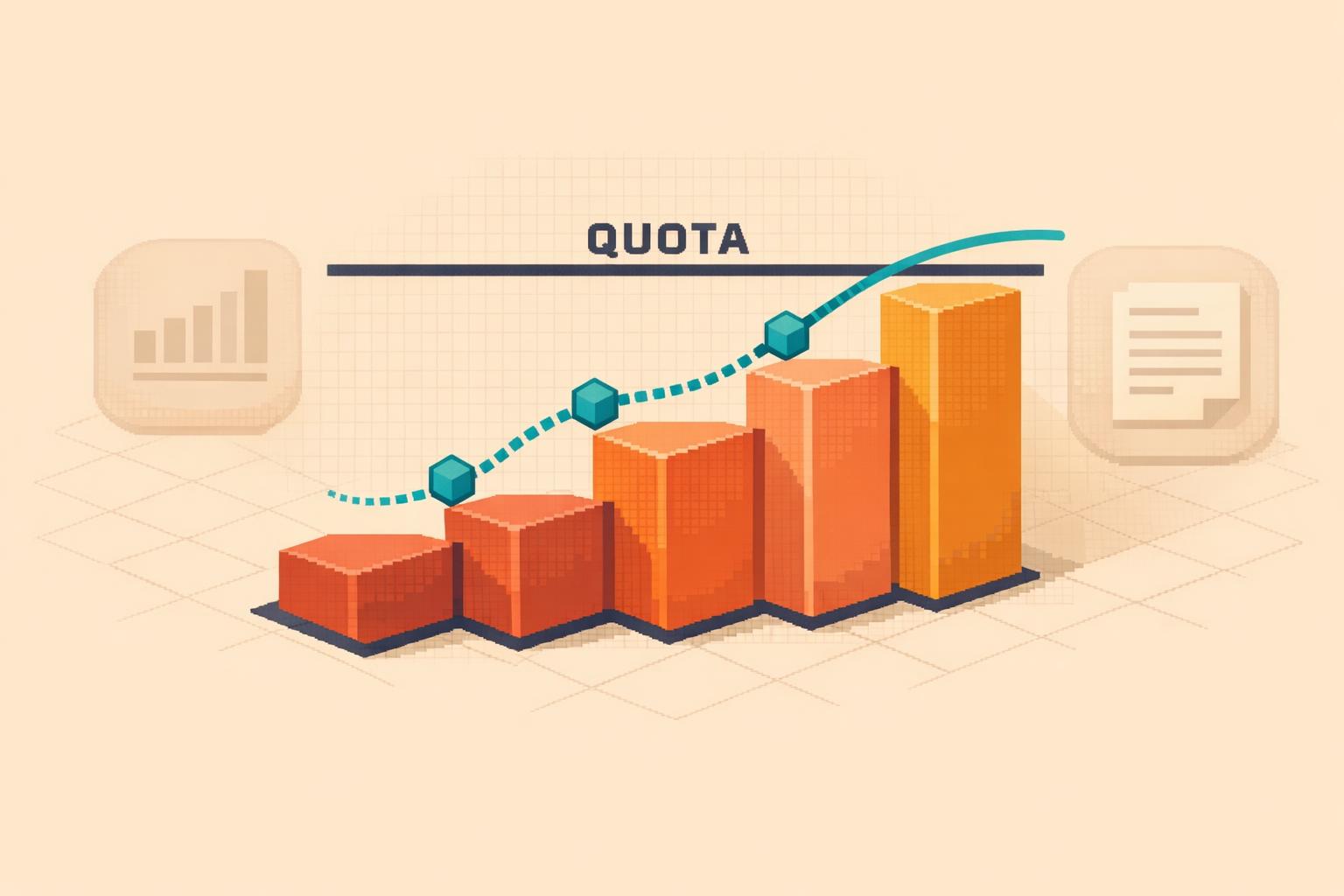
AI is transforming how sales teams track and achieve quotas by automating manual tasks, providing real-time insights, and delivering accurate forecasts. With sales reps spending only 28% of their time selling and 71% of teams starting the year without quotas, inefficiencies are rampant. AI addresses these challenges by:
Automating data entry, saving over 40,000 hours annually for teams of 500.
Providing real-time deal scoring, flagging risks 3.2 weeks earlier than manual methods.
Boosting forecasting accuracy to 94%-98%, compared to 67% with traditional methods.
Increasing quota attainment by 15% and cutting false commitments by 20%-30%.
Companies like Salesforce and Siemens have seen millions in revenue growth and improved sales performance by adopting AI-powered tools. AI also enables personalized coaching, dynamic dashboards, and actionable alerts, ensuring teams can respond quickly to pipeline changes and improve long-term outcomes.
How to Use AI in Sales: Tools, Tips, and Templates to Win More Deals | ClickUp

How AI Improves Quota Attainment Tracking

Traditional vs AI-Powered Sales Forecasting: Key Metrics Comparison
AI has completely reshaped how quota tracking is managed, turning it into a dynamic, real-time process. Instead of waiting for quarterly reviews to uncover issues, AI keeps its finger on the pulse of deal health, automates repetitive tasks, and delivers highly accurate forecasts. Let’s break down how AI achieves this through deal scoring, automation, and forecasting.
AI-Powered Deal Scoring
In the past, deal scoring often relied on gut feelings, but AI takes a more objective approach. By analyzing behavioral signals and engagement patterns, AI assigns probability scores to deals, making it easier for managers to identify potential issues early. For instance, AI can flag deals at risk an average of 3.2 weeks earlier than traditional manual reviews [5].
A great example of this is Siemens, which replaced subjective evaluations with AI-driven deal scoring. By focusing on engagement patterns, they achieved better transparency and more reliable assessments [9].
Automated Performance Monitoring
Sales teams often spend a staggering 70% of their time on administrative tasks [8]. AI steps in here by automating the capture of sales activities - like calls, emails, and meetings - eliminating common issues like duplicate records and inconsistent logs [20,21]. Real-time synchronization with CRM systems ensures that performance data is always up to date, reflecting the latest pipeline changes [7].
By integrating data from multiple platforms such as CRM, financial systems, and HR tools, AI creates a unified view of quota attainment across different regions and products [6]. This continuous tracking has a measurable impact: companies using AI-powered sales analytics report up to 40% higher quota attainment, and teams adopting AI see revenue grow by 83%, compared to 66% for those that don’t [19,20].
Salesforce provides a compelling case study. During a four-month internal pilot in 2025, they delivered 24,000 personalized recommendations to their sales team. This led to a 38% action completion rate - nearly five times their previous 8% baseline - and generated $28 million in pipeline, with $9 million in closed ACV [3].
"Insight doesn't equal impact. Our challenge wasn't to build more models - it was to operationalize the ones we already had." – Ali Nahvi, Director of Product Innovation at Salesforce [3]
With such real-time insights, AI also enhances forecasting, delivering an entirely new level of precision.
Predictive Forecasting
AI-powered forecasting goes beyond traditional methods by analyzing over 300 different buying signals, such as shifts in customer sentiment and how quickly commitment language evolves. This depth of analysis allows AI to predict outcomes with exceptional accuracy. While traditional forecasting methods hover around 67% accuracy, AI systems achieve an impressive 94% to 98% accuracy [5]. This 15% to 25% boost in precision helps sales leaders set achievable quotas and allocate resources more wisely.
AI doesn’t just improve accuracy - it also helps manage risk. For example, RUCKUS Networks saved $2 million annually by identifying pipeline risks in real time rather than waiting for quarterly reviews [9]. Companies using AI-driven tracking have seen a 15% increase in quota attainment compared to those relying on older methods. Additionally, AI cuts false commitments by 20% to 30%, ensuring deals marked as "likely to close" are backed by solid evidence [5].
Here’s a quick comparison of traditional forecasting versus AI-powered forecasting:
Feature | Traditional Forecasting | AI-Powered Forecasting |
|---|---|---|
Data Source | Manual CRM updates and gut feel | CRM, emails, calls, and meetings |
Update Frequency | Weekly or monthly roll-ups | Continuous, real-time updates |
Accuracy | Average 67% [5] | 94% to 98% [5] |
Risk Detection | Reactive (after a deal stalls) | Proactive (flagged earlier) |
Manager Effort | 6 hours/week [5] | 2 hours/week [5] |
"With generative AI, sales managers can shift from relying on historical trends to leveraging real-time insights." – Lou Turner, Korn Ferry [4]
Step-by-Step Guide to Implementing AI for Quota Tracking
Introducing AI into quota tracking means connecting your tools, streamlining workflows, and setting up alerts that drive action. Here's a breakdown of how to get started.
Integrating AI with CRM Systems
The first step is linking your CRM - like Salesforce or HubSpot - with tools such as Zoom, Microsoft Teams, email, and calendar systems. This integration allows AI to automatically capture every customer interaction. While the initial setup can take less than an hour, getting your entire team on board may take one to two weeks [11].
The real game-changer here is automating data capture. Configure your AI to log key details - like call outcomes, next steps, and commitments - directly into CRM fields after each meeting. This not only eliminates manual data entry (which eats up about 64% of a sales rep's time) but also reduces CRM errors by as much as 30% [27, 28].
Before rolling out AI, it's essential to clean up your CRM. Audit for duplicates and incomplete data, starting with objective fields like dates and deal stages. Once your system is clean, you can layer in more subjective metrics, like sentiment scores, ensuring your AI has reliable data to work with from day one [24, 26]. With this foundation in place, you’re ready to build dynamic dashboards for real-time tracking.
Creating Automated Dashboards
Ditch static weekly reports in favor of live dashboards that update automatically as deals progress [23, 31]. Keep your focus on five to eight key metrics per view to avoid overwhelming users. Examples include quota attainment percentage, pipeline coverage ratio (aim for 3x), deal velocity, win rate, and stage conversion rates. Place the most critical metrics in the top-left corner to align with natural viewing habits [12].
Tailor these dashboards to different roles. Sales reps need metrics that track their personal performance, like quota progress and next steps, while executives benefit from broader views showing regional performance and forecast accuracy. Adding drill-down options allows managers to move seamlessly from high-level summaries to detailed deal information [12].
Set your dashboards to refresh either in real time or at short intervals (every 15–30 minutes). This constant visibility can boost quota attainment by around 15% compared to monthly manual reviews [10]. These dashboards lay the groundwork for the future of sales enablement through actionable alerts that help teams respond quickly to shifts in the pipeline.
Using Real-Time Insights and Alerts
Alerts turn insights into action. Set up automated notifications based on specific deal conditions - like no activity for seven days, missed follow-up dates, or negative cues such as "budget pushed." Start with one or two high-impact rules before expanding [11].
To make alerts seamless, integrate them with platforms like Slack or Microsoft Teams so that reps get updates instantly, without needing to log into a dashboard. You can also use natural language queries - like asking, "Which deals had no activity this week?" - to get immediate answers from your CRM and call data [11]. This conversational approach transforms static reports into dynamic tools, helping managers spot pipeline gaps and adjust strategies in real time.
How Coach Pilot Supports AI-Driven Quota Tracking
Coach Pilot builds on AI's ability to deliver real-time insights by translating them into coaching strategies that lead to measurable results. It takes AI-driven quota tracking a step further by providing actionable sales guidance right when it’s needed most.
By integrating AI coaching into daily workflows, Coach Pilot offers real-time suggestions based on the habits of top performers. It also automates tasks like capturing deal data and updating CRM entries, freeing up time for sales reps to focus on selling [14][15]. The results speak for themselves: In May 2024, Rebecca Veksler tripled her monthly sales and closed 14 deals in just 8 weeks, while Naum Sekulovski closed 13 contracts over 9 weeks, leading to a combined 45% revenue increase [16]. Teams using Coach Pilot have reported a 39% improvement in quota attainment and a 7.8x growth in their sales pipeline within the first 90 days [14][15][16].
Next, let’s look at how Coach Pilot’s dynamic playbooks keep sales reps on track during every deal.
Custom Sales Playbooks and AI Coaching
Instead of relying on outdated, static playbooks, Coach Pilot introduces dynamic, real-time guidance tailored to the unique context of each sales interaction. This includes personalized messaging, strategies for overcoming objections, and actionable next steps - all delivered during live conversations [14][15]. The AI also identifies advanced patterns, such as the best times to involve executives or how to handle procurement challenges, and scales this expertise across the entire team [14][15].
The results are impressive. In June 2024, Connor Bell, a Business Development Manager at HubSpot, increased net new opportunities by 50% and secured 12 new deals in just 11 weeks, driving a 38% boost in quarterly sales revenue [16]. Additionally, reps using Coach Pilot save an average of 19.5 hours per week on administrative tasks like CRM updates, giving them more time to focus on closing deals [14][15][16].
But coaching is just one piece of the puzzle. Accurate metric tracking ensures that every strategy translates into real outcomes.
Sales Metrics Tracking
Coach Pilot doesn’t just guide sales reps - it also tracks critical metrics like win rates, sales cycle length, and forecast accuracy, integrating this data into its coaching process [14]. For example, in December 2024, Stephen Luxmoore, CEO of Your HR Team, saw a 32% jump in new client acquisitions, signing 8 contracts in just 9 weeks after applying the platform’s tailored strategies [16]. Research further shows that blending AI with sales training leads to 3.3x higher year-over-year growth in quota attainment compared to using AI alone [13].
Measuring the Impact of AI on Quota Attainment
Understanding the impact of AI on your sales processes is crucial to validate its effectiveness. Without clear metrics, it's impossible to know if your investment is paying off. Businesses that measure AI's impact effectively are 2.5 times more likely to achieve notable revenue growth [17]. To get the full picture, track both immediate efficiency improvements and long-term revenue trends.
Key Performance Metrics to Track
Start by creating baseline comparisons before implementing AI. Document metrics like close rates, average deal size, and the amount of time reps spend selling versus handling administrative tasks [19]. This baseline will serve as a reference point for evaluating progress.
Focus first on efficiency metrics. Compare the time your reps spend selling before AI (typically 28–30%) with post-AI results to measure gains [17][1]. AI tools can cut CRM input time by up to 90%, potentially saving each rep 8 hours per week [1]. Look for a 20-30% reduction in administrative tasks and a 15-25% increase in selling time [17].
Next, examine revenue and conversion metrics to understand financial outcomes. AI can boost win rates by up to 26%, increase average deal size by 10-20%, and improve conversion rates [17][4]. Companies using real-time quota tracking have seen a 15% improvement in attainment compared to traditional methods [10].
Predictive accuracy is another key area. AI-assisted forecasting improves accuracy by 15-25% [4]. Monitor how often AI-driven lead scoring accurately predicts which deals will close. Also, track action completion rates - how often reps follow AI-generated recommendations. For instance, between February and May 2025, Salesforce's internal pilot of Agentforce Sales Coach achieved a 38% action completion rate, compared to just 8% for standard dashboard-based suggestions. This initiative generated $28 million in pipeline and $9 million in closed ACV over four months [3].
Once you’ve established baseline metrics and measured efficiency gains, focus on how AI continues to refine and improve these numbers over time.
Continuous Improvement with AI Analytics
AI analytics transform your strategy from retrospective to predictive. Instead of merely reviewing last quarter’s results, AI uses live data from your pipeline, deal velocity, and rep activities to predict risks and opportunities before the quarter ends [4].
"With generative AI, sales managers can shift from relying on historical trends to leveraging real-time insights." - Lou Turner, Korn Ferry [4]
When quota attainment drops, AI can perform a root-cause analysis to pinpoint issues. It might reveal that win rates are falling because deals are stalling at specific pipeline stages, or because pricing discussions are happening too early in the process [18]. For example, AI could flag that deals are losing momentum because key decision-makers haven’t been engaged [4].
Keep an eye on risky deal signals. Track patterns like frequent changes to close dates, shrinking deal sizes, or a lack of recent activity [18]. In 2025, Webflow used a AI-driven sales playbook to help its SDR team prioritize high-value prospects. This led to an increase in quota attainment from 99% to 137% in just one quarter, even with higher targets [2].
Adopt continuous learning loops to ensure AI systems improve over time. As these tools process more data, their recommendations and training suggestions become increasingly tailored and effective [4]. For example, Allianz Trade standardized its sales process with AI-driven insights, achieving a 20% boost in quota attainment and a 10% rise in win rates [2].
Conclusion
AI has transformed quota tracking into a precise, data-driven process. By replacing outdated spreadsheets and guesswork, sales teams now benefit from real-time insights and automated systems that deliver measurable outcomes. In fact, 83% of teams using AI have reported revenue growth [6].
To get started, focus on unifying data from your CRM, financial, and HR systems into a single source of truth. Incorporate AI-powered deal scoring to identify high-probability opportunities, create real-time automated dashboards, and integrate predictive forecasting and AI coaching into daily workflows.
These foundational steps pave the way for advanced tools like Coach Pilot. This platform connects planning with execution by creating tailored sales playbooks, offering immersive training, and embedding AI-driven coaching into existing processes. Teams using Coach Pilot have seen substantial improvements in quota attainment, pipeline expansion, and reduced time spent on administrative tasks [14][20]. For example, in June 2024, Connor Bell at HubSpot used Coach Pilot to increase net new opportunities by 50%, close 12 new deals in 11 weeks, and achieve a 38% boost in quarterly sales revenue [20].
As Nathan Thompson, Content Manager at Copy.ai, aptly put it:
"AI turns quota planning from friction into a repeatable path to predictable revenue." [6]
When decisions are driven by data, organizations position themselves for faster and more sustainable growth.
FAQs
What data does AI use to predict quota attainment?
AI uses a combination of real-time sales data, past performance metrics, deal health indicators, and market analysis to predict how likely teams are to hit their quotas. By analyzing these factors, sales teams can spot trends, fine-tune their strategies, and make more accurate forecasts.
How much clean CRM data do we need before using AI?
For AI to truly deliver results, your CRM data needs to be accurate and reliable. Here's a concerning fact: studies indicate that only 23% of CRM data is typically accurate. That’s a big problem because AI depends on high-quality data to improve sales productivity and enhance forecast accuracy.
Think of it this way: if your data is flawed, AI can't perform at its best. Keeping your CRM data well-maintained ensures AI can effectively track quota attainment and deliver actionable insights. In short, clean data unlocks AI's full potential.
How do we measure AI ROI on quota tracking?
The return on investment (ROI) of AI in quota tracking is assessed by examining critical sales metrics. These include higher quota attainment, better pipeline accuracy, and quicker response times. Studies show that AI-powered sales coaching can lead to noticeable improvements in quota achievement.
To maximize results, it’s important to follow best practices. This involves comparing performance against established benchmarks and using AI-driven insights to make smarter decisions and boost overall efficiency. By doing so, teams can better understand the impact of AI on their sales processes.
Related Blog Posts

Remove the guesswork from winning more deals.