B2B Sales
Pipeline Data Enrichment vs. Cleansing
Apr 3, 2026
Explains why you must cleanse CRM data before enrichment, and how automated enrichment and AI improve data accuracy and outreach.

When it comes to managing your sales pipeline, the quality of your data is everything. Bad data - like duplicates, outdated information, or missing details - costs companies millions annually and wastes over 27% of sales teams' time. To fix this, businesses rely on two key processes: data cleansing and data enrichment. Here's the difference:
Data Cleansing: Removes duplicates, corrects errors, and standardizes formats to ensure your CRM data is accurate and reliable.
Data Enrichment: Adds missing information, like job titles, company details, and technographics, to make your data more complete and actionable.
Key Takeaway: Always cleanse your data first to eliminate errors before enriching it. This sequence prevents costly mistakes, improves outreach precision, and maximizes ROI.
Quick Comparison
Aspect | Data Cleansing | Data Enrichment |
|---|---|---|
Goal | Fix existing issues (accuracy) | Add missing details (completeness) |
Action | Remove duplicates, correct errors | Append external data |
Timing | First step | Second step |
Frequency | Periodic (e.g., every 5 months) | Continuous or automated |
Outcome | Reliable, standardized records | Detailed, actionable profiles |
Clean and enriched data ensures your sales team works efficiently, reduces errors, and drives better results. Start with cleansing to create a solid foundation, then enrich to add depth and context to your records.
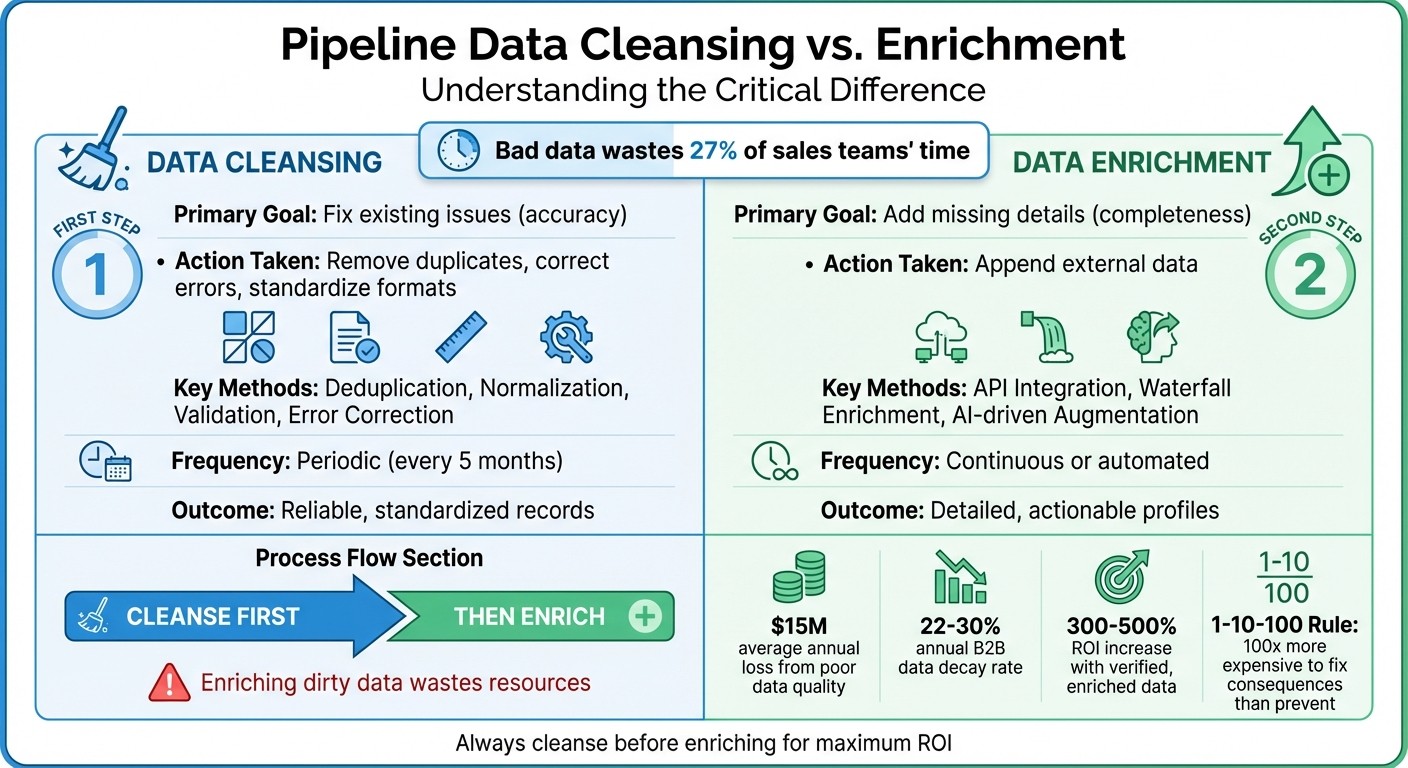
Data Cleansing vs Data Enrichment: Key Differences and Process Order
Clean and enrich your CRM with AI in Google Sheets or Excel
What is Pipeline Data Cleansing?
Pipeline data cleansing - sometimes called data scrubbing - is all about identifying and fixing issues in your sales database. This includes tackling corrupt, outdated, duplicate, or improperly formatted data [1]. Think of it as giving your CRM a fresh start: removing duplicates, correcting errors, and standardizing formats so your team can confidently rely on the data they’re using. It’s especially important when you consider that B2B databases degrade at a rate of 22% to 30% each year.
Without cleansing, your pipeline can quickly become a problem. Attempting to enrich data that hasn’t been verified only makes things worse. Cleansing lays the groundwork for further improvements, ensuring your sales team has access to reliable information.
"Data cleansing ensures that the foundation of your CRM is reliable, prevents errors in reporting, reduces frustration for sales and marketing teams, and enhances overall productivity." – Laura Tussi, HubSpot Consultant [3]
Common Data Cleansing Techniques
There are a few core methods that make data cleansing effective:
Deduplication: Eliminating or merging duplicate records that inflate lead counts and confuse your team [2].
Standardization (Normalization): Ensuring consistent formats across your data. For example, converting variations like "CA", "Calif.", and "California" into a single format, or standardizing phone numbers to +1-555-123-4567 [2].
Validation: Checking the accuracy of your data by verifying email syntax, confirming phone numbers, and cross-referencing details with external sources [2].
Error Correction: Fixing typos, misspellings, and formatting errors caused by manual data entry [3].
These techniques work together to clean up common issues like incomplete records, outdated details, duplicate entries, and inconsistent formatting. With B2B data decaying at a rate of 20% to 30% every year [8], regular cleansing is a must to keep your CRM in good shape.
Benefits of Data Cleansing
Clean data doesn’t just look better - it makes your sales operations run smoother. A well-maintained CRM reduces errors and gives your team accurate information they can trust. For example, better data quality lowers email bounce rates, protecting your sender reputation. Standardized firmographic data also ensures leads are routed correctly, improving your forecasting accuracy.
On top of that, investing in data cleansing can help prevent substantial revenue losses. Organizations often lose 15% to 25% of revenue due to bad data [7]. The 1-10-100 rule highlights this clearly: it’s 100 times more expensive to fix the consequences of bad data than to clean it up proactively [1].
What is Pipeline Data Enrichment?
Pipeline data enrichment involves the automatic addition of missing details to your records using external sources [6][4]. While data cleansing focuses on removing inaccuracies and duplicates, enrichment fills in the blanks, transforming incomplete records into detailed profiles. For instance, a contact with just a name and email address can be expanded to include job titles, company revenue, tech stack, and direct-dial numbers.
This process builds on a clean dataset. Cleansing comes first - starting with accurate data ensures that errors don’t multiply when new, high-quality information is added.
Enrichment supports the future of sales enablement by giving your team the insights they need to work smarter. Instead of making uninformed cold calls, they can see that a prospect uses Salesforce, recently secured Series B funding, and matches your ideal customer profile. Since B2B data decays at a rate of about 2.1% per month - or 22.5% annually [9] - enrichment isn’t a one-and-done task. It’s an ongoing process that keeps your pipeline current as contacts change roles, companies grow, and tech stacks evolve.
"Data enrichment takes the skeleton of a contact or company record and fills it in with verified, current information so your team can actually do something with it." – Jesse Ouellette, Founder, LeadMagic [10]
Common Data Enrichment Methods
Several methods can help you enrich your pipeline data effectively:
Third-party API integration: This method connects your CRM with external data providers, automatically adding firmographic details (like company size and revenue), technographic data (such as software stack), and contact information (like verified emails and direct-dial numbers) [4].
Waterfall enrichment: This accuracy-focused approach queries multiple data providers - often 15 or more - in sequence until the required information is found. It delivers higher coverage rates (85% to 95%) compared to single-source tools (50% to 70%), with email accuracy reaching up to 98% [4].
AI-driven data augmentation: Using AI agents, this method extracts real-time business intelligence that traditional databases might miss. It’s especially useful for identifying recent company news, funding updates, or hiring trends that signal buying intent [9].
Benefits of Data Enrichment
Enriched data revolutionizes how your sales team operates. For starters, sales development representatives (SDRs) save an average of 6 hours per week - or 312 hours annually - by eliminating the need for manual prospect research [10]. This time can be redirected toward selling.
Lead qualification becomes faster and more precise when enriched firmographic and technographic data is available. With detailed profiles, you can quickly determine if a prospect aligns with your ideal customer profile, assign leads to the correct territories, and prioritize accounts showing intent signals. Teams leveraging enriched and verified contact data have reported a 300% to 500% ROI on campaign spend, thanks to reduced bounce rates and improved reply rates [4].
Personalization also gets a major boost. When your team knows a prospect’s tech stack, recent funding activity, or specific challenges, their outreach becomes far more targeted and relevant. This level of detail supports better decision-making across sales, marketing, and customer success teams, ensuring every interaction is more impactful.
Key Differences Between Data Cleansing and Enrichment
Data cleansing and enrichment both improve the quality of your pipeline data, but they tackle different challenges. Data cleansing focuses on fixing existing issues - like removing duplicates, correcting errors, and validating information. On the other hand, data enrichment involves adding external details to fill in gaps, creating more complete profiles. With poor data wasting over 27% of sales time and costing businesses millions annually, it's clear why cleansing should always come first [5].
Comparison Table
Aspect | Data Cleansing | Data Enrichment |
|---|---|---|
Primary Goal | Fix existing data issues (accuracy) | Add missing details (completeness) |
Action Taken | Removing, correcting, or merging records | Appending, supplementing, or verifying |
Key Methods | Deduplication, normalization, validation | Data appending, waterfall enrichment, intent tracking |
Timing | First step; lays the groundwork | Second step; builds on clean data |
Frequency | Periodic (e.g., every 5 months) | Ongoing or automated |
Result | Reliable, standardized records | Detailed, actionable prospect profiles |
This side-by-side breakdown highlights why the order of these processes is so important.
Order of Operations
Cleansing always comes before enrichment - this sequence prevents costly errors. For example, enriching a database riddled with duplicates might mean paying to enrich the same lead multiple times. That’s an unnecessary expense that can be avoided by starting with clean data [2].
The 1-10-100 data rule drives this point home: fixing the business impact of bad data is 100 times more expensive than cleaning and verifying it upfront [1]. Enrichment tools rely on accurate "seed data" - like standardized email addresses, phone numbers, and company names - to find the right matches. Without cleansing first, inaccuracies can derail the entire enrichment process [4].
When done in the correct sequence, automated tools can streamline both steps, ensuring your data is both clean and enriched for maximum effectiveness.
When to Use Data Cleansing vs. Data Enrichment
Clean and enriched data are the backbone of any successful sales pipeline. But knowing when to apply each process is just as important as understanding their benefits. It’s not about choosing one over the other - it’s about timing and prioritizing effectively.
When to Use Data Cleansing
Start with data cleansing if your sales team is running into issues like high email bounce rates, disconnected phone numbers, or duplicate records inflating your lead counts [1][4]. If your data is outdated - say, more than five months old - or you’ve just acquired a new list, it’s time for a thorough cleanse [3].
Here’s why cleansing matters: Poor data quality costs businesses a staggering $15 million annually [1]. And with sales reps spending 27% of their time chasing bad leads [5], regular deep audits (at least every five months) are essential. These audits catch issues like formatting errors, duplicate entries, and invalid contact details before they become major headaches [3].
Once your data is clean and reliable, you’re ready to focus on enrichment to add more depth and context.
When to Use Data Enrichment
Enrichment works best when it builds on a clean database [4][6]. Think about using enrichment if your outreach feels generic, manual research is eating up valuable time, or leads are being misrouted because of missing details like company size or revenue [1][6]. Enrichment adds layers of context, such as technographics (the tools a company uses), intent signals (buying behavior), and demographic data (job titles, seniority), enabling highly personalized outreach [4][6].
For inbound leads, real-time enrichment can provide instant insights - like company size, industry, or existing tools - right when a prospect enters your CRM [3][6]. This helps with accurate lead scoring, territory assignments, and filtering for your ideal customer profile. And since B2B data decays at an annual rate of 22% to 30% [4], quarterly enrichment is key to keeping your intelligence up-to-date. Teams that verify and enrich their contact data before outreach can see impressive results, with campaign ROI increasing by 300% to 500%, and bounce rates staying below 3% [4].
Using AI Tools for Data Cleansing and Enrichment
Did you know that manual data entry eats up a staggering 71% of a sales rep's time, leaving just 35% for actual selling [12]? AI-powered tools are changing that. By automating data cleansing and enrichment in real time, these tools free your team to focus on what really matters - closing deals. This shift enables faster, more efficient data processes that keep your operations running smoothly.
Benefits of Automation
AI doesn’t just make things faster - it reshapes how data moves through your systems. For example, as records are added to your CRM, AI validates them on the spot. It checks email deliverability, formats phone numbers correctly, and uses fuzzy matching to flag duplicate entries [14, 15].
The time saved is massive. Tasks that used to take 8–12 hours each week can now be done in as little as 15 minutes with AI-driven playbooks [13]. That’s time your sales team can reclaim to focus on selling [12].
But it’s not just about speed. AI tools can also tap into the data you already have to uncover valuable insights. They analyze call transcripts, emails, and calendar entries to automatically fill in CRM fields with details like budget ranges or organizational hierarchies [16, 18]. The impact is clear: 83% of sales teams using AI report revenue growth, compared to 66% of teams that don’t [11]. It’s a competitive edge that’s hard to ignore.
How Coach Pilot Uses Clean and Enriched Data

Coach Pilot takes AI’s potential even further by turning clean and enriched data into actionable sales coaching. The platform integrates directly into your workflow, using your company’s specific winning strategies - like messaging models, objection-handling techniques, and deal stages - to provide real-time coaching during live calls. Forget static playbooks collecting dust; this is dynamic, AI-driven guidance tailored to your actual deal patterns.
One standout feature is how Coach Pilot eliminates the need for manual CRM updates. It captures "deal truth" directly from conversations, ensuring your analytics reflect real-world activity. The platform also identifies advanced patterns, like optimal moments to discuss pricing or strategies for navigating procurement, and scales these insights across your team.
The results? Customers have reported 7.8× pipeline growth in under 90 days, a 39% increase in quota attainment, and an average savings of 19.5 hours per week by cutting down on administrative tasks [14]. When your data is accurate and enriched, AI coaching becomes not just helpful but game-changing - delivering insights that are precise, relevant, and ready to act on.
Conclusion
Data cleansing and enrichment work hand in hand to create a strong and efficient sales pipeline. Cleansing eliminates errors and duplicates, while enrichment adds valuable details like firmographics, technographics, and intent signals [5][15]. Together, they transform scattered and incomplete records into a cohesive, actionable dataset that supports accurate lead scoring and tailored outreach efforts [2][7].
As emphasized earlier, tackling data cleansing before enrichment is essential for building effective sales workflows [2][4].
"Enriching a dirty database is like putting a new coat of paint on a crumbling wall - it might look better briefly, but you haven't fixed the underlying problem." – Karli Stone, Apollo.io [1]
By standardizing formats and removing duplicates before adding new data, you prevent wasting resources on invalid records.
The cost of poor data quality is staggering - organizations lose an average of $15 million annually, and sales teams waste about 27% of their time dealing with bad data [1][5]. On the flip side, teams that verify and enrich contact data before outreach see 2× to 3× higher reply rates and maintain bounce rates below 3% [4].
With clean and enriched data, sales leaders can confidently make decisions that propel revenue growth. Focus your enrichment efforts on the data points that directly impact lead scoring and individual rep decisions. Automate enrichment for new leads, and plan quarterly updates for your entire database, keeping in mind that B2B data deteriorates at a rate of 22% to 30% annually [4][6].
Coach Pilot takes this foundation of clean, enriched data and integrates it into your sales workflow with AI sales coaching. By adhering to the principles of data quality and completeness discussed throughout this article, the platform delivers actionable insights during live calls, maximizing the potential of your sales strategy.
FAQs
How do I know if my CRM needs cleansing first?
Keeping your CRM clean is crucial if it’s cluttered with outdated, duplicate, or incorrect information that interferes with your sales efforts. Regularly refreshing your data - say, every five months - helps maintain accuracy by eliminating errors and redundancies. If your CRM is riddled with inaccuracies or irrelevant entries, begin by tidying it up. This gives you a solid base to work from, allowing you to then enrich the data by filling in gaps and making it more useful for your team.
What data fields should I enrich for better lead scoring?
Focusing on enriching verified fields such as email addresses, phone numbers, job titles, and firmographics (like company size and industry) can make a world of difference. These details don't just add depth to your data - they help fine-tune lead scoring. With this extra layer of insight, you can better understand your prospects and prioritize the ones most likely to convert.
How often should I cleanse and enrich my pipeline data?
Data cleansing should happen at least every five months - or more frequently if necessary - to keep your information accurate and up to date. Meanwhile, data enrichment is typically a continuous or automated process aimed at filling in gaps and improving the completeness of your data. Keeping up with both tasks ensures your sales workflows stay efficient and dependable.
Related Blog Posts

Remove the guesswork from winning more deals.