B2B Sales
Personalized Sales Pitches: Data-Driven Insights
Mar 18, 2026
AI-driven, trigger-based personalization and coordinated multichannel outreach that boost reply rates, shorten sales cycles, and increase revenue.
Personalized sales outreach is no longer optional - it’s essential for success. Buyers are ignoring generic pitches, with cold email reply rates dropping to just 4–5% by 2025. However, personalization changes the game, boosting reply rates, revenue, and deal speed. Here’s what you need to know:
Personalized outreach increases revenue by up to 40%. Even basic personalization can lift revenue by 10–15%.
Trigger-based emails are 497% more effective than generic ones. Acting on triggers like funding rounds or leadership changes improves conversion rates significantly.
Modern AI tools for sales enablement save time and improve results.AI-powered personalization takes seconds per email, generating reply rates of 15–25% while allowing for higher outreach volumes.
Multichannel strategies amplify impact. Combining email, LinkedIn, and phone outreach can increase reply rates by over 250%.
The key to winning? Use AI to identify timely triggers, craft tailored messages addressing buyer pain points, and leverage multichannel outreach for maximum engagement. Timing and relevance are critical - act fast, act smart.
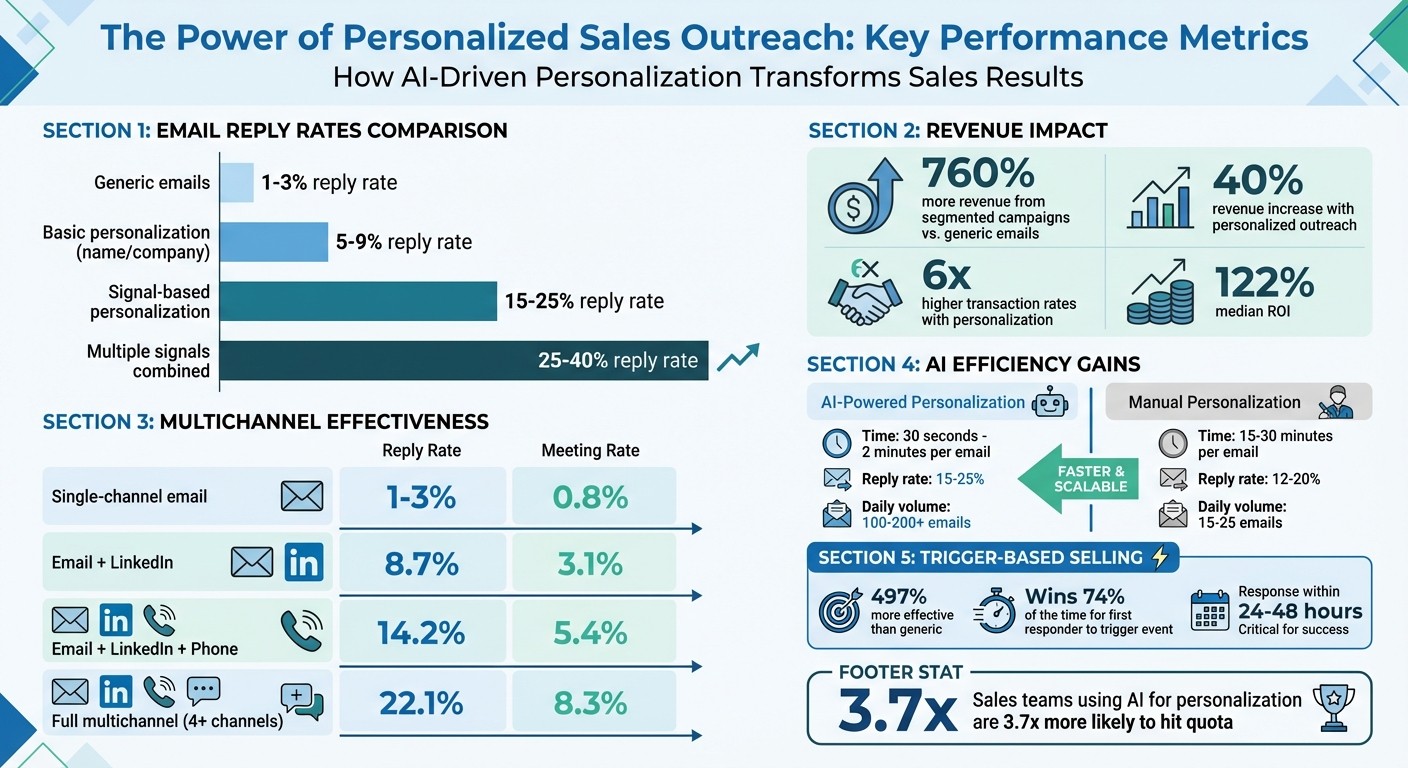
Personalized Sales Outreach Performance Statistics and ROI Comparison
Research Findings on Personalized Sales
Open and Reply Rate Statistics
When it comes to email outreach, personalization is a game-changer. Generic emails typically see reply rates of just 1–3.43%, while basic personalization - like including a recipient's name or company - boosts that to 5–9%. But the real magic happens with signal-based personalization, where emails reference specific trigger events like funding rounds or leadership changes. This approach can drive reply rates to 15–25% [4][9]. Sales teams that combine multiple signals, such as mentioning a recent job change alongside a LinkedIn post, report reply rates as high as 25–40% [4][9].
Open rates show a similar trend. Emails with generic subject lines average a 12% open rate. Adding a first name increases that to 19% [6]. A "Company + Role" subject line - dubbed the "mid-market sweet spot" - delivers a 28% open rate with just two minutes of research, a 133% improvement over generic emails [6]. Including a prospect's name in the subject line takes open rates even higher, reaching 43.41% [8].
Efficiency also plays a key role. AI-powered tools enable signal-based personalization in just 30 seconds to two minutes per email, achieving reply rates of 15–25% and supporting outreach volumes of 100–200+ emails per day [4]. In contrast, manual personalization takes 15–30 minutes per email, yields reply rates of 12–20%, and limits daily output to 15–25 emails [4]. These efficiency and engagement gains directly contribute to faster revenue growth, moving beyond the static sales playbook of the past.
Revenue Growth Through Targeted Messaging
The numbers don’t lie - personalization drives revenue. Segmented and personalized email campaigns generate 760% more revenue than generic "batch-and-blast" emails [7]. Personalized emails also boast transaction rates six times higher than their generic counterparts, delivering a median ROI of 122% [7].
Case studies back this up. Amazon credited $35 billion in annual sales to AI-powered email recommendations in 2025. EasyJet found that AI-driven emotional triggers were 14 times more effective, with 7.5% of recipients booking flights within 30 days. Meanwhile, Sage Publishing reduced email drafting time by 99% using AI-powered segmentation [7].
"Segmented email campaigns generate 760% more revenue than non-segmented campaigns. The extraordinary multiplier effect results from improved relevance." - G2 Email Marketing Research [7]
Top-performing sales teams using a B2B sales playbook are embracing these tools. They are 3.7 times more likely to use AI for personalization to hit their quotas [4]. This approach has led to a 41% increase in revenue and a 13.44% boost in click-through rates [7]. Signal-based selling also speeds up conversions by nine times compared to generic outreach [2], proving that relevance and timing are key to closing deals faster and more profitably.
How I Built an AI Sales Outreach Machine (Hyper-Personalized at Scale)
Using Trigger Events and Buyer Pain Points
Tying trigger events to buyer pain points is a powerful way to craft personalized and impactful sales pitches.
Trigger-Based Personalization Methods
Trigger events create prime opportunities for sales engagement. Some of the most effective triggers include leadership changes, financial milestones, growth indicators, technology updates, market pressures, and engagement behaviors.
Leadership transitions often deliver the highest conversion rates. New executives, for instance, are 5–10 times more likely to evaluate and adopt new tools within their first 90 days[11][12]. For example, a new VP of Sales might immediately review the company's tech stack to identify areas for improvement. Similarly, when a "champion" changes jobs, outreach efforts convert 3–5 times faster than standard campaigns[10].
Financial triggers, like funding rounds, signal both available budgets and a push for rapid growth. A Series B funding announcement, for instance, often indicates an urgent need to scale operations and improve efficiency. Reaching out within two weeks of such an announcement can increase your chances of success by 74%[13]. Growth signals, such as hiring spikes in specific departments, can highlight potential challenges like onboarding inefficiencies or training gaps.
Advanced sales teams take it a step further with "signal stacking" - combining multiple triggers to zero in on high-intent prospects. For example, pairing a funding announcement with a new CRO hire and a hiring surge creates a compelling buying signal. This approach has led to a 400% boost in conversion rates compared to cold outreach[11][12].
"The first seller to reach a prospect after a trigger event wins 74% of the time. Not the best product. Not the lowest price. The first one in the door."
Craig Elias, Founder, SHiFT Selling[15]
The real impact of these triggers lies in connecting them to specific buyer challenges.
Aligning Solutions with Customer Pain Points
The best trigger-based outreach links events directly to buyer challenges. For example, a funding announcement might indicate scaling challenges that your solution can address. Using the "Observation + Implication + Value Proposition" framework, you can structure your pitch like this: acknowledge the trigger, highlight the challenge it creates, and then present your solution[13]. If a company secures Series B funding, they may need to quickly scale their go-to-market efforts - your product could simplify onboarding for their growing team.
Different triggers point to distinct pain points. A new CRO may be reevaluating the tech stack for redundancies, while M&A activity can lead to integration issues and overlapping systems. Similarly, a hiring surge might expose onboarding delays or management challenges. Personalizing your message to address these specific pain points can increase buyer engagement by 63%[5].
Timing is just as critical as relevance. Acting on high-priority triggers within 24 to 48 hours is essential, as competitors will also be monitoring these events[10][11]. For digital behaviors like visits to your pricing page, responding within 4 hours is ideal. For broader company-level triggers, such as leadership changes or funding announcements, aim to act within 48 hours[16]. Delays can significantly hurt your chances - responsiveness drops by 30% to 40% for every additional week that passes after the event[17].
Keep your emails short - under 100 words - and focus on the challenge rather than offering generic congratulations. Instead of saying "Congrats on the funding", address the specific challenges the funding creates. This focused approach has resulted in win rates of 37%, compared to just 19% for traditional cold outreach[14].
Trigger Type | Implied Pain Point | Response Angle |
|---|---|---|
New Executive Hire | Mandate to change; auditing existing tools | Focus on quick wins within 90 days |
Funding Round | Pressure to scale rapidly; growth targets | Highlight efficiency and scaling infrastructure |
Hiring Surge | Onboarding bottlenecks; management overhead | Emphasize reducing ramp time for new reps |
M&A Activity | Redundant tech stacks; integration friction | Offer consolidation and seamless migration |
Tech Stack Change | Dissatisfaction with current vendor | Focus on competitive advantages and ROI |
AI in Personalized Sales Pitches
AI has transformed how sales teams approach prospects, allowing them to analyze data instantly and create messaging tailored to individual needs. Let’s dive into how modern AI platforms are integrating diverse data sources to make this possible.
AI Tools for Sales Personalization
AI draws from a mix of data sources like CRM records, intent signals, product usage patterns, and technographics. For example, Salesforce Data Cloud combines these inputs to deliver a comprehensive view of each prospect[18][21]. Once data is consolidated, AI identifies key triggers - such as recent funding rounds, executive changes, updates to a company’s tech stack, or even LinkedIn activity - to pinpoint the best time to engage[18][20]. Tools like Cotera's Lead Follow-up Automator can then summarize a prospect's challenges in seconds, saving valuable time for sales reps[19][20].
AI doesn’t stop at gathering information; it uses strategic playbooks to recommend the next best action. For instance, it might suggest an upsell when customer satisfaction is high or flag a rescue strategy when a deal seems to be stalling[21]. Platforms like Coach Pilot take it a step further by integrating AI coaching into sales processes, helping reps practice their pitches and receive real-time feedback tailored to their company’s sales approach.
Between February and May 2025, Salesforce tested its Agentforce Sales Coach alongside Data Cloud. The results were hard to ignore: over 24,000 personalized recommendations led to a combined pipeline and revenue boost of $37 million in just four months. Even better, action completion rates surged from 8% to 38%[21].
"We've gone from sending generic messages like 'Your top growth factor is pipeline generation - here's a video,' to saying: 'Pick up the phone. Call this customer. Here's the pitch. Here's the coach. Let's go.'"
Ali Nahvi, Director of Product Innovation, Salesforce[21]
The impact of these tools isn’t just theoretical. In March 2026, a sales rep named Tyler used Cotera's AI tool to revive 140 dormant leads in his CRM. By crafting personalized emails that referenced specific webinar engagement and feature interests, Tyler boosted his reply rate from 1.4% to 7.2% and doubled his meeting volume[19].
These examples show how AI is reshaping sales strategies and delivering measurable results.
Performance Results from AI-Enhanced Sales
The numbers speak for themselves. AI coaching increased conversion rates from 24.4% to 29.2% in 2025[22]. Sales cycles became significantly shorter, dropping by 32.6% - from 62.0 days to 41.8 days - when AI recommendations were acted on within 24 hours[22]. On top of that, AI-equipped reps generated 41% more revenue per person ($1.75 million vs. $1.24 million)[23].
In terms of prospecting, AI-assisted teams saw dramatic improvements, increasing meetings booked per hour from 0.7 to 1.9[19]. Personalized AI-driven outreach led to an 80% jump in response rates and sped up pipeline velocity by 45%[1]. These efficiency gains highlight how AI can amplify the effectiveness of personalized sales efforts.
The most successful teams, however, combine AI with human coaching. This hybrid model not only improves performance but also enhances team satisfaction (scoring 8.4 out of 10) and boosts retention rates to 89%[22]. While AI handles repetitive tasks like follow-up reminders and identifying stakeholder gaps, managers can focus on more complex activities like pricing negotiations and strategic account planning[22].
Coaching Model | Avg. Conversion Rate | Avg. Sales Cycle | Manager Time/Week |
|---|---|---|---|
AI-Only | 29.2% | 41.8 days | 4.7 hours |
Hybrid (AI + Human) | 27.9% | 47.7 days | 5.2 hours |
Human-Only | 24.4% | 62.0 days | 8.3 hours |
(Source: Optifai study of 938 B2B teams, 2025)[22]
AI is a powerful tool, but it’s not a substitute for human touch. Sales reps need to refine AI-generated drafts to ensure they align with brand tone and feel authentic[20][3].
"AI should be the research assistant, not the closer. The reps who win are the ones who use AI to save time on research and targeting, then reinvest that saved time into thoughtful outreach."
Multichannel Personalization Approaches
Personalized, trigger-based messaging has proven its worth, but multichannel strategies take things to the next level, driving both engagement and conversion rates.
Relying on just one channel can severely limit your reach. In fact, multichannel campaigns have been shown to increase purchase rates by a staggering 287% [28]. When outreach is coordinated across email, phone, and LinkedIn, conversion rates can climb by as much as 250% [25].
The secret lies in coordination. Simply duplicating the same message across channels can come off as spammy. Instead, each channel should add something new to the conversation. For example, an email might introduce your value proposition, a LinkedIn message could showcase social proof, and a phone call can address specific concerns in real time. This creates a "surround sound" effect, where each touchpoint reinforces the others, building trust and familiarity in a way that single-channel efforts simply can't match [25].
"Multi-channel outreach - combining email, video, LinkedIn, and phone in a coordinated sequence - generates 2-3x more replies than any single channel working alone."
Different prospects respond to different channels. For example, C-suite executives may prefer LinkedIn messages over emails, while other buyers might favor phone calls [30]. LinkedIn messages boast a 10.3% response rate, which is nearly double the 5.1% average for cold emails [27][28]. Adding personalized video to the mix can further boost reply rates by up to three times compared to text-only follow-ups [26].
Multichannel Communication Methods
To make the most of multichannel outreach, successful teams use structured touch frameworks that seamlessly integrate multiple channels.
One proven method is the 10-14 touch framework, which involves 10 to 14 touchpoints over 21 to 22 days using a combination of email, LinkedIn, and phone outreach [25][30]. Here's how reply rates stack up across different outreach methods:
Outreach Type | Reply Rate | Meeting Rate |
|---|---|---|
Single-channel Email | 1-3% | 0.8% |
Email + LinkedIn | 8.7% | 3.1% |
Email + LinkedIn + Phone | 14.2% | 5.4% |
Full Multi-channel (4+ channels) | 22.1% | 8.3% |
(Source: Multi-channel outreach studies, 2025-2026)
Speed is also critical. Leads contacted within 5 minutes of engagement are 21 times more likely to qualify than those contacted after 30 minutes [29]. Many sales teams use intent-based triggers - for example, if a prospect visits your pricing page, the system can automatically initiate a phone call within minutes [30].
Here’s an example of a typical outreach sequence:
Day 1: Send an email introducing your value proposition.
Day 2: Send a personalized LinkedIn connection request.
Day 3: Follow up with an email offering a new angle or case study.
Day 5: Make your first phone call and leave a voicemail.
Day 7: Send another email with fresh insights.
Day 10: Send a LinkedIn message highlighting social proof.
Day 14: Place a second phone call.
Day 21 or 22: Send a final "breakup" email [32][31][35][38].
That final breakup email can be surprisingly effective. By removing pressure and tapping into loss aversion, it often generates 15-20% of total sequence replies [25][30].
It’s also vital to use automated "pause rules." If a prospect replies on one channel, outreach on all others should stop immediately to avoid overwhelming them [29].
"The fix is not adding more channels. The fix is unifying them into a single conversation that builds trust instead of annoyance."
Raul Kaevand, Author, Instantly [29]
Follow-Up Frequency and Timing
Timely follow-ups are the backbone of effective multichannel outreach. Research shows that many sales reps give up too soon. On average, it takes 8 touchpoints to book a meeting with a cold prospect, yet 44% of reps stop after just one attempt [25][26]. 80% of sales require five or more follow-ups, so persistence is key - but it needs to be strategic to avoid coming across as pushy [32][33][31].
Spacing your follow-ups smartly is crucial. For cold prospects, wait 2-3 business days between touches [26][27]. If a prospect shows interest - like opening an email or visiting your website - shorten the gap to 1-2 days [26][27]. Engagement usually drops sharply after the first week, so front-load your sequence with more frequent touches early on [38].
Timing also matters. The best times for emails are Tuesday, Wednesday, and Thursday between 9:00 AM and 11:00 AM in the recipient’s local time zone [34][37]. For phone calls, aim for 11:00 AM to 12:00 PM or 4:00 PM to 5:00 PM [38]. Including voicemails can increase subsequent email open rates by 22% [30].
Interestingly, the first follow-up email (around Day 3) often generates 38% of replies, compared to 32% for the initial outreach email [34]. After three unanswered emails, it’s best to switch channels - persisting with emails alone can triple spam complaints and unsubscribe rates [31][37].
"After the second touch, unless we bring real value or switch channels, it's like shouting into the void. Timing and relevance beat volume every time."
Every follow-up should offer something new, whether it’s a case study, an industry benchmark, or a fresh insight. Generic follow-ups without added value tend to lower response rates [31][34][37].
The rewards for getting this right are huge. Omnichannel customers have a 30% higher lifetime value compared to single-channel customers [28]. Reaching out within 60 seconds can boost conversion rates by 400% [36]. For C-suite executives, connection rates rise from 39% on the first call to 93% by the third [31]. When done thoughtfully, multichannel persistence can deliver impressive results.
Platforms like Coach Pilot (https://coachpilot.com) can help teams streamline their outreach strategies by providing tailored playbooks, immersive training, and AI-driven coaching to make every touchpoint count.
Conclusion
Personalization has become a non-negotiable in sales. With 73% of B2B buyers steering clear of sellers who send irrelevant outreach, generic pitches are no longer effective [4]. On the other hand, AI-personalized emails significantly outperform generic templates in reply rates [4]. Combining multiple signals - like referencing a recent funding announcement alongside a LinkedIn post - can push reply rates to an impressive 25–40% [4].
Top-performing sales teams focus on three critical data areas: Mutual Fit (proving alignment), Personal Value (addressing individual motivations), and Time-Spend Justification (explaining why action is urgent) [39]. Instead of relying on static data like firmographics, these teams leverage signal-based selling, referencing dynamic events such as hiring trends, SEC filings, or leadership changes [4][24]. When paired with multichannel outreach and well-timed follow-ups, this approach delivers measurable results. Personalization not only boosts overall revenue by 5–15%, but sellers using AI tools are 3.7 times more likely to meet their sales quotas [4][3].
"AI is the tool, not the strategy. Teams that win combine AI research automation with intentional personalization."
Maria Akhter, Editor, Outreach [24]
Still, the challenge lies in execution. Only 5% of sales teams personalize every email they send, and many fall back on ineffective, mass-emailing tactics that erode trust and credibility [4][39]. Despite the clear benefits, implementation remains a hurdle. The answer? Using AI to streamline the research process - cutting it down from 15–30 minutes to mere seconds - while preserving the human touch that fosters genuine trust [4][39].
Platforms like Coach Pilot are stepping in to help sales teams close this gap. By offering tailored sales playbooks, immersive training, and AI-powered coaching embedded into daily workflows, they make it easier to integrate personalized outreach into scalable strategies. With AI handling the heavy lifting of research, sales teams can focus on crafting meaningful, personalized pitches that not only improve win rates but also shorten sales cycles - turning personalization into a repeatable, revenue-driving process.
FAQs
What triggers should I personalize around first?
Keeping an eye on buyer signals like job changes, funding rounds, employee sentiment shifts, tech stack updates, SEC filings, hiring trends, and even social media activity can transform your outreach. These triggers not only boost response rates but also ensure your messaging feels timely and relevant to your audience.
How do I keep AI-written outreach from sounding fake?
To create outreach messages that feel natural and relatable, focus on prompts that encourage specific, human-like elements. For instance, include personal observations, moments of uncertainty, or conversational tones. Steer clear of rigid, overly formal, or template-style language, as it often comes across as detached. Instead, aim for genuine insights, personalized touches, and references that are relevant to the recipient. This approach helps craft messages that sound more like they came from a real person, not a machine.
What’s the simplest multichannel sequence that works?
The most straightforward and effective multichannel strategy brings together email, phone, and LinkedIn, with an emphasis on quality over quantity. Each interaction should provide something meaningful, building trust and paving the way for the next step. Instead of bombarding prospects, focus on creating valuable, relevant touchpoints that make every outreach count.
Related Blog Posts

Remove the guesswork from winning more deals.