B2B Sales
Best Practices for AI Sales Forecasting
Mar 18, 2026
Guide to improve forecast accuracy using clean data, real-time AI, dynamic deal scoring, explainable models, and action-driven sales coaching.

AI sales forecasting replaces guesswork with data-driven accuracy. By analyzing historical trends, buyer engagement, and pipeline activity, it predicts deal outcomes and timelines, helping teams improve revenue planning and quota attainment. Businesses using AI report 83% higher revenue growth, compared to 66% without AI. However, success depends on clean data, centralized systems, and clear explanations.
Key Takeaways:
Data Quality: Poor data costs companies millions annually. Regular audits, standardization, and automation improve accuracy by up to 40%.
Real-Time Insights: AI continuously updates forecasts, identifying risks like stalled deals or missing stakeholders early.
Dynamic Deal Scoring: AI evaluates buyer engagement and progress, offering dual probabilities for deal closure and timing.
Explainable AI: Transparency builds trust, with clear insights into why forecasts change.
Actionable Forecasts: AI connects predictions to specific actions, enabling better coaching and decision-making.
Modern AI tools, when paired with human expertise, transform forecasting into a precise, actionable process. Accurate forecasts drive revenue growth and improve team performance.
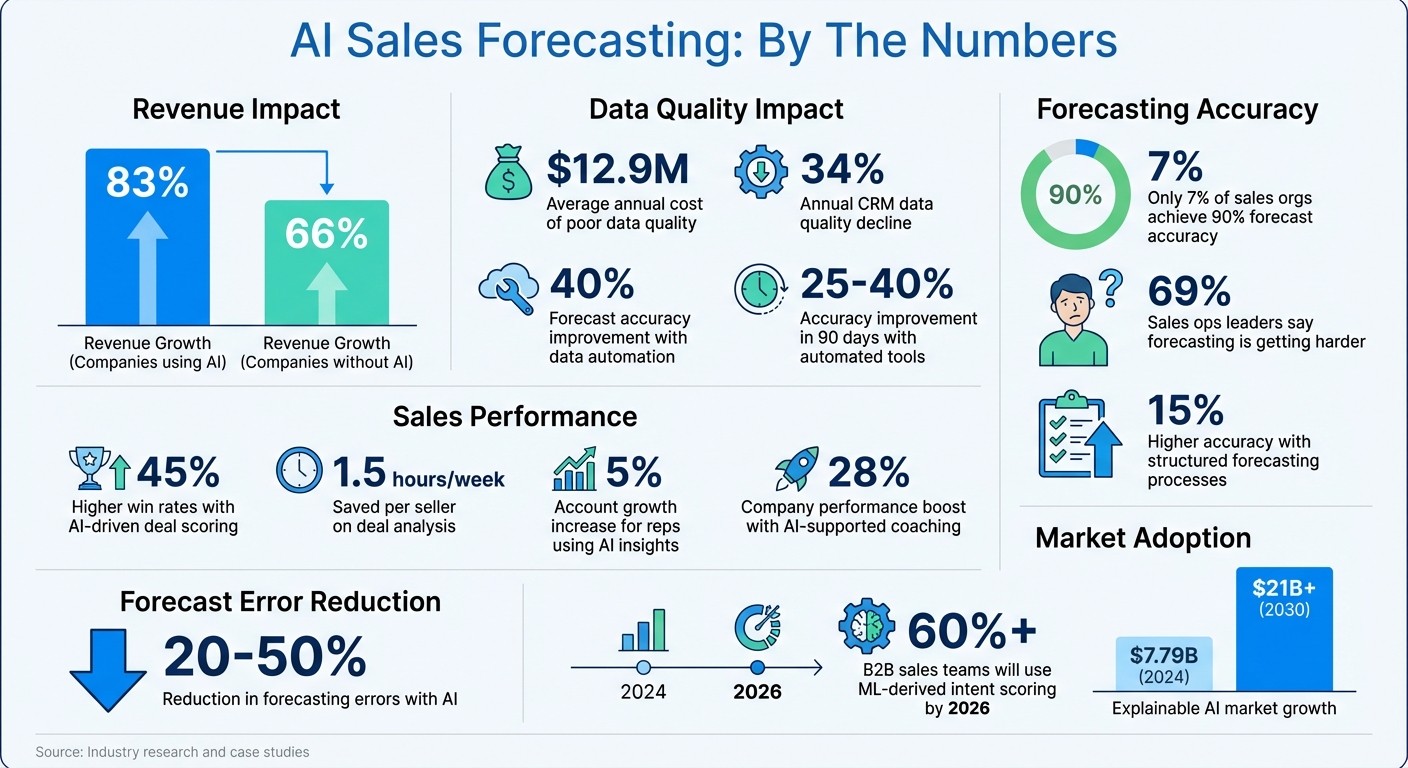
AI Sales Forecasting Impact: Key Statistics and Benefits
Enhancing Sales Forecasting Accuracy with AI and Machine Learning
Build a Strong Data Foundation
Accurate AI forecasts rely on clean, reliable data. Messy or incomplete data can have a huge financial impact - poor data quality costs businesses an average of $12.9 million annually, and underperforming AI models built on flawed data can drain up to 6% of a company’s yearly revenue [9]. CRM systems are especially vulnerable, with data quality declining by up to 34% each year due to job changes, company rebrands, and inconsistent data entry by sales teams [8].
For instance, when 20% of sales opportunities are missing key details like amounts or close dates, forecast accuracy takes an immediate hit. Atlassian faced this very issue in 2022, with their forecast accuracy stuck at 65%. By rolling out a structured data quality program that included automated monitoring and team accountability, they boosted forecast accuracy to 87% in just two quarters. This initiative also improved pipeline visibility by 24% and shortened the average sales cycle by 12 days [7].
"The truth is that in sales forecasting, bad data is worse than no data at all." – Dmytro Chervonyi, CMO, Forecastio [7]
To avoid these pitfalls, businesses need to prioritize rigorous data cleaning and standardization.
Clean and Standardize Your Data
The first step is to set clear formatting rules for every field used in your forecasts. For example, standardize industry categories, enforce consistent formats for geographic data (e.g., "United States" instead of abbreviations), and create uniform job title entries. Without these rules, AI models struggle to identify patterns and group similar deals.
A thorough data audit is essential. Identify missing fields and use rule-based logic - like matching email addresses or company domains - to merge duplicate records. Duplicate entries can inflate pipeline figures and distort win rates, so it’s critical to enforce mandatory fields like deal amounts, close dates, and next steps with validation rules. This ensures incomplete records don’t compromise your forecasts.
Standardize your pipeline stages by defining clear exit criteria as part of a structured B2B sales playbook. For example, terms like "Qualified" or "Commit" should mean the same thing to everyone on the team. Use AI-driven sales playbooks and automation tools to fill in missing firmographic data (like company size or revenue) and archive inactive records (e.g., opportunities with no activity for 18 months) to reduce clutter. Replace free-text fields with dropdown menus to ensure consistency when data is entered into your CRM.
One practical approach is tying the "Close Date" field to external deadlines, like a quote expiration date, to prevent arbitrary dates from being entered by sales reps [10]. Additionally, set up automated workflows to flag opportunities with no activity for over 15 days and notify managers [10]. Businesses that use automated tools to maintain data integrity have seen forecast accuracy improve by 25% to 40% in just 90 days [7][9].
While standardization is critical, centralizing your data is equally important for generating reliable AI insights.
Create a Single Source of Truth
AI forecasting works best when all your data is centralized. This means integrating information from your CRM, marketing automation tools, ad platforms, and customer success systems [12][3]. Without this integration, teams waste time reconciling conflicting data, and AI models miss out on key engagement signals.
Real-time data syncing between business systems and your forecasting platform is essential to eliminate errors from manual data entry and prevent reliance on outdated dashboards [11][2]. Align field mappings across all systems so that definitions remain consistent. For example, ensure that "Annual Recurring Revenue" is defined the same way in your CRM, finance tools, and forecasting software.
"AI can work, but if you don't have the data foundation that's set up properly… you can't just lay AI on top of crappy data." – Adam Cornwell, The Go-to-Market Podcast [9]
To maintain data quality over time, set up automated deduplication reports to run weekly, review stale deals on a monthly basis, and conduct quarterly audits of custom fields and user permissions [8]. Assign a dedicated team member - such as someone in RevOps or Sales Ops - to oversee data governance and quality metrics [8][13]. Without clear ownership, data hygiene can quickly fall by the wayside.
Use AI for Real-Time Forecasting
Traditional forecasting often relies on outdated weekly or monthly snapshots, which can miss critical developments. AI flips the script by continuously analyzing pipeline activity, updating forecasts as new data and signals emerge, and flagging risks as they happen. This allows teams to respond to potential issues before they spiral into bigger problems.
Take RUCKUS Networks, for example. In 2025, they saved $2 million annually by adopting real-time pipeline management. Their system identified risks and engagement gaps as they arose - long before the typical end-of-quarter reviews. This proactive approach helped the team address at-risk deals early, safeguarding their forecasts from last-minute surprises [3].
"Market dynamics shift faster than internal systems can respond... a forecast built last week can feel outdated by the time it reaches the leadership review." – Abhishek Shanbhag, Saxon AI [14]
The challenges are real: only 7% of sales organizations achieve 90% forecast accuracy, and 69% of sales operations leaders say forecasting is getting harder due to fragmented data and complex deals [4][15]. AI tackles these hurdles by delivering objective, evidence-based insights that enable precise, actionable forecasting.
Monitor Pipeline Activities in Real Time
Real-time monitoring replaces guesswork with hard evidence. Instead of relying on a sales rep's optimistic outlook, AI continuously pulls data from sources like CRM entries, emails, and call transcripts. It tracks key indicators such as response rates, meeting attendance, and even shifts in sentiment [1][3][15].
This approach helps spot problems early. For instance, AI can flag when a key stakeholder stops responding, when decision-makers skip meetings, or when a deal stalls in the same pipeline stage for too long. Advanced systems even apply time decay to lower the win probability of stagnant deals [2]. Some models go further, calculating two probabilities: the chance of winning a deal and the likelihood of closing it within a specific timeframe [1].
AI also monitors midweek changes like contracts moving to legal or sudden dips in stakeholder engagement [3]. It can track multi-threading - flagging deals that rely on just one relationship as high-risk [1][4]. Sentiment analysis adds another layer, evaluating meeting notes and emails to detect declining buyer interest, a common precursor to deals slipping through the cracks [14][15].
Once this real-time data is collected, adaptive models transform it into forecasts that sales teams can act on.
Apply Adaptive Forecasting Models
Static forecasting cycles - whether monthly or quarterly - struggle to keep up with today’s fast-paced sales environment. Adaptive forecasting models solve this by recalibrating predictions in real time, creating rolling forecasts that evolve with the latest pipeline signals [4][14].
Different models serve different purposes. Deep learning models like LSTM and RNN excel at identifying sequential patterns, while tree-based models such as XGBoost handle complex, non-linear relationships. Survival models predict when a deal is likely to close by analyzing how probabilities shift over time, and Monte Carlo simulations explore "what-if" scenarios to model probability ranges dynamically [1][14][16].
The best results often come from combining these approaches through ensemble methods, which balance the strengths and weaknesses of individual algorithms. These systems can quickly adjust forecasts when, for example, buying committees expand or contract reviews speed up unexpectedly [3].
Rather than offering a single forecast number, AI can provide ranges and confidence intervals, giving executives a more nuanced view of potential outcomes [1]. You can also segment forecasts by sales motion - using velocity models for SMB deals and AI-driven scoring for enterprise accounts [2]. This creates forecasts that adapt to changing realities instead of forcing sales teams to conform to outdated cycles.
Apply AI Pattern Recognition and Deal Scoring
AI doesn’t just monitor deals - it learns from them. By analyzing large volumes of historical data, machine learning models can spot the traits of successful deals, uncovering patterns that might escape manual analysis [17]. These patterns shed light on how factors like buyer engagement, deal speed, and market conditions combine to determine whether a deal closes or stalls.
The key difference between traditional forecasting and AI-powered scoring lies in activity versus progress. Traditional methods often focus on counting emails and calls - essentially measuring effort. In contrast, AI prioritizes the quality of buyer engagement, the involvement of key stakeholders, and shifts in sentiment [17]. As Rob Stanger from Fullcast explains: "Reality of it is a lot of times that's really just more of an activity score... true deal scoring measures progress toward a close" [17]. AI builds on these insights by analyzing historical data to identify consistent patterns that can predict outcomes more accurately.
Analyze Historical Data for Patterns
Machine learning models thrive on clean, well-organized data. To get meaningful results, it’s essential to standardize key CRM fields like close dates, deal amounts, and sales stages before training the model. Inconsistent data can lead to unreliable predictions [3,6]. For example, reviewing the past quarter’s data to ensure consistent sales stage definitions can help avoid the classic "garbage in, garbage out" problem. These standardized insights lay the foundation for smarter, data-driven forecasting.
AI models also uncover complex patterns that manual methods might miss. For instance, they can analyze factors like rep experience, deal size, and activity levels to reveal non-linear relationships [1]. A great example: AI might show that deals involving multi-threaded engagement - where multiple senior stakeholders are involved - are 6.3× more likely to close than those with just one point of contact [17]. Similarly, deals stuck in the same stage for over 60 days might benefit from time decay coefficients to automatically lower their probability of closing [2]. These insights often come from integrating CRM data with tools like email systems, calendars, and conversation intelligence platforms, capturing real buyer behavior instead of relying solely on rep-reported activity [4,16].
Score Deals Dynamically
Static probabilities - like assigning "Negotiation = 75%" - can often mislead. AI-driven deal scoring, however, adapts in real time as conditions change. For example, if stakeholder engagement drops or communication sentiment turns negative, the score adjusts immediately [4,18].
Advanced systems even calculate dual probabilities: the likelihood of winning and the chance of closing within a specific timeframe, such as a month [1]. These systems analyze variables like deal speed, frequency of stakeholder interactions, and historical success rates for specific industries [4,6,18]. For instance, if a rep forecasts a deal at 80% but AI scores it at 45% based on historical trends, that gap can spark a productive coaching conversation during pipeline reviews [3].
"By 2026, over 60% of B2B sales teams will use ML-derived intent scoring as a core component of pipeline qualification, replacing gut-instinct assessments with evidence-based deal evaluation." – Gartner [15]
The benefits are clear. Sales teams using AI-driven deal scoring report 45% higher win rates and individual sellers save an average of 1.5 hours per week on deal analysis [17]. One of AI’s biggest strengths is its explainability - it clearly highlights factors like stalled communication, missing stakeholders, or negative sentiment that impact a score [4,5]. These dynamic scores integrate seamlessly into sales workflows, helping managers refine strategies and coach their teams using real-time, contextual guidance.
Build Trust Through Transparent AI Forecasts
Trust in AI grows when its logic is clear and accessible. AI forecasting works best when your team understands and believes in it. A major obstacle to this trust is the "black box" problem, where AI delivers predictions without showing how it arrived at them. This lack of transparency can hinder coaching and decision-making. According to a 2024 McKinsey study, 47% of organizations reported negative outcomes from AI, often tied to unclear processes behind the technology [20]. The solution lies in explainable AI (XAI), which makes the reasoning behind predictions easy to understand.
The market is already moving in this direction. The global XAI market is expected to grow from $7.79 billion in 2024 to over $21 billion by 2030. Companies that train their teams to interpret AI insights see adoption rates increase by 30% [19]. When teams grasp why AI adjusts forecasts, they stop resisting the technology and start using it to close more deals. This transparency ensures AI insights align with actionable sales strategies.
Provide Clear Forecast Explanations
AI tools should do more than just predict - they should explain their predictions. Instead of vague probabilities like "Deal probability: 68%", advanced systems now offer feature attribution. This means they break down which factors - such as company size, prior engagement, or decision-making authority - most influenced the prediction.
Take Rogers Communications as an example. They improved forecasting accuracy by offering a 360° view of sales activities along with clear, data-backed explanations for predictions [19].
"If we can leapfrog by augmenting our core sales pipeline with advanced AI-guided selling methods, Rogers has an opportunity to secure a competitive advantage."
– Joe Deklic, VP Sales Operations, Rogers Communications [19]
Clear explanations can also include counterfactual insights, which show how different actions could change outcomes. For instance, "If the budget increased by 20%, the close probability would rise to 92%" [19]. Similarly, when HubSpot and Gong launched the Gong Revenue Intelligence Platform globally in 2019, sales managers gained insights into effective messaging strategies. This reduced their weekly forecast preparation time from one hour to just 20 minutes [19].
Give Managers Validation Tools
Transparency doesn’t stop at explanations - managers also need tools to validate AI insights. One effective method is backtesting, which involves testing AI models against historical data to ensure accuracy before full deployment [20].
Prestige Financial Services provides a great example. In 2018, they adopted a fully explainable machine learning model for subprime auto lending. Chief Credit Officer Steven Warnick used XAI to highlight the factors behind every credit decision. This led to a doubling of lending volume, a 36% rise in new applicants, and a 14% higher approval rate - all without increasing risk [19].
"We knew ML models were better at predicting risk, but had concerns because we couldn't explain them. ZestFinance helped us build better predictability models and provided key factors that led to credit decisions."
– Steven Warnick, Chief Credit Officer, Prestige Financial Services [19]
Managers also benefit from tools that allow them to dig into individual deals and engagement data - like meeting frequency, email responses, and stakeholder involvement. These insights help refine AI forecasts and uncover discrepancies between sales rep estimates and AI predictions. Such gaps can highlight coaching opportunities to address blind spots or hidden risks [15]. Additionally, systems with human-in-the-loop overrides allow managers to integrate qualitative insights into forecasts, while keeping an annotated audit trail for accountability [2].
Integrate AI Insights into Sales Operations
AI forecasts only become truly impactful when they're tied to immediate, targeted actions that bridge the gap between prediction and execution. The real game-changer is linking these predictions to specific, actionable strategies.
Connect AI Forecasts to Specific Actions
AI forecasting systems excel when they use predefined thresholds to trigger automatic interventions. For instance, if a late-stage deal shows declining engagement or lacks a clear economic buyer, the system can alert managers to step in or shift technical pre-sales resources where they're needed most [3].
These AI-powered deal health scores help teams focus on high-potential opportunities and address territory imbalances before they become critical issues [3]. Siemens demonstrated this by replacing subjective sales rep evaluations with AI-driven scoring based on engagement data, leading to greater transparency [3].
Additionally, "what-if" analyses can stress-test revenue projections. For example, modeling the effects of a 10% drop in win rates or delayed deal closures helps businesses create stronger contingency plans. Companies using AI-driven forecasting have reported error reductions of 20% to 50% [2][21].
These automated systems not only streamline decision-making but also create opportunities for more effective coaching, ensuring insights turn into measurable actions.
Coach Teams with AI-Driven Insights
AI isn't just about immediate actions - it also transforms sales coaching by turning routine check-ins into meaningful, strategic conversations. Instead of just reviewing updates, managers can use AI-flagged risks to address deeper performance issues. For example, if data shows that similar deals usually close at 45%, a manager can discuss specific steps to push that rate closer to 80% [3][23].
Conversation intelligence adds another layer by identifying coaching priorities. It pinpoints which discussion topics lead to higher win rates. For instance, if top-performing reps excel at handling pricing objections, AI can identify those who struggle in this area and prompt targeted coaching. Structured coaching programs, supported by AI, have been shown to boost company performance by 28% [22].
AI also helps eliminate bias by comparing sales rep optimism to actual engagement data and historical trends. If a rep's positive outlook doesn't match declining email responses or missed stakeholder interactions, it highlights an immediate coaching opportunity. Reps who use AI to uncover buyer insights have seen account growth rise by 5% [3].
Tools like Coach Pilot integrate AI-driven coaching directly into daily workflows. By offering guidance based on real-time engagement and performance data, these platforms help teams execute strategies more effectively.
Coaching Trigger | AI Signal | Recommended Action |
|---|---|---|
High Slippage | Close date moved 3+ times | Coach on qualification and mutual action plans [22] |
Low Multi-threading | Only one contact engaged | Coach on stakeholder mapping and executive outreach [22][24] |
Negative Sentiment | AI detects friction in call transcripts | Role-play objection handling or involve an executive sponsor [3][24] |
Improve AI Forecasting Models Over Time
AI forecasting models need regular updates to stay accurate as market conditions, sales behaviors, and customer expectations shift. Without ongoing adjustments, even the most advanced models can lose their edge, leading to unreliable predictions.
"AI models are not set-and-forget tools; they require regular monitoring to maintain forecast accuracy." - Alex Zlotko, CEO, Forecastio [16]
As mentioned earlier, even small errors in predictions can have a big impact. The key to solving this issue isn’t just better data - it’s smarter model maintenance.
Set Up Feedback Loops
Improving AI models starts with comparing predictions to actual outcomes. Every closed-won or closed-lost deal offers a chance to learn. By analyzing where predictions missed the mark, you can pinpoint weaknesses in the model and make targeted adjustments [4][6].
Human input plays a crucial role here. Sales leaders bring insights that AI can’t detect - like strategic pivots, unique customer risks, or emerging trends that aren’t yet reflected in the data. When managers validate or override AI predictions based on their experience, it builds trust in the system [1][20].
Before rolling out updates, always run backtesting against past data. This type of "what-if" analysis demonstrates whether the updates would have improved accuracy, helping to reassure stakeholders. Since 44.4% of people see human skepticism as a bigger obstacle than technical challenges [18], proving the model’s effectiveness is essential.
To monitor how well your model is performing, track specific metrics. MAPE (Mean Absolute Percentage Error) is useful for evaluating accuracy at the individual rep level, while WAPE (Weighted Absolute Percentage Error) works better for team-wide forecasts since it accounts for deal size [4]. Keep an eye on bias as well, to see if your team consistently over-forecasts ("hero commits") or under-forecasts ("sandbagging") [4].
Using these insights, you can retrain your models regularly to ensure they stay aligned with current sales realities.
Retrain Models Regularly
Beyond feedback loops, scheduled retraining is vital. While many AI tools update continuously as new data flows in [1][5], formal retraining should happen monthly or quarterly [2][5]. This helps the model adapt to changes in sales processes, pricing, or market conditions that historical data alone might miss [1].
"Over time, the models behind your forecasting tools need to be retrained or fine-tuned to stay relevant and accurate." - Forecastio [1]
Retraining should also be triggered by major changes, such as shifts in qualification criteria, target customer segments, pricing, or pipeline structure [1][16]. If you notice performance drift - a steady decline in MAPE or WAPE scores over several months - it’s a sign your model needs immediate attention [16].
Set up a clear review schedule. Weekly pipeline scrubs focus on cleaning up data and verifying close dates [25]. Monthly optimizations compare your team’s performance against the forecast and adjust strategies as needed [2][5]. Quarterly retrospectives take a deeper dive into accuracy metrics and help decide if full retraining is necessary [2]. Companies with structured forecasting processes see 15% higher forecast accuracy compared to those with less formal approaches [26].
Finally, designate power users from your sales team to act as liaisons between reps and the AI system. These individuals can provide feedback on usability, flag mismatches between predictions and reality, and encourage team adoption [5]. With 83% of sales teams using AI reporting revenue growth by 2025, compared to 66% of those not using AI [5], getting your team invested in the technology is well worth the effort.
Conclusion
Integrating AI into sales forecasting shifts your process from guesswork to actionable, data-driven strategies. While perfection isn’t the goal, building a consistent and explainable system ensures that data translates into smarter decisions. Key steps like maintaining clean data, monitoring in real time, recognizing patterns to reduce bias, and providing transparent insights create a strong foundation for trust and accountability within your team.
Replacing subjective instincts with measurable engagement signals - such as email response rates, meeting frequency, and stakeholder involvement - helps eliminate the inflated forecasts that often derail organizations. Evidence-based approaches undeniably outperform gut-driven predictions [5][6].
"The shift from opinion to evidence is the entire value proposition." - Spotlight.ai [15]
That said, technology alone won’t solve everything. The most successful teams pair AI-driven insights with human expertise, relying on tools that explain why a forecast changes rather than just presenting unexplained numbers. This balance of technology and human judgment builds trust and fosters adoption across the team.
For those ready to take these practices to the next level, platforms like Coach Pilot provide a comprehensive solution. By embedding AI-driven coaching into your workflows, Coach Pilot bridges the gap between strategy and execution. It combines custom sales playbooks, immersive training, and real-time AI insights to boost win rates, shorten sales cycles, and enhance forecast accuracy. The result? Predictions that don’t just sit on a dashboard but actively guide your team toward success every day.
FAQs
What data do I need before using AI for sales forecasting?
To make the most of AI in sales forecasting, you’ll need to start with clean, high-quality historical data. Add to that pipeline signals, deal activity, and external market indicators. Together, these data sources provide the foundation for accurate predictions while streamlining the forecasting process.
How can I tell if my AI forecast is trustworthy?
To make sure your AI forecast can be relied upon, start by confirming that it’s built on clean, well-organized data. The metrics it uses should be clear and backed by evidence-based assumptions. Keep an eye on its performance regularly - compare predictions to actual outcomes to see how well they align. Over time, this consistent tracking can strengthen trust in its accuracy.
How often should we retrain an AI forecasting model?
AI forecasting models need regular retraining - typically on a monthly or quarterly basis - to ensure they stay accurate while balancing computational costs. However, for sales forecasting, experts often suggest retraining every two weeks, especially if the data shows high variability or if the business demands more frequent updates. The timing ultimately depends on the specific needs of the organization and the nature of the data being analyzed.
Related Blog Posts

Remove the guesswork from winning more deals.