B2B Sales
How AI Improves Sales Playbook Onboarding
Mar 19, 2026
AI personalizes sales playbooks to shorten ramp time, provide real-time call coaching, automate feedback, and boost quota attainment.

Onboarding new sales reps is often expensive and time-consuming. It takes an average of 5.3 months for reps to become productive, and ineffective onboarding can cost companies up to $115,000 per lost hire. Worse, traditional methods - like static PDFs and slide decks - fail to engage new hires, leaving them unprepared and prone to forgetting 70% of what they learn within a week.
AI-driven sales playbooks solve these problems by offering dynamic, personalized training that adjusts to each rep's needs. Companies using AI tools report a 28% faster ramp-up time, improved quota attainment, and reduced managerial workloads. AI provides real-time coaching during calls, tracks progress automatically, and delivers targeted feedback to help reps improve faster.
Key benefits include:
Faster ramp times: New hires reach productivity 28% sooner.
Cost savings: Early intervention reduces turnover and training expenses.
Improved consistency: AI ensures all reps follow proven sales processes.
Manager efficiency: Saves 43% of weekly onboarding hours.
AI onboarding doesn’t just train reps - it prepares them to perform effectively from day one, improving revenue predictability and reducing costs.
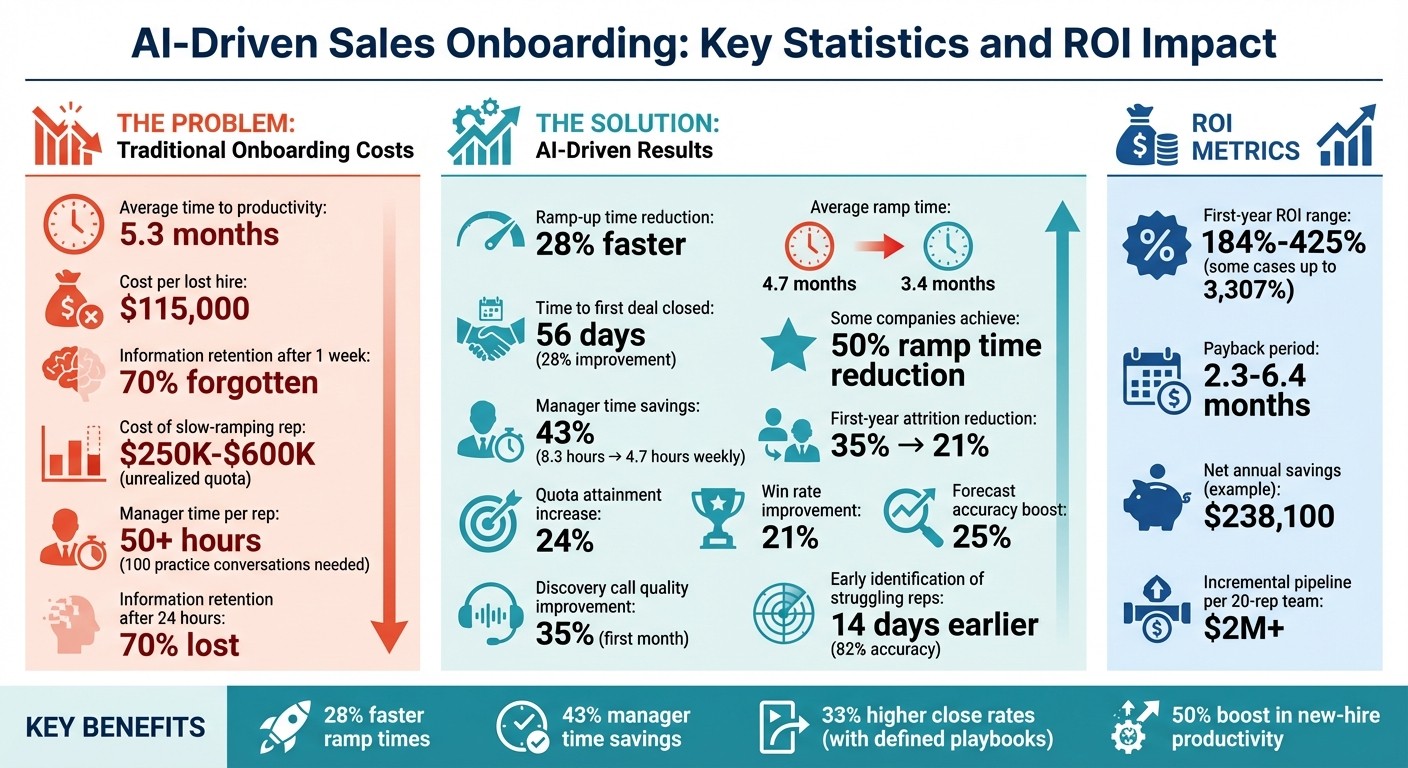
AI-Driven Sales Onboarding: Key Statistics and ROI Impact
Onboarding Sales Reps Faster With AI
As AI continues to redefine the future of sales enablement, teams can automate the most tedious parts of the onboarding process.
Common Problems in Sales Playbook Onboarding
Traditional onboarding methods often introduce hurdles that keep new sales reps from reaching their potential. These challenges end up costing companies hundreds of thousands of dollars per rep and show up in a few key areas.
Inconsistent Training and Knowledge Gaps
One of the biggest issues is the overwhelming amount of information thrown at new hires. Imagine being handed over 200 slide decks, product manuals, and endless documentation - all in your first week. This "Firehose Problem" leaves reps retaining as little as 15% of the material simply because it’s too much to process [4].
"Most sales onboarding programs are designed around what the COMPANY wants reps to know, not around what REPS need to do their job." - Jennifer Park, Director of Growth, Prospectory [4]
Another problem? Knowledge fades quickly. For instance, if a rep learns about pricing on day three but doesn’t get to use that information until week six, much of it will likely be forgotten. Shadowing senior reps doesn’t always help either. New hires might pick up on surface-level behaviors - like tone and pacing - but miss the deeper strategies behind successful decisions [4].
Long Ramp-Up Times
It takes time for new sales reps to hit their stride. Account Executives (AEs) typically need 5.3 months to become fully productive, and Sales Development Representatives (SDRs) require about 3.6 months [6]. This delay can be incredibly costly. For example, a slow-ramping AE can result in up to $635,000 in unrealized quota, compensation, and lost coaching time [4].
"A single slow‑ramping rep costs somewhere between $250K and $600K depending on your business. Multiply that by every rep you hire this year. Now you see why this matters more than almost any other sales operations problem." - Jennifer Park, Director of Growth, Prospectory [4]
Early prospect calls often turn into training sessions rather than opportunities to build a strong pipeline. This not only leads to missed revenue but also creates inconsistent messaging, further delaying productivity [7].
Heavy Resource Demands on Managers
For a new rep to get up to speed, they typically need about 100 practice conversations. If managers handle these sessions manually, it can take over 50 hours of one-on-one time per rep. That’s time managers could be spending on strategic priorities, pipeline oversight, or coaching the broader team [3][7].
The feedback in these sessions isn’t always consistent either. One manager might focus on objection handling, while another emphasizes discovery techniques. This mixed messaging can leave reps confused about what success actually looks like [7].
Missing Real-Time Feedback
Traditional role-plays with managers often create performance anxiety. Instead of focusing on learning, reps may feel pressured to impress, which discourages them from trying out new approaches or tackling difficult scenarios [7]. On top of that, feedback is usually given during scheduled sessions, sometimes days or weeks after the issue occurs, making it less effective for immediate improvement.
The forgetting curve adds another layer of difficulty. Without reinforcement, reps can lose up to 70% of new information within 24 hours [7]. This means that techniques learned just days earlier may not be readily available when they’re needed most.
How AI-Driven Playbooks Address Onboarding Problems
AI-driven playbooks are changing the game when it comes to onboarding, offering a more flexible and responsive approach to training. Instead of sticking to a rigid timeline, these tools adapt to how each sales rep learns and performs, ensuring a more tailored and effective experience.
Personalized Learning Paths for Each Rep
Using AI, companies can create a detailed map of each rep's skill gaps by analyzing role-plays and live calls. This helps pinpoint areas like discovery, objection handling, or closing that need attention [2]. Instead of relying on the traditional 30-60-90 day plans, AI enables a mastery-based system that allows reps to progress only after demonstrating real competence [3]. As Optif.ai highlights:
"Traditional 'one-size-fits-all' 30-60-90 day plans fail to account for individual learning speeds, often leaving fast learners bored and slow learners overwhelmed." - Optif.ai [3]
This personalized approach has been shown to cut ramp-up time by 28%, reducing it from 4.7 months to 3.4 months on average, with some companies reporting reductions of up to 50% [3] [7]. Training sessions and quizzes adjust dynamically based on how reps perform, focusing more on areas where improvement is needed [4]. This sets the stage for the real-time support covered in the next section.
Real-Time Guidance During Sales Conversations
AI tools also shine during live customer calls, offering immediate support when it matters most. For example, if a prospect raises an objection, AI can instantly provide the appropriate battlecard, complete with relevant data or product details, helping reps respond confidently and effectively. Live prompts and speaker notes ensure reps stick to the sales process and ask the right qualifying questions.
"We have to enable the salespeople to have the information they need at the moment they need it. When we go to digital types of playbooks, we can really save a lot of time." - Alice Heiman, CRO and Co-founder, Alice Heiman LLC [8]
Teams that use clearly defined playbooks are 33% more likely to close deals at a higher rate [8], and reps trained with AI tools see a 24% boost in quota attainment [9]. Beyond just in-call support, AI continues to refine rep performance by analyzing interactions and providing targeted feedback.
Automated Progress Tracking and Feedback
AI doesn’t just assist during calls - it also tracks and evaluates every sales interaction to identify skill gaps across the team [2]. By leveraging advanced language models, AI can assess whether a rep has truly qualified a prospect or simply mentioned a keyword, aligning closely with sales methodologies like MEDDPICC or BANT [2].
"AI-native platforms shift the paradigm from documentation (recording calls) to execution (closing deals)." - Oliv.ai [2]
This creates a continuous coaching loop. AI identifies specific weaknesses, assigns micro-tasks - like reviewing a battlecard - and allows reps to practice with a voice bot before tackling live calls [2]. Managers save over five hours per week that would typically be spent on manual reviews, easing the burden outlined earlier. Strong onboarding programs have been linked to a 50% boost in new-hire productivity and a 21% increase in win rates [2].
Platforms like Coach Pilot integrate this AI-driven coaching into daily sales workflows, crafting custom playbooks and providing managers with automated progress reports. This ensures reps get the support they need without overloading managers with extra administrative tasks.
Measurable Results of AI-Enhanced Onboarding
AI-driven playbooks are proving their worth by delivering measurable improvements in three key areas: speeding up new hire performance, improving revenue predictability, and reducing the administrative burden on managers.
Faster Time-to-Quota Achievement
AI-powered onboarding cuts ramp-up time by an impressive 28%, reducing the average ramp period from 4.7 months to just 3.4 months. New reps are also closing their first deals in just 56 days, representing the same 28% improvement [3]. In some cases, companies report even greater reductions, with ramp times slashed by as much as 50% compared to traditional onboarding methods [11][13].
"Average sales rep ramp is 5.3 months; AI-native coaching compresses this to under 3 months, unlocking $2M+ incremental pipeline per 20-rep team." – Oliv.ai [12]
For example, in Q1 2025, a B2B SaaS company with 80 sales reps introduced AI onboarding for its 12 new hires. This initiative reduced ramp-up time from 5.2 months to 3.7 months and lowered first-year attrition from 35% to 21%. The result? $238,100 in net annual savings and an incredible first-year ROI of 3,307% [3]. Across the board, companies using AI-driven coaching report ramp-up times that are 35% faster than those achieved through manual processes [12].
These time savings directly enhance sales consistency and make forecasting more reliable.
Better Sales Consistency and Forecast Accuracy
When every sales rep operates within a standardized framework - validated by AI analyzing 100% of their interactions - performance becomes far more predictable. AI-enhanced onboarding has been shown to boost forecast accuracy by 25% and win rates by 35% [2]. Structured onboarding plans make reps 79% more likely to hit their targets, while AI-driven feedback improves the quality of discovery calls by 35% within just the first month [5]. By tracking key elements like pain point identification, buyer engagement, and success metrics, AI can spot gaps in real time and alert managers [14][2]. Companies that adopt AI in their onboarding processes see a 21% increase in quota attainment during the first year compared to those using manual methods [1].
This consistency not only drives better results but also frees up managers to focus on more strategic tasks.
Cost Efficiency and Managerial Time Savings
AI automation significantly reduces the time managers spend on repetitive training tasks. Weekly onboarding workloads for managers drop from 8.3 hours to 4.7 hours - a 43% reduction [3]. Instead of manually reviewing full call recordings, managers can now rely on AI-generated skill-gap analyses, which highlight exactly where each rep needs improvement [2].
"Before AI, I'd spend 8 hours every week doing 1-on-1s with new reps, and I'd still miss warning signs. Three reps quit before I even knew they were struggling. Now the AI tells me exactly who needs help and why." – VP of Sales, SaaS Company [3]
AI tools also help identify struggling reps 14 days earlier with 82% accuracy [3], giving managers time to intervene before turnover becomes an issue. Considering that the average cost of losing a single sales rep is $115,000 [3], these early warnings are financially vital. Companies report first-year ROI on AI onboarding tools ranging from 184% to 425%, with payback periods as short as 2.3 to 6.4 months [3]. Platforms like Coach Pilot streamline these benefits by embedding automated progress reporting into daily workflows, allowing managers to dedicate more time to high-impact coaching rather than administrative chores.
Conclusion
Outdated onboarding methods often lead to costly delays, inconsistent training, extended ramp times, and limited feedback loops. However, AI-driven playbooks are changing the game. By introducing personalized learning, real-time guidance, and scalable feedback, these systems shift onboarding from static documents to dynamic tools that are actively used, not forgotten.
The results speak for themselves: ramp-up times decrease, first-year attrition drops by 39%, managers save 43% of their weekly onboarding hours, and new reps close their first deals 28% faster[3].
"The modern sales playbook has shifted from a document to a dynamic system - one that learns, adapts, and guides sellers in real time with the power of AI." – Mary Flaherty, Vice President of Research and Thought Leadership, RAIN Group [10]
One of the biggest challenges in sales today is bridging the gap between strategy and execution. Coach Pilot’s AI-driven platform addresses this by embedding personalized guidance into daily workflows. This ensures every rep operates within a proven framework while receiving tailored support right when they need it most. Instead of relying solely on initial training, the platform provides just-in-time coaching that aligns with real-world scenarios.
The stakes are high - manual onboarding delays can cost up to $600,000 per slow-ramping rep in unrealized quota[4]. That’s why adopting AI-enhanced onboarding isn’t just a smart move; it’s an economic necessity. The message is clear: embrace AI-driven playbooks now to unlock faster results and turn onboarding into a strategic advantage.
FAQs
What data does AI use to personalize onboarding for each rep?
AI personalizes the onboarding process by examining data such as individual performance metrics, predictive attrition models, and insights about reps who may be at risk. This allows for tailored training and coaching strategies that address the specific needs of each sales representative.
How does real-time AI coaching work during live sales calls?
Real-time AI coaching takes live sales conversations to the next level by offering immediate, actionable insights. It works by suggesting relevant questions, spotting missed opportunities, and keeping an eye on buyer sentiment. This allows sales reps to tweak their approach in the moment, leading to stronger engagement and better results from their calls.
How can I measure ROI from AI playbook onboarding?
To evaluate the ROI of AI coaching, connect its benefits to measurable outcomes such as shortened ramp-up times, reduced attrition rates, and improved performance. Research highlights the potential impact:
28% reduction in ramp-up time, helping employees become productive faster.
39% decrease in attrition, leading to lower hiring and training costs.
ROI ranging from 184% to 425%, showcasing substantial financial returns.
When calculating ROI, consider these improvements alongside factors like payback periods and percentage returns. This approach provides a clearer picture of the value AI coaching brings to your organization.
Related Blog Posts

Remove the guesswork from winning more deals.