B2B Sales
Top AI Tools for Sales Pipeline Forecasting
Apr 8, 2026
AI-driven CRM and engagement analysis for dynamic, accurate pipeline forecasts that flag at-risk deals and improve predictability.

AI is transforming sales pipeline forecasting by analyzing CRM data, buyer behavior, and engagement trends to deliver more accurate revenue predictions. Traditional methods, often relying on sales reps' intuition, struggle with accuracy and scalability. In contrast, AI tools achieve up to 95% accuracy by leveraging real-time updates and predictive analytics. They identify risks, such as stalled deals or declining buyer interest, and provide actionable insights to improve decision-making.
Key takeaways:
Only 7% of sales teams achieve forecast accuracy above 90%.
AI improves win rates by 30% and forecast accuracy by 15-25% compared to single-data models.
By 2026, over 60% of B2B sales teams will use AI-driven intent scoring.
Top AI Features:
Pattern recognition: Tracks deal velocity, engagement, and stakeholder involvement.
Predictive models: Time series, regression, tree-based, and neural networks handle various sales scenarios.
CRM integration: Bi-directional sync ensures clean, consistent data.
Real-time updates: Dynamic forecasts adjust as buyer behavior changes.
Example Tool: Coach Pilot combines AI-driven forecasting with coaching to improve deal qualification and execution, offering tailored playbooks and real-time insights.
To implement AI forecasting effectively:
Clean and standardize CRM data.
Pilot the tool with a small team before full rollout.
Align forecasts with real-world outcomes over 2-3 quarters for measurable improvements.
AI sales forecasting eliminates guesswork, enabling data-driven decisions and more predictable revenue growth.
Next-Gen Sales Forecasting: AI-Powered Pipeline Management | The Data Apps Conference
How AI Sales Forecasting Works
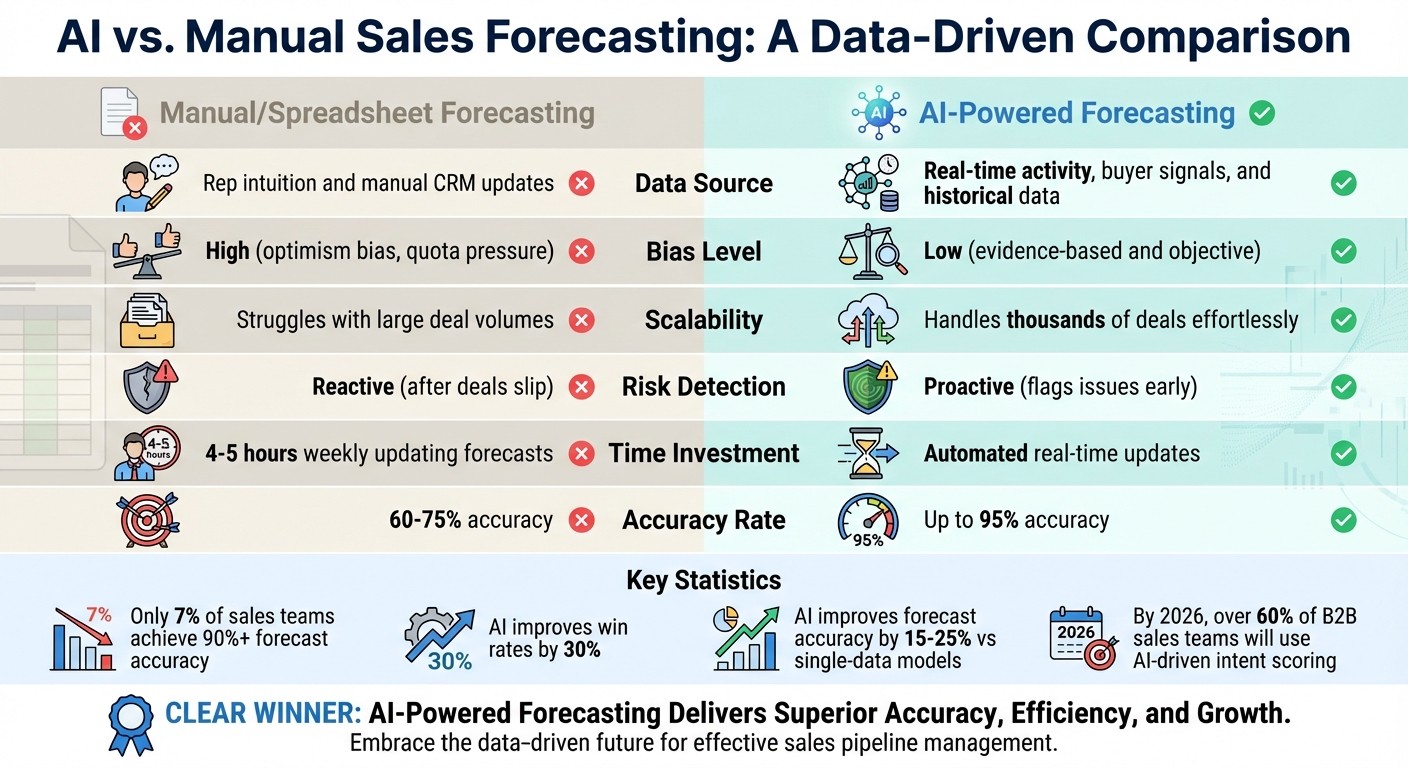
AI vs Manual Sales Forecasting: Accuracy, Efficiency, and Risk Detection Comparison
AI sales forecasting brings together data from CRM systems, activity logs, and billing records to create a unified view of the sales pipeline [8][9]. Instead of relying on fragmented snapshots, this approach offers a comprehensive look at your pipeline, effectively turning your sales process into a living AI.
The magic lies in pattern recognition. Machine learning models sift through thousands of past deals to spot patterns and signals - like deal velocity, the number of stakeholders involved, or rep activity - that are linked to successful outcomes [6]. AI also tracks buyer engagement in real time, analyzing factors such as email response tone, document views, and the participation of new stakeholders. This evidence-based approach replaces the guesswork often associated with deal health assessments by aligning with buyer needs through a structured B2B sales playbook [9].
Each deal is assigned two key probabilities: its likelihood of closing and the expected close month [6]. AI can also flag potential problems that might go unnoticed, like a deal stalling in a particular stage longer than usual or a sudden dip in buyer engagement [10]. These features highlight the transformative potential of AI in sales forecasting.
What AI Forecasting Models Can Do
AI models pull data from various sources - CRM systems, emails, calendars, and conversation tools - into a single, cohesive view of pipeline health [8][9]. This eliminates the need for sales reps to spend hours manually updating spreadsheets every week.
Where AI truly excels is in predictive analytics. Different models specialize in various tasks:
Time series models like ARIMA and Prophet detect seasonal patterns and trends in high-volume transactional sales.
Regression models predict individual deal outcomes based on factors such as deal size and rep activity.
Tree-based models like Random Forest and XGBoost manage complex, non-linear relationships between variables.
Neural networks like LSTM shine in scenarios with long sales cycles, large teams, and high variability [6].
Another game-changer is real-time updates. Instead of weekly snapshots, AI adjusts forecasts dynamically as buyer engagement changes - whether it’s an increase in email activity or a key stakeholder going silent [5]. This constant stream of updated insights gives sales leaders the tools to make better decisions about resource allocation and deal prioritization. Compared to traditional manual methods, this is a major leap forward.
AI vs. Manual Forecasting Methods
AI replaces subjective, intuition-driven forecasts with objective, data-backed predictions. Traditional methods often rely on sales reps’ "gut feelings" and manual CRM updates, which can suffer from optimism bias and pressure to meet quotas. In contrast, AI uses real-time buyer behavior and engagement data to calculate deal probabilities [7].
Feature | Manual/Spreadsheet Forecasting | AI-Powered Forecasting |
|---|---|---|
Data Source | Rep intuition and manual CRM updates | Real-time activity, buyer signals, and historical data |
Bias | High (optimism bias, quota pressure) | Low (evidence-based and objective) |
Scalability | Struggles with large deal volumes | Handles thousands of deals effortlessly |
Risk Detection | Reactive (after deals slip) | Proactive (flags issues early) |
Manual forecasting also faces scalability issues. Sales teams often spend 4 to 5 hours weekly updating manual forecasts [4]. As the number of deals grows, spreadsheets become unmanageable. AI, however, can process large datasets and complex pipelines across regions and products without constant human effort [7][11]. The accuracy gap is striking: manual methods typically achieve 60% to 75% accuracy, while AI-driven forecasts can reach up to 95% accuracy on some platforms [13].
What to Look for in AI Sales Forecasting Tools
AI sales forecasting tools can vary widely in their capabilities. To make the most of these tools, you need more than just accurate predictions. The best tools provide detailed pipeline insights and integrate seamlessly into your team's workflows. The difference between a tool that drives results and one that sits unused often boils down to a few key features.
Prediction Accuracy and Pipeline Visibility
Leading AI forecasting tools focus on buyer actions - like emails, calls, and stakeholder engagement - rather than relying on subjective input from sales reps [1][9]. Generative AI takes it a step further by analyzing the context and sentiment of conversations instead of simply counting interactions [14]. For example, a deal with 20 emails might seem promising, but if those emails show declining interest or fail to involve key decision-makers, the AI should flag it as a risk.
By 2026, more than 60% of B2B sales teams are expected to use machine learning-driven intent scoring as a core part of their pipeline qualification process [1].
The best tools go beyond predictions to identify risks like ghosting, missing contacts, or deals that have stalled - flagging these issues before they impact quarterly results [12][9]. They also deliver insights directly to your team’s workspace, like Slack or email, eliminating the need for managers to sift through dashboards manually [14].
In addition to accuracy, seamless data flow is crucial for turning forecasts into actionable strategies.
CRM Integration and Team Collaboration
Since your CRM serves as the central hub for opportunity data, smooth integration with forecasting tools is non-negotiable [9]. Interestingly, 63% of Salesforce Einstein forecasting implementations fail due to incomplete or messy CRM data [14].
To avoid this, prioritize tools with bi-directional sync. This allows the AI to not only pull data from your CRM but also update it with predictions, risk scores, and recommended actions - all within the same fields your team already uses [9][15]. Without this feature, your team may waste time switching between platforms and manually transferring data, defeating the purpose of automation.
Here’s a quick look at key features to evaluate:
Feature to Evaluate | Why It Matters | What to Look For |
|---|---|---|
Sync Direction | Keeps data consistent across platforms | Bi-directional (Read/Write) capability |
Data Enrichment | Addresses incomplete or messy data | Automated field completion and contact cleaning |
Activity Logging | Ensures forecasts are based on real actions | Automatic capture of emails, calls, and meetings |
Roll-up Logic | Saves time for managers | Multi-level hierarchy support (Rep → Manager → VP) |
The best tools automatically log emails, calendar events, and call transcripts into your CRM. This ensures that forecasts are grounded in real buyer activity instead of subjective or outdated data from sales reps [9][2]. By automating data capture, these tools address the common "garbage-in, garbage-out" issue that can derail AI implementations [1][14].
Accurate and consistent data lays the groundwork for advanced analytics that enable smarter decision-making.
Analytics and Reporting Tools
Analytics are what turn raw data into actionable insights. Modern AI forecasting tools stand out by moving from reactive dashboards to proactive recommendations.
Instead of just showing you what happened, top platforms guide you on what to do next. For example, scenario modeling lets you test assumptions about win rates and deal velocity, helping with strategic decisions like budgeting and workforce planning [3]. Tools with waterfall reporting can also visualize pipeline movement and slippage, making it easier for executives to review week-over-week changes [14].
When assessing platforms, ask how insights are delivered. The most advanced tools use "agentic" AI to push insights directly to users - sometimes as little as 30 minutes before a call - so they don’t have to dig through complex dashboards [14].
Top AI Tools for Sales Pipeline Forecasting
Coach Pilot takes a fresh approach to AI sales forecasting by tackling one of the biggest challenges: inconsistent deal qualification and execution. Below, we’ll explore how Coach Pilot uses AI-powered training and tailored playbooks to reshape sales forecasting.
Coach Pilot: AI-Driven Sales Enablement and Forecasting
Coach Pilot doesn’t just analyze sales data - it ensures forecasts are more reliable by focusing on consistent deal qualification and execution. The platform combines custom sales playbooks, immersive training, and AI-driven coaching to guide your team through every step, from initial contact to closing the deal.
One of its standout features is AI coaching, which integrates directly into your sales workflows. This helps sales reps spot potential issues early, like deals missing key decision-makers or showing reduced engagement. By standardizing how opportunities are qualified and logged, Coach Pilot builds a solid, evidence-based data foundation for more accurate forecasts. This method is what separates top-performing teams from the rest [1].
When a rep’s forecast doesn’t align with the AI’s predictions, it’s treated as a coaching moment. These instances help identify blind spots or missed steps in the qualification process [1]. Coach Pilot also seamlessly integrates with your existing CRM and communication tools, ensuring its insights fit right into your team’s current systems. Plus, with custom options like tailored playbooks, live training sessions, and ongoing AI support, the platform is adaptable to your specific sales process.
How to Implement AI Sales Forecasting Tools
Using AI sales forecasting tools effectively requires careful planning, team collaboration, and a realistic view of how quickly results will appear. Here's how to make it work.
Getting Your CRM Data Ready
Your CRM data needs to be clean and standardized - this is non-negotiable. Did you know that about 60% of AI projects fail because of poor data quality? Even with tools like Salesforce Einstein, 63% of forecasting implementations fail due to similar issues [17][14].
Start by exporting at least 12 months of deal history, covering all sales stages and outcomes. This gives the AI model enough data to identify patterns [17]. During the cleanup process, you’ll likely lose around 20% of your data as you remove duplicates and fix incomplete records [17].
"Garbage in, garbage out applies to machine learning as much as spreadsheets." – Spotlight.ai [18]
Consistency is key. Define terms like "closed-won", clarify the criteria for each sales stage, and set clear forecast categories such as "commit" versus "best case" [6][19][1]. Also, connect your CRM with tools like email, calendars, and conversation tracking systems to capture buyer engagement data that might otherwise be missed [18][19]. For platforms like Salesforce or HubSpot, mapping CRM fields to AI inputs usually takes under two hours [17].
Finally, establish ongoing data hygiene protocols. Sales reps should log activities and update deal stages in real time. Companies with well-integrated data systems see 3.5× better forecast accuracy compared to those with siloed data [17].
Once your data is ready, it’s time to focus on getting your team aligned with the tool.
Getting Your Team on Board
AI tools only succeed if your team embraces them. Present AI as a way to reduce administrative tasks, not as a replacement for human expertise [1][18]. Use tools that automate data capture - like logging calls, emails, and meetings - so your team isn’t burdened with extra work [1][5].
Start small with a pilot program. Roll out the AI tool to one team or region first to test its accuracy and build confidence before a full-scale launch [18]. Focus on quick wins, such as identifying at-risk deals early in the quarter, giving reps time to address them [1]. When AI predictions differ from a rep's forecast, use these moments as coaching opportunities to uncover missed chances [1].
For long-term adoption, the AI must provide clear explanations for its predictions. If reps don’t understand why a deal is scored a certain way, they’re unlikely to trust the tool [18][14].
"If reps don't understand why a deal is scored a certain way, they won't trust it." – Spotlight.ai [18]
Incorporate AI insights into regular deal reviews and pipeline meetings. Shift the conversation from "what do you think will close?" to "what does the evidence suggest?" [1].
Once your team is on board, set achievable goals for performance improvements over the next few quarters.
Setting Realistic Goals and Timelines
AI forecasting isn’t a magic switch - it takes time to deliver results. While basic forecasts can start within weeks of ingesting historical data [5], full accuracy improvements often take two to three quarters as the model learns from new outcomes [1][18].
Begin by documenting your forecast accuracy over the past four quarters as a baseline [21]. On average, sales organizations miss forecasts by 34%, and a 10% forecast miss can cost a $50 million company roughly $1.2 million [21]. Run the AI in shadow mode alongside manual processes for 5–10 weeks, comparing its predictions to your historical accuracy. Aim for a MAPE (Mean Absolute Percentage Error) of less than 10% for mature pipelines [21][17].
Over time, companies typically see forecast variance shrink from ±28% to ±8% after two or more quarters of AI use [21]. To build trust, present AI forecasts alongside traditional reports for 2–3 quarters [21]. If the AI doesn’t show measurable improvements within two quarters, revisit your data or configuration [18].
Implementation Phase | Timeline | Key Activities |
|---|---|---|
Data Foundation | Weeks 1–3 | Clean CRM data; integrate email/calendar signals [21] |
Baseline Setup | Weeks 3–5 | Document historical accuracy and identify errors [21] |
Shadow Mode | Weeks 5–10 | Run AI alongside manual processes; compare results [21] |
Full Integration | Ongoing | Combine AI scores with human judgment; refine models [21] |
Measurable ROI | 2+ Quarters |
High-performing teams review AI forecasts at least weekly, and during busy periods, 2–3 times per week [20]. By following these steps, you’ll not only improve forecast accuracy but also empower smarter sales decisions, reinforcing the value of your AI investment.
Conclusion
AI-driven forecasting has changed the game for sales teams, offering a smarter, more reliable way to predict revenue. Some platforms boast accuracy rates as high as 95% [6][16]. Yet, the reality is that only 7% of sales organizations manage to hit a forecast accuracy of 90% or more [1][3].
By automating data capture from emails, calls, and meetings, AI tools keep CRM systems up-to-date while reducing errors from manual entry [5][16]. These tools also identify at-risk deals by spotting red flags like stalled activities or missing stakeholders, allowing managers to step in before opportunities slip away [5][7].
This operational edge paves the way for advanced coaching solutions. For example, Coach Pilot combines AI-driven forecasting with built-in coaching features and tailored playbooks, turning strategy into action. By embedding real-time insights directly into workflows, it helps teams close more deals faster, improves forecast accuracy, and transforms your pipeline into a reliable source of predictable revenue.
Adopting the right AI tool can shift your team toward a data-first mindset, relying on evidence rather than gut feelings. As one industry leader shared:
"Our forecast accuracy has reached 95%, enabling us to run a truly predictable revenue organization and streamline our tech stack, saving valuable time on forecasting" [16].
With the right platform and clean data, your team can create a forecasting system that fuels consistent growth.
FAQs
What data is needed in my CRM for AI forecasting to work?
For AI forecasting to deliver reliable results, your CRM needs to be packed with comprehensive, accurate, and up-to-date data. The key pieces of information include:
Deal stages: Make sure these are current and reflect the real status of each opportunity.
Activity logs: Capture every call, email, meeting, or interaction to build a clear picture of customer engagement.
Qualification criteria: Clearly define and track the factors that qualify a lead or deal.
Neglecting CRM hygiene - like leaving deal stages outdated or failing to log activities - can seriously hurt the accuracy of your forecasts. To get the most out of AI-driven predictions, focus on recording detailed customer interactions, tracking deal history, and monitoring engagement metrics consistently.
How long does it take to see better forecast accuracy with AI?
Improving forecast accuracy with AI often shows results within a few months to a year after implementation. The exact timeline depends on the tools you’re using and the quality of your data. Regularly updating and fine-tuning your data is key to achieving better outcomes over time.
How can I get reps to trust and use AI forecasts?
To earn confidence in AI-generated forecasts, it's crucial to prove their reliability. Start by showcasing how AI can tackle common challenges like outdated data, biased decision-making, and inconsistent lead qualification. Demonstrate specific examples where AI has improved these areas to make its value clear.
Providing training is another key step. Sales teams need to understand how to interpret AI outputs and effectively integrate CRM-driven insights into their strategies. This kind of practical knowledge empowers teams to use AI tools with confidence.
Don't forget to emphasize the tangible benefits. AI can help shorten sales cycles and improve resource allocation, making processes more efficient and results more predictable. Highlighting these advantages can help overcome skepticism.
Finally, focus on fostering a data-driven mindset within the team. Share quick, visible successes achieved with AI to build momentum and encourage adoption. When sales teams see immediate, real-world results, they're much more likely to embrace the technology.
Related Blog Posts

Remove the guesswork from winning more deals.