B2B Sales
How AI Improves SDR Training Outcomes
Apr 8, 2026
How AI shortens SDR ramp time, reviews 100% of calls, delivers instant feedback, cuts training costs, and supports hybrid coaching.

AI tools are changing how Sales Development Representatives (SDRs) are trained by cutting onboarding time, improving performance, and reducing costs. Here's what you need to know:
Faster Onboarding: AI-powered tools like ServiceNow’s sales coach "Jordan" helped reduce ramp time from 3 months to 6 weeks.
Better Feedback: AI reviews 100% of calls and provides feedback in 2–3 seconds, compared to managers reviewing just 5–10% of calls.
Improved Results: Teams using AI sales coaching reported 3.3x higher quota attainment and shorter sales cycles.
Cost Savings: AI training costs $13,000–$14,000 per rep annually, compared to $33,200 for manager-led methods.
AI handles repetitive tasks like call reviews and instant feedback, allowing managers to focus on personal coaching. The best approach combines AI's efficiency with human oversight, ensuring SDRs receive actionable insights while maintaining a personal touch.
1. Traditional SDR Training
Training Delivery and Personalization
Traditional SDR training often revolves around weekly 1:1 meetings, manual call reviews, quarterly assessments, and the occasional role-play session. External workshops, which teach models like SPIN or Challenger, typically cost around $500 per sales development representative (SDR) [1].
Group training sessions provide the same advice to all reps, regardless of individual skill gaps [4]. While 1:1 coaching offers a more tailored approach, it’s often inconsistent and heavily influenced by the manager's personal experience and biases [1][4]. Adding to the challenge, this type of training is usually treated as a one-time event - like an annual kickoff or a quarterly workshop - rather than a continuous process. This approach leads to poor retention, with sales reps forgetting 80% to 90% of the material within 90 days [4].
The result? Feedback that’s delayed, inconsistent, and often ineffective.
Feedback Mechanisms
Managers typically review just 2–3 calls per rep each month, which accounts for only 5–10% of their total calls [1][4]. Furthermore, feedback is often delivered days or even weeks later, significantly diminishing its effectiveness [1]. Taylor Galbraith, Co-Founder of Parlay, summed it up perfectly:
"Before AI coaching, our 1:1s were basically vibes. A manager would say 'you need to ask more open-ended questions' and the rep would say 'okay.' Nobody tracked whether it actually happened." [4]
This lack of structure means assessments are often based on subjective impressions rather than measurable data. Limited and delayed coaching also makes it nearly impossible to scale effectively while keeping costs under control.
Scalability and Cost-Effectiveness
Scaling traditional coaching is a major hurdle. Managers must dedicate 8–10 hours every week to review just 3–5 calls per rep, which translates to annual costs of approximately $31,200–$33,200 per rep [1][2]. External sales coaching isn’t much better, with hourly rates ranging from $150 to $300 [1]. These time and cost demands make traditional methods an expensive and inefficient option.
Performance Outcomes
The numbers paint a stark picture. Traditional onboarding takes an average of 87 days for a new SDR to close their first deal and 143 days to hit their sales quota [1]. Without proper coaching, reps repeat the same mistakes in 90–95% of their calls [1]. SDR turnover rates hover around 35%, with average tenure lasting only 16 to 22 months [5][6]. When a rep leaves, the cost of replacing them ranges from $100,000 to $300,000 per individual [4].
These inefficiencies are a big reason why AI-driven coaching solutions are gaining momentum. The traditional approach simply doesn’t meet the demands of today’s fast-paced sales environment.
2. AI-Powered SDR Training
Training Delivery and Personalization
AI-powered SDR training has completely changed the game by analyzing every single SDR call - far beyond the typical 5–10% that managers usually review [1]. This level of detail allows for highly tailored training plans that focus on each rep's specific strengths and areas for improvement. Instead of relying on generic group sessions, SDRs now get coaching based on clear, measurable data like talk-to-listen ratios, the number of questions asked, and even sentiment analysis [1].
Take ServiceNow as an example: in early 2026, they introduced an AI sales coach through ServiceNow University for their 8,000 sellers. Under the leadership of Chief Learning Officer Jayney Howson, the program used AI personas like "Jordan" to simulate buyer conversations. This cut onboarding time from three months to just six weeks, with a 90% adoption rate [3].
AI practice bots are another key tool. These bots allow SDRs to target specific weaknesses with short, focused drills lasting 15–20 minutes daily. Automated scorecards track their progress over time [2]. Some systems even create AI "clones" of actual prospects by analyzing past calls, making role-play exercises directly relevant to upcoming sales opportunities [2]. In 2025, Braintrust, a sales training firm, used the AI tool Yoodli to train a pharmaceutical sales team using an "AI oncologist" persona. Over three months, the team's ability to connect personally with prospects skyrocketed from 10% to 84% [3].
This personalized and targeted training approach sets the stage for real-time, actionable coaching.
Feedback Mechanisms
Building on tailored training, AI provides instant feedback during live calls, helping SDRs adjust their strategies on the fly [1]. Each interaction is reviewed to create detailed scorecards that assess key factors like tone, personalization, and clarity of the call-to-action. For example, TechFlow Solutions, a team of 24 reps, implemented Pitch Mentor’s AI coaching system. The results? Their average close rates jumped from 22% to 29%, and their sales cycles shrank from 47 days to 38 days - all within just 90 days [1].
This approach eliminates the guesswork of subjective evaluations, replacing them with consistent, unbiased feedback that drives real results.
Scalability and Cost-Effectiveness
AI coaching doesn’t just enhance training - it’s also a cost-saver. On average, companies save $19,000–$20,000 per rep annually compared to traditional training methods [1]. By automating tasks like call scoring and transcript analysis, AI reduces the time managers spend on reviews by about 8 hours each week [2]. At TechFlow Solutions, this meant manager coaching time dropped from 8 hours to just 3 hours weekly, while still ensuring every rep received regular feedback [1].
For new hires, AI training bots allow for hundreds of practice sessions before their first live call. At ServiceNow, these AI-driven role-play simulations cut onboarding time from three months to six weeks, significantly improving efficiency [3].
Performance Outcomes
By covering every interaction and providing immediate feedback, AI-powered training ensures no learning opportunity goes unnoticed. The results speak for themselves: faster onboarding, improved close rates, shorter sales cycles, and lower turnover rates - all while cutting training costs per rep. Platforms like Coach Pilot take this a step further by embedding AI coaching directly into sales workflows. They create custom playbooks and provide immersive training that seamlessly integrates into daily activities, helping sales teams consistently raise their performance.
5 AI Cold Call Training Scenarios Every Outbound SDR Team Should Run
Pros and Cons
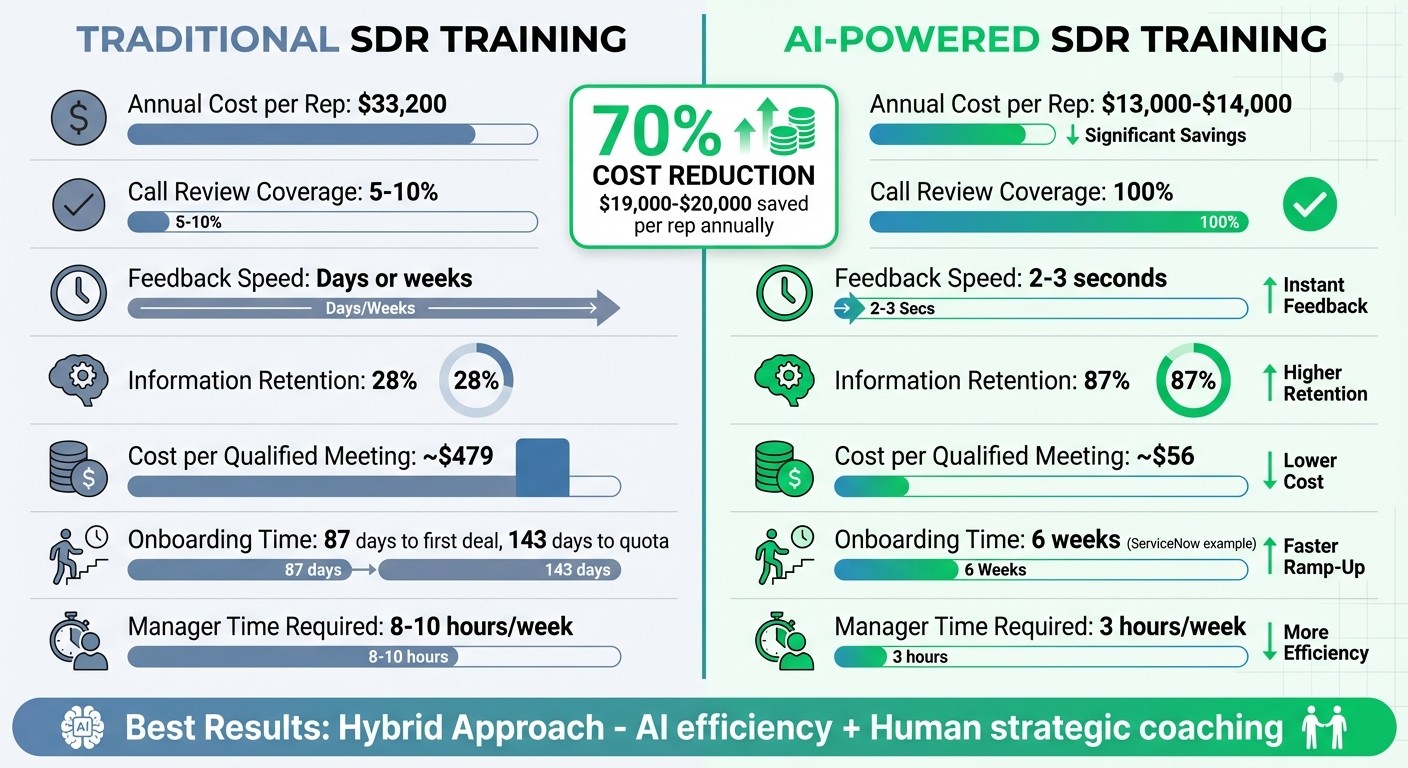
Traditional vs AI-Powered SDR Training: Cost, Speed, and Performance Comparison
Here's a closer look at the key trade-offs between traditional and AI-powered training methods, highlighting their effects on performance and cost.
Traditional training methods bring a personal touch. Managers offer tailored insights and emotional support, but these methods come at a steep price - $33,200 per rep annually [1]. They're also tough to scale. With limited call reviews and delayed feedback (often arriving days or weeks after the fact), many learning opportunities slip through the cracks, making it hard to address active deals effectively [1].
AI-powered training takes a different approach. It’s far more cost-effective, averaging $13,000–$14,000 per rep annually [1], which is about 70% less when factoring in manager time and facilities [7]. AI reviews every single call, delivering feedback in as little as 2–3 seconds [1]. The results are impressive: sellers retain 87% of information from AI role-play, compared to just 28% with traditional training [7]. At TechCorp - a 200-person B2B SaaS company - AI role-play boosted meeting booking rates from 12% to 41% and reduced new hire ramp time from five months to just three weeks [7].
Here’s how the two methods compare on key metrics:
Factor | Traditional Training | AI-Powered Training |
|---|---|---|
Annual Cost per Rep | $33,200 [1] | $13,000–$14,000 [1] |
Call Review Coverage | 5–10% [1] | 100% [1] |
Feedback Speed | Days or weeks [1] | 2–3 seconds [1] |
Information Retention | 28% [7] | 87% [7] |
Cost per Qualified Meeting | ~$479 [9] | ~$56 [9] |
While AI has clear advantages in cost, speed, and retention, it’s not without limitations. It lacks the nuanced judgment needed for complex decisions or the emotional support struggling reps might require. To address this, managers should still conduct weekly spot checks to ensure AI feedback aligns with brand standards [8]. The ideal solution is a hybrid approach: let AI handle repetitive tasks like call analysis, freeing managers to focus on strategic coaching and career development [1].
Platforms like Coach Pilot make this hybrid model seamless. They integrate AI coaching into daily workflows while keeping the human element intact through custom playbooks and live training sessions. This approach combines the scalability and efficiency of AI with the strategic guidance only experienced managers can provide.
Conclusion
The evidence is clear: AI-powered SDR training significantly reduces ramp times. For example, ServiceNow managed to cut their ramp time from three months to just six weeks[3]. By handling repetitive tasks like call reviews and instant feedback, AI allows managers to shift their focus toward strategic coaching. As Jayney Howson, ServiceNow's Chief Learning Officer, aptly put it:
AI should help you manage so you can lead.[3]
With tools that ensure 100% call coverage and deliver real-time feedback in just a few seconds[1], sales leaders can use AI to reinforce skills through quick, daily roleplay sessions[2] and pinpoint specific gaps with AI-generated scorecards[2]. These capabilities make a hybrid coaching model not only possible but practical.
The best approach combines AI's efficiency with the nuance of human expertise. Platforms like Coach Pilot, which offers sales coaching insights, simplify this integration by weaving AI-driven coaching into everyday workflows while maintaining the personalized touch of live training and tailored playbooks. With AI enhancing coaching accessibility and driving measurable performance gains, the real question for sales teams isn't whether to adopt AI-powered training - it’s how soon they can put it into action. Teams that embrace this approach can expect faster development and stronger results.
FAQs
What SDR tasks should AI coach vs managers?
AI coaching excels at handling repetitive, data-heavy tasks. For example, it can analyze calls, deliver real-time feedback, and pinpoint skill gaps with precision. Its ability to process all sales interactions instantly ensures consistent and unbiased coaching across the board.
Meanwhile, managers are best suited for tasks that require emotional intelligence. These include personalized coaching, offering strategic direction, and building trust within their teams. By dividing responsibilities this way, AI boosts efficiency, allowing managers to concentrate on meaningful, relationship-driven activities.
How do you measure AI coaching ROI for SDRs?
To gauge the return on investment (ROI) of AI coaching for Sales Development Representatives (SDRs), focus on tracking key performance metrics. These include:
Improved win rates: Monitor how often leads convert into successful deals.
Quota attainment: Look for growth in quota achievement, such as a potential 3.3x increase.
Deal velocity: Measure how quickly deals progress through the pipeline.
Revenue growth: Track overall increases in revenue tied to coaching efforts.
Sales productivity: Evaluate how efficiently SDRs are performing their tasks.
Using data-driven scorecards and detailed feedback is essential for analyzing performance shifts. These tools provide clear, actionable evidence of how AI coaching impacts results.
How do you keep AI feedback accurate and on-brand?
To keep AI feedback aligned with your brand and accurate, it's important to take a few steps. Start by regularly analyzing sales interactions using reliable, high-quality data. Train your AI system to understand your specific sales playbook and messaging. This ensures the AI reflects your unique approach.
Additionally, review the insights generated by the AI to make sure they match your brand's voice and overall strategy. Frequent updates and consistent monitoring are essential for keeping AI outputs in sync with your goals.
Related Blog Posts

Remove the guesswork from winning more deals.