B2B Sales
How AI Enhances Data-Driven Sales Mapping
Mar 4, 2026
AI turns CRM and live market data into automated territory planning, lead scoring, and forecasting that boost speed, accuracy, and revenue.

AI is transforming sales processes by replacing outdated tools like spreadsheets with systems that analyze real-time data. These systems streamline tasks such as lead scoring, territory planning, and forecasting while improving accuracy and efficiency. Key benefits include:
Time Savings: Automates repetitive tasks like data entry, allowing sales reps to focus on selling.
Improved Predictions: AI refines forecasts, identifies high-value leads, and adjusts strategies based on real-time data.
Revenue Growth: Companies report up to 15% revenue increases and reduced planning time by 80%.
For example, Salesforce's 2025 pilot program generated $28 million in pipeline and $9 million in closed revenue in just four months by using AI to deliver 24,000 personalized recommendations. AI doesn't replace human judgment but supports it, helping teams make smarter, faster decisions.
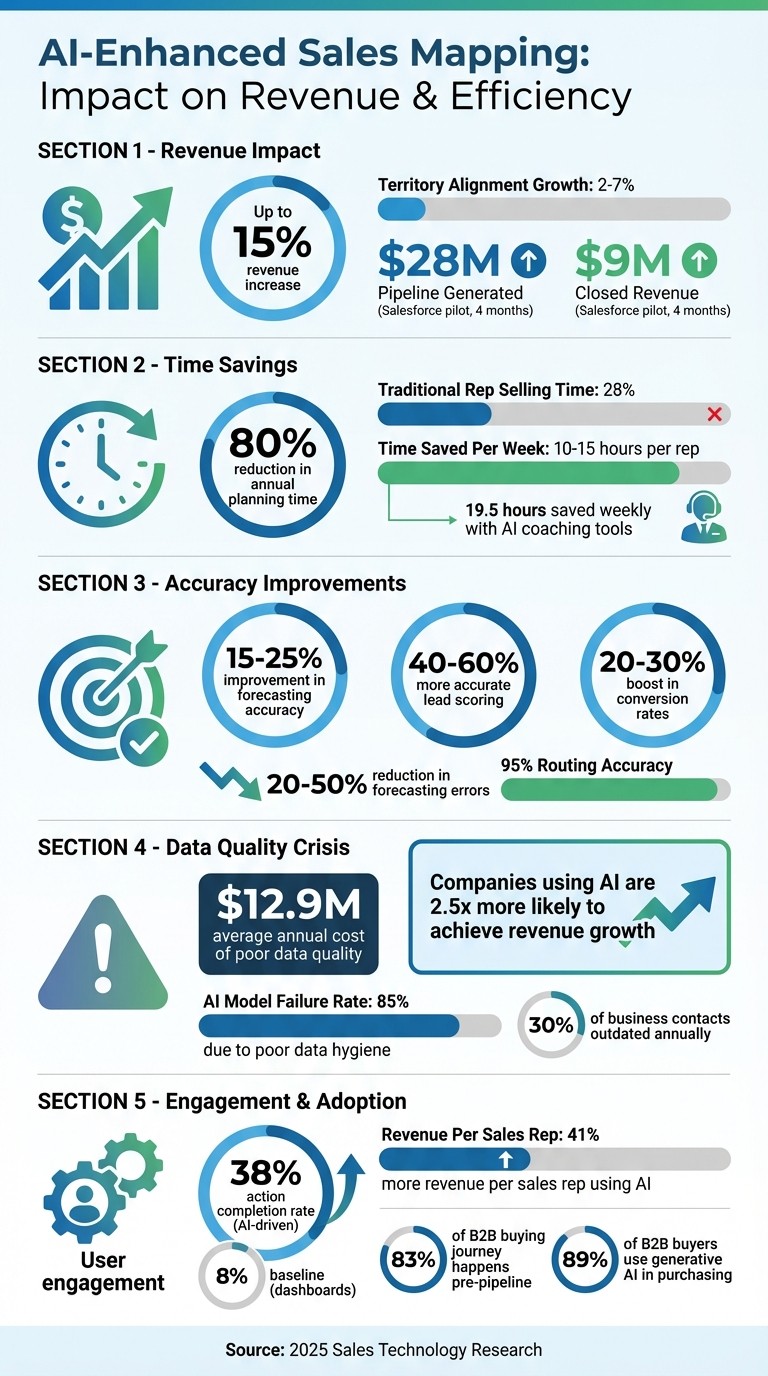
AI-Driven Sales Mapping: Key Performance Metrics and ROI Statistics
Process Mapping for AI Automation
What is AI-Enhanced Sales Mapping?
AI-enhanced sales mapping leverages machine learning and predictive analytics to create, test, and refine sales territories and coverage models [1][5]. Unlike static spreadsheets that capture a single point in time, these AI-driven systems evolve dynamically. They adapt to changes in the market, competitor strategies, and real-time CRM data, making them far more agile and effective [1][2].
The shift from traditional methods is dramatic. Older approaches often relied on intuition and annual updates [1][2]. In contrast, AI-enhanced mapping acts as an operating system for coverage and capacity, balancing workloads based on opportunity-weighted factors like active pipelines and renewal risks through AI sales coaching, rather than just tallying accounts [1].
What sets AI mapping apart is its ability to go beyond basic analytics. These "agentic" systems handle tasks from start to finish [1][4]. They can define territory boundaries, create multiple planning scenarios, and assign tasks down to the individual sales rep. As Ameya Deshmukh from Everworker explains:
"Traditional territory planning tools and spreadsheets were never designed to reason, simulate, and iterate continuously. They capture a moment in time - then require humans to maintain the truth manually." [1]
A prime example of this innovation comes from Salesforce's internal pilot program, "Customer Zero", conducted between February and May 2025. Using Salesforce Data Cloud and Agentforce, the system generated over 24,000 personalized recommendations for sellers in real time. This approach achieved a 38% action completion rate, significantly higher than the 8% baseline for dashboard-based requests, leading to $28 million in pipeline generation and $9 million in closed ACV over just four months [4].
These capabilities lay the groundwork for the standout features of AI-enhanced sales mapping.
Key Features of AI-Enhanced Sales Mapping
This modern approach introduces several defining features that distinguish it from traditional methods:
Real-time data processing: AI continuously updates maps using CRM data, revenue history, and intent signals. This eliminates the need to wait for quarterly reviews, keeping strategies current [1][3].
Predictive analytics: At its core, AI mapping relies on models to identify patterns and predict outcomes. It calculates win probabilities, estimates deal cycle lengths, and forecasts pipeline trends using historical data [7].
Adaptive workflows: These systems learn from past results and adjust automatically. For instance, if a territory underperforms or a competitor disrupts the market, AI recalibrates assignments and strategies. Its logic is transparent, showing clear reasons for changes [2][5].
Micro-segmentation: Instead of relying solely on static firmographics, AI clusters accounts based on live behaviors, like researching competitors or viewing specific content. This ensures reps are matched with leads exhibiting real-time intent [6].
Organizations adopting AI for sales mapping report up to 15% revenue growth [2]. Additionally, these tools can cut sales planning time in half, allowing teams to focus on selling rather than administrative tasks [2].
Benefits of AI in Sales Mapping
The features of AI-enhanced mapping translate into tangible benefits, particularly in visibility, speed, and accuracy.
Improved sales funnel visibility: AI tracks pre-pipeline activities such as anonymous website visits, third-party research, and content downloads - behavior that can make up as much as 83% of the B2B buying journey[3]. With 89% of B2B buyers now using generative AI during their purchasing process, traditional methods miss much of this activity [3].
Accelerated sales cycles: AI can instantly route leads and alert reps based on buyer intent. For example, if a prospect visits a pricing page or downloads a competitor comparison, the system notifies the right salesperson within minutes [8][9]. Companies using AI for territory alignment report sales growth of 2% to 7%, even without changing other strategies [2].
Higher forecasting accuracy: AI-driven predictions improve forecasting accuracy by 15% to 25%[5]. Sales organizations that adopt AI-assisted forecasting are 10% more likely to grow revenue year-over-year[8]. Unlike static formulas, AI continuously refines its insights as new data emerges [7].
For instance, Udemy replaced fragmented tools and spreadsheets with a centralized revenue platform. This transition resulted in an 80% reduction in annual planning time, freeing their team to focus on strategic priorities [3].
AI-enhanced sales mapping isn't just about technology - it's about reimagining how sales teams operate, making them faster, smarter, and more effective.
Steps to Build a Data Foundation for AI-Driven Sales Mapping
Creating a reliable data foundation is the backbone of AI-driven sales mapping. Without it, even the most advanced AI systems will yield flawed results. As Il'ya Dudkin from DataGroomr aptly states:
"AI is not fixing bad data; it is magnifying it." [11]
And the stakes are massive. Poor data quality costs organizations an average of $12.9 million annually [12][14], and 85% of AI models fail to perform optimally due to poor data hygiene [20]. Building this foundation requires a structured approach, starting with a thorough data audit to ensure seamless integration and optimal AI performance.
Auditing and Cleaning Existing Data
Start with a deep dive into your CRM data. Review samples of accounts, contacts, and opportunities to ensure the information is accurate and actionable. Focus on identifying and addressing four primary issues: duplicates (which skew metrics), incomplete records (missing details like revenue or industry), inconsistent formatting (e.g., "NY" vs. "New York"), and outdated accounts [11].
The numbers are eye-opening. About 30% of business contact records become outdated annually due to changes like job shifts or company moves [11][16]. Even worse, 91% of CRM data becomes obsolete within a year without ongoing monitoring [16]. This data decay directly undermines AI performance - if the data feeding the system is flawed, the outcomes will be too.
To combat this, prioritize standardization. Replace free-text fields with picklists to eliminate variability and help AI identify patterns more effectively [11]. Enforce validation rules to prevent incomplete or misformatted entries from slipping through [11][13].
The value of clean data is clear. Cisco, for example, used Informatica's AI-powered tools in 2023 to audit over 90 million records, cutting sales cycle delays by 65% and saving $76 million annually by reducing data-entry errors and rework [12].
Beyond cleaning, enrich your data with additional layers of context. Add firmographics (company size, revenue), technographics (tools used), and behavioral signals (like website traffic or hiring trends) to give AI the depth it needs to make accurate predictions [11][12].
The 1-10-100 Rule is a crucial guideline: It costs $1 to verify a record at entry, $10 to clean it later, and $100 in compounded errors if left unchecked [15]. Start with one impactful use case, such as lead qualification, and define the specific data patterns your AI model requires [11][14].
Ongoing maintenance is key. Assign responsibility to RevOps teams or Salesforce admins to ensure continuous data governance - this isn’t a one-and-done task [11][13].
Integrating Data Sources and Tools
Once your data is clean, the next step is integration. Consolidate data from various platforms - like CRM deal data, ERP commission data, and territory spreadsheets - into a unified system, such as a Revenue Command Center [17][3]. This provides AI with a comprehensive view, enabling smarter recommendations.
Bi-directional synchronization is critical. When updates occur in your CRM, your AI platform should reflect those changes automatically, and vice versa, ensuring a single source of truth across all systems [19].
Don’t overlook pre-pipeline signals. Integrate data from email, video meetings (e.g., Zoom, Microsoft Teams), and messaging platforms (like Slack) to capture buyer behaviors often hidden in the "dark funnel." These early activities represent 83% of the B2B buying journey [3].
Make AI insights easily accessible by embedding scores, risk assessments, and recommendations directly into CRM fields. Sales reps shouldn’t have to switch between platforms to access crucial information [19].
Atlassian provides a compelling example. By integrating ZoomInfo’s machine-learning enrichment into Salesforce CRM and Marketo, they boosted pipeline generation from outbound efforts by 37% and slashed email bounce rates from 17% to under 4% [12].
To avoid costly errors, establish a tiered control system for AI interactions with your CRM. For instance:
Tier 1: Automate fixes like formatting or filling in non-sensitive fields.
Tier 2: Require approvals for changes to stages, close dates, or ownership.
Tier 3: Escalate sensitive updates affecting commissions or legal matters [18].
Before rolling out fully, pilot your integration with a small batch - about 10,000 records - to test field mapping and triggers [12][13]. This helps catch potential issues early, minimizing disruption to your broader database.
As Adam Cornwell warns:
"AI can work, but if you don't have the data foundation that's set up properly for it, you can't just lay AI on top of crappy data… because the AI can be crappy, and so garbage in, garbage out." [17]
While the integration process may seem tedious, it’s the difference between AI that enhances your sales process and AI that creates chaos.
Implementing AI in Key Stages of the Sales Funnel
Once you’ve established a solid data foundation, the next step is leveraging AI to streamline your sales funnel. This isn’t about replacing your team - it’s about freeing them from repetitive tasks so they can focus on selling. Right now, sales reps spend just 28% of their time selling, with the rest lost to administrative tasks like data entry and proposal drafting [26]. AI, powered by clean data, can transform how each stage of the funnel operates.
AI-Powered Lead Scoring and Routing
Traditional lead scoring systems often fall short, with 67% of efforts wasted on leads that never convert [21]. These outdated, static models (like assigning "+10 points for attending a webinar") aren’t equipped to handle today’s complex buying signals. AI changes the game by using predictive models that analyze thousands of data points - such as firmographics, behavioral patterns, and technographic shifts - to pinpoint high-value leads.
AI-driven lead scoring is 40–60% more accurate, resulting in a 20–30% boost in conversion rates. Sales reps using AI tools generate 41% more revenue per person, with averages jumping from $1.24 million to $1.75 million [24]. The system evaluates leads based on three key factors: fit (how well they match your Ideal Customer Profile), intent (are they showing buying signals?), and timing (are they in a buying cycle?) [21].
AI also picks up on subtle signals that traditional methods miss. For example, it can detect early-stage anonymous signals - like when a company posts job openings, secures funding, or adopts complementary technology. These signals, which account for up to 83% of the B2B buying journey, are flagged in real time to adjust lead scores [3].
Routing takes this a step further by assigning leads to the right sales reps based on expertise, location, workload, and past performance. Advanced systems achieve up to 95% routing accuracy, ensuring top leads get immediate attention with auto-scheduled meetings, while lower-priority leads are funneled into nurturing sequences [23].
"AI's great at scoring qualification, extracting that from the core recordings and giving our leadership teams the insights they need to know who's qualifying well and who needs training." - Guy Rubin, Founder of Ebsta [22]
Streamlining Proposal Generation and Follow-Ups
Creating proposals and handling follow-ups can eat up a huge chunk of time. AI can cut this effort by up to 90%, with some sales teams seeing win rates improve by 30–50% [25]. The secret? Context-aware drafting - using actual conversation transcripts and meeting notes instead of relying on generic templates [26].
In 2025, Insider implemented Inventive AI for proposal automation and saw a win rate increase of over 50%.
"Overall, my RFP workflow is SO much faster now with Inventive. My day was a lot less stressful using Inventive." - Anthony Pukal, Solutions Consultant at Insider [25]
This tool can generate first drafts of RFPs in minutes, pulling directly from verified company data and drastically reducing manual work.
Other companies have seen similar success. Medisafe, a health-tech platform, used AiSDR to automate lead qualification and booked 29 meetings with top pharmaceutical companies in just 30 days [27]. ESLNA, a global logistics provider, achieved a 32% reply-to-demo rate and secured meetings with brands like Disney and Airbnb by using AI to craft tailored outreach messages [27].
AI ensures personalization at scale by learning the writing style of individual reps, making automated emails feel authentic [26]. It also uses behavioral triggers to time follow-ups perfectly - responding within 5 minutes can make leads nine times more likely to convert [28]. A centralized hub of brand-approved content helps maintain accuracy and consistency, with systems achieving up to 95% content validation accuracy [25].
"AI handles process, humans handle persuasion." [25]
Optimizing Post-Sale Processes
AI doesn’t stop at closing deals - it plays a crucial role in post-sale activities too. It helps retain customers and drive growth by monitoring behavioral signals like reduced product usage, high support ticket volume, or silence from key stakeholders. These insights are used to calculate health scores and flag at-risk accounts before they churn, reducing churn rates by 27% and increasing expansion revenue by 19% [31].
Between February and May 2025, Salesforce piloted its "Agentic Enterprise" system, integrating tools like Data Cloud, Slack, and Agentforce. The system delivered over 24,000 personalized recommendations to sellers, suggesting specific upsell strategies when customer satisfaction and buying intent were high. This approach generated a $37 million impact on pipeline and closed revenue, with seller engagement rates climbing from 8% to 38% [4].
AI also simplifies routine tasks like summarizing meeting notes, tagging sentiment in customer emails, and updating CRM data - saving reps 10 to 15 hours each week [30]. One small online retailer used AI to deliver personalized post-purchase product recommendations, boosting repeat purchases by 20% in just one quarter [29].
Behavioral triggers can also automate outreach when customers hit milestones or become inactive, keeping engagement strong. Sentiment analysis further refines health scoring by tagging risks or positive themes in customer communications.
"AI doesn't replace salespeople - it removes the repetitive grind so they can focus on building real relationships and closing deals." - Vamsi Allu, Head of Sales at Smartlead [31]
Tools like Coach Pilot embed AI-driven coaching into sales workflows, helping teams execute these strategies with precision. By integrating real-time analytics and guidance, they can identify upsell opportunities, automate playbooks, and ensure every customer interaction adds value.
Balancing AI Autonomy with Human Control
AI can handle the grunt work in sales mapping, but letting it operate entirely on autopilot might not be the best idea. A human-in-the-loop (HITL) approach strikes a balance by allowing AI to tackle data-heavy tasks - like lead scoring and recognizing patterns - while reserving decisions requiring emotional intelligence, negotiation, or ethical judgment for human experts. This setup amplifies the advantages of automated insights while keeping your team firmly in control with an AI-powered sales workspace [32]. The aim isn't to micromanage every decision but to create checkpoints that catch errors early and maintain oversight.
Clear boundaries are essential. While AI excels at crunching numbers, identifying trends, and even drafting proposals, humans are still best at closing deals, handling complex objections, and making strategic decisions. A responsibility matrix can help define whether specific sales activities fall under AI, human oversight, or a combination of both [32].
Establishing Review and Escalation Points
Routine decisions can be delegated to AI, but high-risk actions should always involve human review. Systems should be designed to escalate decisions based on specific triggers tied to risk, complexity, or customer sentiment. For instance, confidence-based escalation activates when AI's certainty drops below a set threshold (like 85%) [33]. Similarly, risk-based triggers might be set for high-stakes scenarios, such as deals exceeding a certain dollar amount, irreversible actions, or regulatory concerns [33][35].
Other triggers include sentiment-based escalation, where tone analysis detects buyer frustration, and complexity-based escalation, which flags situations involving multiple stakeholders [33][35]. For example, a pilot program found that routing high-value opportunities for human review significantly improved action completion rates [4].
In early 2025, Remote.com implemented an AI-powered IT helpdesk overseen by a small team led by Marcus Saito. The system automatically resolved 27.5% of tickets and escalated more complex cases to human agents, saving the company an estimated $500,000 in hiring costs [36].
A practical example of this is the approval gate model, where AI proposes an action - like a territory reassignment or a high-value proposal - and waits for explicit human approval before proceeding [33].
Using Feedback Loops to Improve AI Models
Defined review points aren't just for oversight - they're also opportunities to improve AI systems. Feedback loops help refine AI actions by logging when sales reps override lead scores, adjust proposals, or escalate deals. These instances provide training signals that help fine-tune algorithms and highlight areas needing improvement [32][33][34]. Metrics like "edit distance" can even measure how much human revision AI-generated content requires [37].
In 2025, Jacob Sirrs, a Marketing Operations Specialist at Vendasta, developed an AI-driven lead enrichment system that analyzed and summarized lead data. Promising prospects were routed to human representatives for personalized outreach, resulting in a $1 million boost in potential revenue [36].
Maintaining context during handoffs is equally important. When AI escalates a case, it should provide a full interaction history and its reasoning, so human agents can make informed decisions quickly [32][33].
"AI doesn't inherently know the difference between good and great the way that our subject matter experts do."
Ali Nahvi, Director of Product Innovation, Salesforce [4]
Finally, regular audits - such as comparing outcomes from fully automated processes against those involving human intervention - can help refine escalation logic and ensure systems are continuously improving. The goal isn't to automate everything but to achieve better results by aligning AI's capabilities with human judgment [35].
Measuring Success and Optimizing AI-Driven Sales Mapping
Introducing AI into sales processes is just the beginning. The real challenge lies in proving its value and continuously improving its impact on sales performance. Companies that successfully measure AI's influence are 2.5 times more likely to achieve noticeable revenue growth [38]. Yet, only about a quarter of organizations manage to scale this value effectively [10]. The difference? Tracking the right metrics and using those insights to refine strategies. Here's how to evaluate AI's impact on your sales efforts.
Key Metrics to Track
Measuring success starts with linking short-term activities to long-term business goals. One critical metric is speed-to-lead. Studies show that conversion rates can increase up to 8x when leads are contacted within five minutes [40]. This makes it essential to track how quickly AI routes qualified leads and whether that speed translates into more meetings or opportunities.
Another essential metric is the Autonomous Handling Rate - the percentage of tasks AI completes without human input [39]. This can highlight how much time your sales team is saving for higher-value activities, like closing deals. Ideally, this rate should steadily rise as AI takes over repetitive tasks like CRM updates, follow-ups, and proposal creation.
Quality matters too. AI recommendations that integrate directly into workflows (rather than being buried in dashboards) lead to higher action completion rates and a noticeable impact on the sales pipeline [4].
Additionally, monitor engagement depth. AI-powered chatbots, for example, have been shown to increase conversion rates by 25% [38]. Go beyond surface-level metrics like email opens - track meaningful responses, meeting sentiment scores, and the expansion of stakeholder involvement within accounts. For instance, Bureau used AI-powered coaching to refine their discovery process, achieving a 30% increase in deal conversions through real-time behavioral reinforcement [10].
Continuous Improvement Through Iteration
While metrics provide a snapshot of performance, ongoing iteration is what drives sustained success. Static reviews simply aren’t enough. For example, Udemy transitioned to an AI-driven territory management platform and cut annual planning time by 80% [3]. What used to take months was reduced to weeks [42]. More importantly, this shift allowed for continuous updates based on real-time data, eliminating the need to wait for the next planning cycle.
"Insight doesn't equal impact. Our challenge wasn't to build more models - it was to operationalize the ones we already had."
Ali Nahvi, Director of Product Innovation, Salesforce [4]
To measure AI's true impact, use control groups. Compare teams using AI tools against those sticking with traditional methods [40]. Identify which AI signals most accurately predict outcomes and fine-tune the system to prioritize those signals over less relevant data [19]. If sales reps are ignoring AI suggestions, check whether the guidance is buried in dashboards instead of being seamlessly integrated into their workflow [4].
Feedback loops are another key component. Track when sales reps override AI recommendations, adjust proposals, or escalate deals differently than suggested. By calculating a Feedback Implementation Rate - the percentage of AI recommendations that are actually followed - you can gauge how well teams are adapting to AI insights [43]. These feedback loops not only refine the AI system but also improve the overall efficiency of sales mapping.
Set a regular optimization schedule. For example:
Weekly micro-adjustments for lead routing
Monthly reviews to detect drift or coverage gaps
Quarterly updates for headcount changes or territory shifts [1]
Organizations that adopt dynamic, ongoing coaching see win rates improve by more than six percentage points compared to their peers [10]. The focus isn’t on achieving perfection immediately. Instead, it’s about building a system that learns and improves with every interaction, making your sales process smarter over time.
Conclusion
AI-driven sales mapping transforms guesswork into precise, data-backed strategies. By eliminating the need for sales representatives to spend 70% of their time on administrative tasks, they can redirect their energy toward building relationships and closing deals [46]. Companies leveraging AI report being 1.3 times more likely to experience revenue growth [47], and AI-powered forecasting reduces errors by 20% to 50% [48].
The real magic happens when AI's efficiency is paired with human strategic insight. Teams that thrive are those that let AI handle repetitive, high-volume tasks - like CRM updates, lead scoring, and drafting follow-ups - while reserving human expertise for complex negotiations and big-picture decisions. As Salesforce demonstrated in their internal pilot:
"The goal wasn't to replace human judgement, but to democratize access to the best judgement in our company" [4].
During this pilot, AI delivered 24,000 personalized recommendations, resulting in a $37 million pipeline impact in just four months.
Tools like Coach Pilot take this a step further by embedding sales playbooks directly into workflows. This real-time coaching saves reps an average of 19.5 hours per week and increases quota attainment by 39% [44]. Instead of letting strategies gather dust in a PDF, platforms like this turn them into actionable systems that guide every deal.
The results are clear: combining AI with human oversight leads to measurable success. AI provides the insights, while human expertise ensures those insights are applied effectively. For example, blending AI coaching with human input has been shown to boost goal attainment from 69% to 91% [45].
The key to success? Start small and scale thoughtfully. Build a strong data foundation, test AI with a high-impact use case, and establish clear points where human judgment takes over. By amplifying institutional knowledge and turning it into consistent execution, AI empowers sales teams to achieve more than ever before.
FAQs
What data is needed before using AI sales mapping?
To make the most of AI in sales mapping, start by ensuring your data is AI-ready. This means it should be accurate, thorough, and capable of revealing patterns, errors, and outliers. Combine external market data with your internal performance metrics, and make sure to perform proper data mapping to keep systems aligned. The key to successfully using AI in sales lies in having high-quality, integrated, and consistently mapped data.
How do we keep AI territory changes under human control?
Organizations keep control over AI-driven territory changes by blending automation with human oversight. While AI processes data to refine territory plans, human reviews ensure these align with broader strategies and specific market conditions. Regular evaluations, scenario testing, and decision checkpoints give sales leaders the ability to tweak plans as needed. Transparent AI systems also make it easier for humans to step in, creating a collaborative approach that balances automated efficiency with human expertise, especially in dynamic or complex markets.
Which metrics prove AI sales mapping is working?
AI tools are transforming sales by sharpening key metrics like pipeline visibility, forecast accuracy, and sales performance. With these tools, sales reps can evaluate pipeline health, focus on high-priority deals, and predict revenue with greater precision.
Real-time insights play a big role too. They not only improve forecast accuracy but also drive better sales outcomes. On top of that, AI-powered coaching identifies skill gaps and provides actionable next steps, leading to higher win rates and smoother pipeline progression.
These advancements highlight how AI sales mapping supports smarter decisions, increased efficiency, and stronger revenue growth.
Related Blog Posts

Remove the guesswork from winning more deals.