B2B Sales
How AI Improves Real-Time Objection Handling
Apr 17, 2026
Real-time AI analyzes calls to surface objections, give instant tailored replies, shorten sales cycles, and raise win rates.

AI is changing how sales teams handle objections during live conversations. By analyzing speech and tone in real-time, AI tools provide instant, tailored responses to common objections like price concerns or timing issues. This boosts accuracy from 28% (human average) to 94% and helps teams close deals faster - 40% shorter sales cycles and 15–20% higher win rates. Tools like Coach Pilot offer AI sales coaching, turning static playbooks into dynamic guides that adapt during calls. Companies using these systems report significant results, such as a 3.2x increase in meetings booked after initial objections and a 30% boost in lead conversions. To get started, train AI with top reps’ successful strategies, integrate it into your CRM, and continually refine its performance based on outcomes.
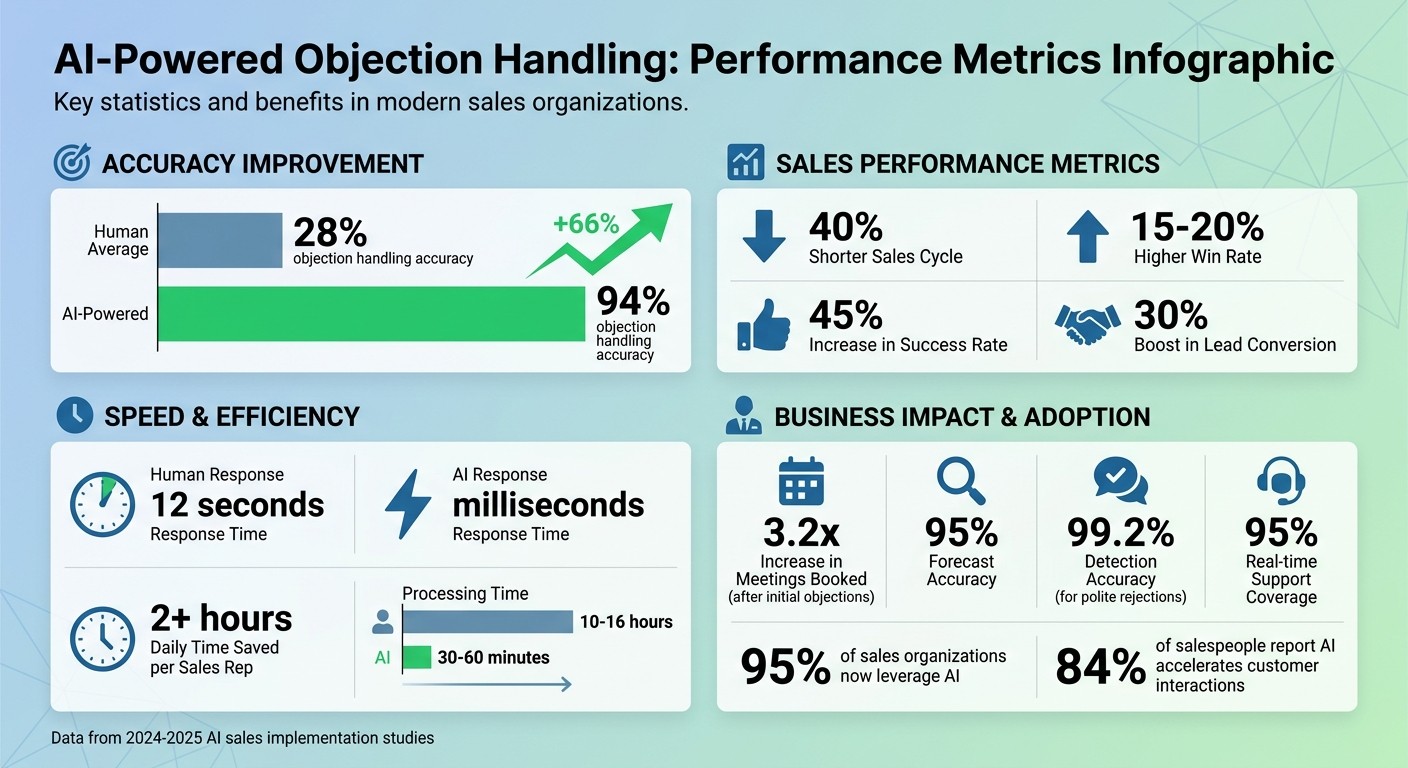
AI-Powered Objection Handling: Key Performance Metrics and Benefits
Common Sales Objections and AI Detection Methods
Examples of Common Sales Objections
Sales teams frequently encounter the same types of objections during pitches. These often include concerns about price ("too expensive", "we don't have the budget"), timing ("not ready yet", "let's revisit this in Q3"), or even the necessity of the product ("we already have a solution", "our manual process works just fine"). Trust can also be a sticking point, with questions like "what’s your track record?" or "I’ve never heard of your company." On top of that, there are technical worries about integration or migration challenges, as well as stakeholder hesitations when approval from higher-ups, like a VP or IT team, is required [8].
AI takes these objections a step further by digging into the underlying concerns that prospects might not voice directly. For example, "I need to think about it" could actually mean they’re unsure about implementation challenges or waiting for internal stakeholder approval [3]. Spotting these hidden barriers is key - if you only address the surface comment, you may miss the real issue preventing the deal from moving forward.
By categorizing objections into clear types, AI can zero in on these patterns and provide actionable insights in real time.
How AI Detects Objections in Real Time
AI uses cutting-edge natural language processing (NLP) and machine learning to identify and interpret objections as they happen. For instance, during live calls, AI systems transcribe conversations in real time. NLP engines then scan for specific keywords like "expensive", "competitor", or "not interested", while also analyzing tone to pick up on hesitation or frustration [5].
"The system detects changes in tone - hesitation, impatience, interest - and adjusts its response accordingly" [5].
Machine learning goes further by connecting current objections to past interactions, mentions of competitors, and stakeholder dynamics. A great example comes from Pro360, which in 2024 trained Amazon Comprehend to identify subtle "polite rejections" such as "I’m busy" or "Let me chew on it." These phrases, which were causing inefficiencies, were mapped to over 800 data points, resulting in a 99.2% detection accuracy. The improvement led to an 8% drop in operational costs and a 28.5% boost in customer retention [7]. LC Lee, the company’s Founder and CEO, shared:
"Initially, I believed that implementing AI would be costly. However, the discovery of Amazon Comprehend enables us to efficiently and economically bring an NLP model from concept to implementation in a mere 1.5 months" [7].
AI also dramatically speeds up response times. While a human representative might take 12 seconds to process and respond to an objection, AI can offer context-aware suggestions in milliseconds [2]. Teams that leverage AI for real-time objection handling report an 88% accuracy in responses and a 45% increase in their success rates when resolving objections [1]. By analyzing patterns across thousands of past conversations, AI provides tailored response frameworks for each unique scenario, aligning with a structured B2B sales playbook.
Using AI In Your Sales Process to Become Objection Proof ft. Steve Trang
Coach Pilot's AI-Driven Real-Time Coaching Features
Coach Pilot takes AI's real-time detection capabilities and applies them directly to live sales calls, offering instant coaching to address objections as they arise. Unlike tools that only provide analysis after a call has ended, this platform delivers actionable guidance during the conversation. It transforms static PDF playbooks into a dynamic "Living Playbook" that reps can access in the moment, providing company-specific strategies, messaging, and proven objection-handling techniques when they’re needed most [9][10].
The platform is powered by six specialized AI-driven coaches, each tailored to your company's unique sales process. These coaches provide precise, actionable advice, helping reps navigate deals with context-aware recommendations. Reps can "pin" important details like roles, goals, KPIs, and active opportunities, ensuring the AI guidance is specifically aligned with their current deal. For instance, Coach Pilot might suggest: "Email the CFO by Thursday with this message. Call the economic buyer Friday at 9:00 AM. Use these talking points that closed three similar deals.” [9].
This targeted, real-time support leads to measurable results. In June 2024, Connor Bell, a Business Development Manager at HubSpot, used Coach Pilot over 11 weeks to achieve a 50% increase in net new opportunities and secure 12 new deals, resulting in a 38% boost in quarterly sales revenue [9]. Similarly, in May 2024, Naum Sekulovski from Food By Us closed 13 new contracts in just 9 weeks, driving a 45% growth in sales revenue by refining his approach to handling objections through the platform [9].
"I went from not knowing the fundamentals of a sales process and having a fear of pushing through objections to then becoming one of the top sales reps at LinkedIn for North America." - Val Perea, Account Executive, LinkedIn [9]
Across its customer base, Coach Pilot delivers impressive results: a 7.8x growth in pipeline within 90 days, a 39% increase in quota attainment, and an average savings of 19.5 hours per week for reps by automating tasks like deal capture and CRM updates [9]. The platform combines 24/7 AI-driven support with weekly live coaching sessions, helping reps build strong sales habits and consistently execute their playbook during live deals [9][10]. These features highlight how integrated AI coaching represents the future of sales enablement and can significantly elevate sales performance.
How to Integrate AI into Sales Workflows
To make the most of AI's real-time objection detection, integrating it into your sales workflow requires a step-by-step approach. A gradual rollout ensures your team can adapt and thrive. Many organizations complete this revenue engine upgrade in about 10 weeks, moving from an initial assessment to full-scale deployment [1].
Start by identifying the common objections your sales team encounters. To do this, export 3–6 months of call notes and CRM data. Use AI to group these into 8–12 key objection categories. For example, in August 2025, Frontify used the Gong Revenue AI platform to analyze past interactions. The result? Real-time contextual signals during calls led to a 30% boost in lead conversion [3].
Next, train the AI with real-world examples. Use 30–50 calls from your top-performing sales reps to capture their successful objection-handling techniques. This data helps create branching conversation trees that reflect various scenarios, such as a prospect saying "next quarter" versus "next year" [2].
Once trained, integrate AI into your live call systems - dialers, video conferencing tools, and CRM platforms. The AI should analyze speech in real-time and provide instant guidance. The interface needs to be simple and non-disruptive, offering subtle visual cues or "whisper coaching" that reps can easily follow without losing focus on the conversation [4][12]. In August 2025, Upwork implemented AI-driven objection analysis across their call stack, achieving an impressive 95% forecast accuracy [3].
Finally, keep refining the system. Add fields like "objection type" and "AI-assisted (yes/no)" to your CRM for better tracking. Regularly review low-confidence AI suggestions with experts, and A/B test different talk tracks to improve conversion rates [1][2][11]. Below is a detailed timeline for implementing AI into your sales workflow:
This structured approach ensures a smooth integration, allowing your team to leverage AI effectively while continuously improving results.
Benefits of AI-Powered Objection Handling
AI-powered objection handling is transforming sales by delivering faster, smarter, and more consistent responses. One standout advantage is response speed - what used to take several seconds now happens instantly. AI provides context-aware suggestions in real time, keeping conversations smooth and natural. This eliminates awkward pauses during key moments and ensures the dialogue flows seamlessly. The result? A consistent experience across every interaction.
Consistency is another game-changer. While human reps handle objections correctly only 28% of the time - often influenced by mood, fatigue, or experience - AI achieves a 94% success rate with reliable quality on every call [2]. Ajay Singh, Co-founder & CEO of Pepsales, highlights this shift:
"AI-driven tools are not just optimizing; they are revolutionizing how sales teams approach objections, making it significantly easier to respond in real-time with precise, data-backed information." [4]
The financial impact is hard to ignore. AI-powered objection handling drives 15–20% higher win rates on tough deals and speeds up sales cycles by 40% [4]. Even initial rejections see a turnaround, with a 3.2x increase in meetings booked [2].
Comparison Table of AI Benefits
AI doesn’t just improve responses and consistency - it also saves time. Sales professionals recover over 2 hours daily by automating tasks like cataloging objections, cutting processing time from 10–16 hours to just 30–60 minutes [1][4]. This extra time lets reps focus on relationship-building, while new hires benefit from on-call coaching that ensures consistent performance across the board.
Measuring Success and Continuous Improvement
To truly understand the impact of AI on your sales processes, focus on outcome-based KPIs like win rates, conversion rates, and appointment settings [11][13][1]. For instance, in 2025, a software company saw a 30% boost in lead conversion by using advanced revenue AI for teams. This system provided contextual signals and improved objection handling strategies [3]. Similarly, by August 2025, a freelancing platform achieved 95% forecast accuracy. This was possible through AI-driven analysis of deal risks and objections, which helped create a more predictable revenue stream [3]. These metrics ensure that AI integration delivers measurable, data-backed results.
At the same time, keep an eye on process-based KPIs to evaluate how well AI is being integrated. Metrics like response times, real-time support coverage (percentage of calls with active AI guidance), and lead qualification rates are essential [1][3]. For example, benchmarks often include 88% response accuracy and 95% real-time support coverage [1]. Additionally, tracking how often AI suggestions align with approved playbooks and measuring objection resolution rates - aiming for 75% resolution without manager escalation - can provide deeper insights into quality and efficiency [1].
Refinement is an ongoing process. Start by tagging objections in the CRM (e.g., budget, timing, competitor) to connect responses to outcomes [11]. Schedule monthly playbook updates, where you analyze top-performing AI-assisted responses and turn them into reusable patterns [11]. For suggestions with lower confidence levels, involve subject matter experts to review them before they’re added to the permanent playbook [1].
Regular A/B testing of AI-driven rebuttals, monitoring escalation rates, and quarterly updates to AI prompts are also critical for improving objection handling [13][1][2]. These practices help build a culture of continuous improvement throughout your sales workflows.
Creating a feedback loop is equally important. Feed successful call transcripts, email threads, and CRM notes back into the AI system. This allows the AI to detect new objection patterns and market trends [11][6]. Linking AI-recommended responses to win/loss data can reveal which talk tracks are most effective in closing deals [6]. Start with a pilot group to test and gather feedback before implementing changes across the organization [14].
Conclusion
AI is reshaping the way objection handling works, shifting it from a reactive process to a proactive strategy. With AI, sales teams can access instant, context-aware responses tailored to every stage of the buyer's journey. This shift not only saves time - cutting manual cataloging from hours to minutes - but also drives measurable results. Teams using AI-powered tools have reported a 45% boost in success rates and win rate improvements of over 30% [1][11].
Importantly, AI isn't here to replace human judgment. Instead, it enhances it, ensuring consistent application across every interaction. As SalesHive aptly puts it:
"AI shouldn't replace judgment - its job is to make your best judgment easier to apply in every reply, on every call, every time" [11].
Platforms like Coach Pilot make this vision a reality by embedding AI-driven coaching directly into sales workflows. These tools transform static playbooks into active guides, helping sales reps navigate live conversations with confidence and precision.
The numbers speak for themselves: 95% of sales organizations now leverage AI [11], and 84% of salespeople report that generative AI accelerates customer interactions [11]. But success isn’t just about adopting AI - it’s about constantly improving its performance. This means tagging objections, refining responses, and updating feedback loops to keep the AI sharp and relevant.
To get started, focus on your most common objections. Train your AI with proven responses, integrate real-time coaching, and continuously monitor and refine your approach. With a well-executed AI strategy, objections can become opportunities to gain a competitive edge.
FAQs
What data is needed to train AI for effective objection handling?
To prepare AI for handling objections effectively, you'll require a few key resources:
Categorized objection types: Group objections into categories like price, timing, or trust. This helps the AI identify patterns and respond accordingly.
Examples of objections and responses: Provide sample interactions to guide the AI in crafting suitable replies.
Labeled conversation transcripts: Use these for supervised learning to teach the AI how to handle specific scenarios.
Historical call data: Offer context by analyzing past interactions, giving the AI a better understanding of real-world dynamics.
Customer insights: Incorporate data about customer preferences and concerns to ensure responses address their underlying needs.
These components work together to create a more responsive and effective objection-handling system.
How can AI coach me during a live sales call without distracting me?
AI can act as a real-time coach during sales calls, delivering quick, context-specific suggestions right when you need them. By analyzing conversations on the spot, it identifies objections or important cues and provides relevant prompts - like talking points or tailored responses - at just the right moment. These subtle, non-intrusive hints keep you engaged with the prospect while boosting your performance, all without interrupting the natural flow of the discussion.
Which KPIs best prove AI is improving objection handling?
Key performance indicators (KPIs) such as objection handling effectiveness (88%) and response accuracy (95%) play a crucial role in measuring success. Metrics like win rates, deal velocity, and forecast confidence further emphasize the influence of better objection management. Together, these numbers demonstrate how AI-powered tools can improve real-time objection handling, leading to stronger results and enhanced sales performance.
Related Blog Posts

Remove the guesswork from winning more deals.