B2B Sales
AI CRM Tools for Accurate Sales Forecasting
Apr 17, 2026
AI-driven CRM replaces guesswork with real-time signals—boosting forecast accuracy, cutting prep time, and surfacing at-risk deals early.

AI-powered CRM tools are transforming sales forecasting by replacing guesswork with data-driven insights. Traditional methods, with accuracy rates of 60–75%, fall short in helping businesses plan effectively. In contrast, AI tools analyze real-time behavioral signals like email sentiment, meeting frequency, and stakeholder engagement to achieve forecast accuracy as high as 90–98%.
Here’s why these tools matter:
Higher Accuracy: Companies using AI forecasting average 79% accuracy, with potential to reach 90%+.
Time Savings: Automating data collection reduces forecast prep time by up to 90%.
Proactive Risk Management: AI identifies stalled deals and risks weeks earlier than manual methods.
Revenue Growth: 75% of companies adopting AI forecasting report increased revenue.
Top platforms like Coach Pilot, Clari, Salesforce Einstein, Gong, and Zoho CRM offer unique features tailored to different team needs. Whether you’re managing a small team or a large enterprise, AI tools provide actionable insights to improve win rates, shorten sales cycles, and create dependable forecasts.
Quick Overview of Top AI CRM Tools:
Coach Pilot: Aligns strategy with real-time coaching.
Clari: Automates forecasts for complex operations.
Salesforce Einstein: Scores opportunities within the Salesforce ecosystem.
Gong: Analyzes conversations to detect risks.
Zoho CRM: Budget-friendly option for SMBs with rule-based predictions.
To get started, ensure your CRM data is clean and structured. Run a pilot program to compare AI predictions against past outcomes, and choose a tool that aligns with your team’s size and sales cycle. AI doesn’t replace human judgment - it enhances it for better decision-making and revenue planning.
How to Use AI to Accurately Call Your Sales Forecast
How AI Improves Sales Forecasting
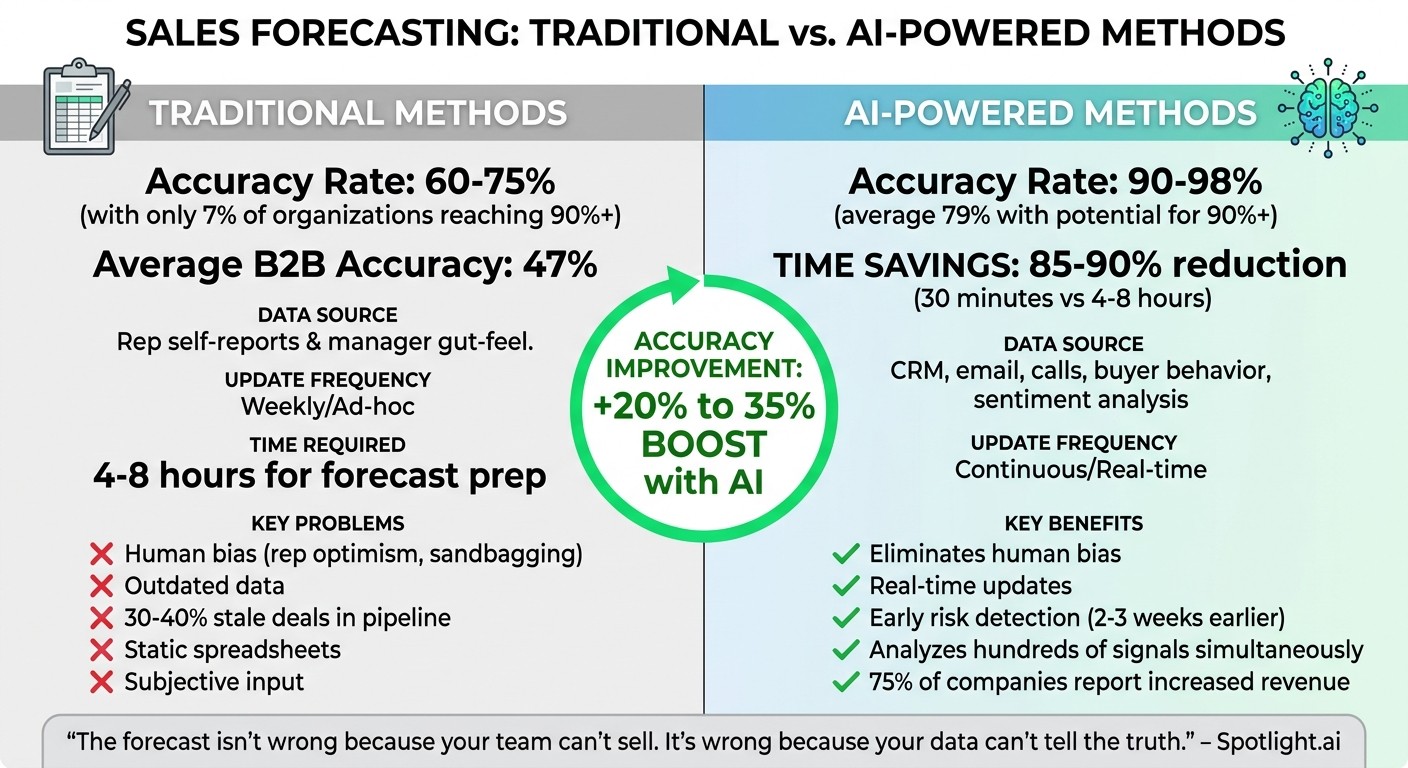
Traditional vs AI Sales Forecasting Methods Comparison
AI shifts sales forecasting from subjective guesswork to a data-driven science. By analyzing behavioral metrics - like email response times, meeting frequency, stakeholder engagement, and sentiment - AI can boost forecast accuracy by an impressive 20% to 35% [6]. This dynamic approach ensures predictions stay relevant and actionable.
Traditional forecasting methods often rely on static spreadsheets that become outdated almost instantly. AI, on the other hand, continuously updates forecasts in real time as new data flows into the CRM. This allows it to capture changes in deal velocity and engagement patterns as they occur. Because of this, sales leaders can spot at-risk deals 2 to 3 weeks earlier than they would using human judgment alone [3][6][8].
Machine learning takes this a step further by analyzing hundreds of signals simultaneously to calculate the likelihood of closing each deal. Factors like rep skill, account health, and activity velocity are all considered. Some systems even run thousands of Monte Carlo simulations per cycle to predict a range of revenue scenarios [6][7].
Benefits of AI in Sales Forecasting
AI addresses common forecasting pitfalls like rep optimism, sandbagging, and stage inflation by eliminating human bias. This leads to more accurate and dependable predictions [6].
"Evidence doesn't panic. Opinions do." – Spotlight.ai [8]
AI also saves time - lots of it. By automating data collection, it cuts the time needed for forecast preparation by 85% to 90%. What used to take 4–8 hours can now be done in just about 30 minutes. This efficiency allows sales managers to focus on what really matters: coaching their teams and closing deals [6].
Another game-changing benefit is AI's ability to uncover patterns that are easy to miss manually. For example, it has revealed that 40%–60% of deals stall due to "no decision" - a pattern that’s nearly impossible to detect without advanced tools. With early risk detection, managers can intervene with AI sales coaching or additional resources, potentially salvaging deals before the quarter ends [9].
Problems with Traditional Forecasting Methods
Traditional forecasting methods face significant challenges, starting with outdated data and human error. On average, B2B companies achieve only 47% forecast accuracy using these methods - barely better than flipping a coin. And just 7% of sales organizations reach 90% or higher accuracy when relying solely on manual processes [6][8].
These methods often depend on subjective input, with reps self-reporting deal status based on personal impressions rather than measurable buyer behavior. This reliance on opinion leads to inflated pipelines and frequent forecasting errors [5][9].
Another issue is data quality. Many pipelines are filled with stale deals - opportunities with no recent activity but still marked as active. These can make up 30% to 40% of most pipelines [6]. Without automated data capture, CRM records often reflect what reps remember to log, rather than what actually happened. This creates forecasts built on incomplete and outdated data.
"The forecast isn't wrong because your team can't sell. It's wrong because your data can't tell the truth." – Spotlight.ai [9]
AI-Powered CRM Tools for Sales Forecasting
AI is changing the game when it comes to sales forecasting. These tools go beyond traditional methods, using data to replace guesswork and offer actionable insights. Here's a closer look at some standout AI-powered CRM tools and how they can elevate your team's forecasting abilities.
Coach Pilot: Bridging Strategy and Execution
Coach Pilot helps your sales team align strategy with everyday actions. It does this by creating tailored sales playbooks that reflect your unique sales process. But it doesn’t stop there - AI-driven coaching is built right into your team’s workflow. Instead of relying on subjective input from reps, Coach Pilot pulls objective data from emails, calls, and other sources to create a "Revenue Context" that's grounded in actual performance [11][12]. This approach allows sales leaders to identify and address execution gaps early, boosting win rates, shortening sales cycles, and delivering forecasts that mirror real-world activity.
Clari: Streamlining Revenue Operations
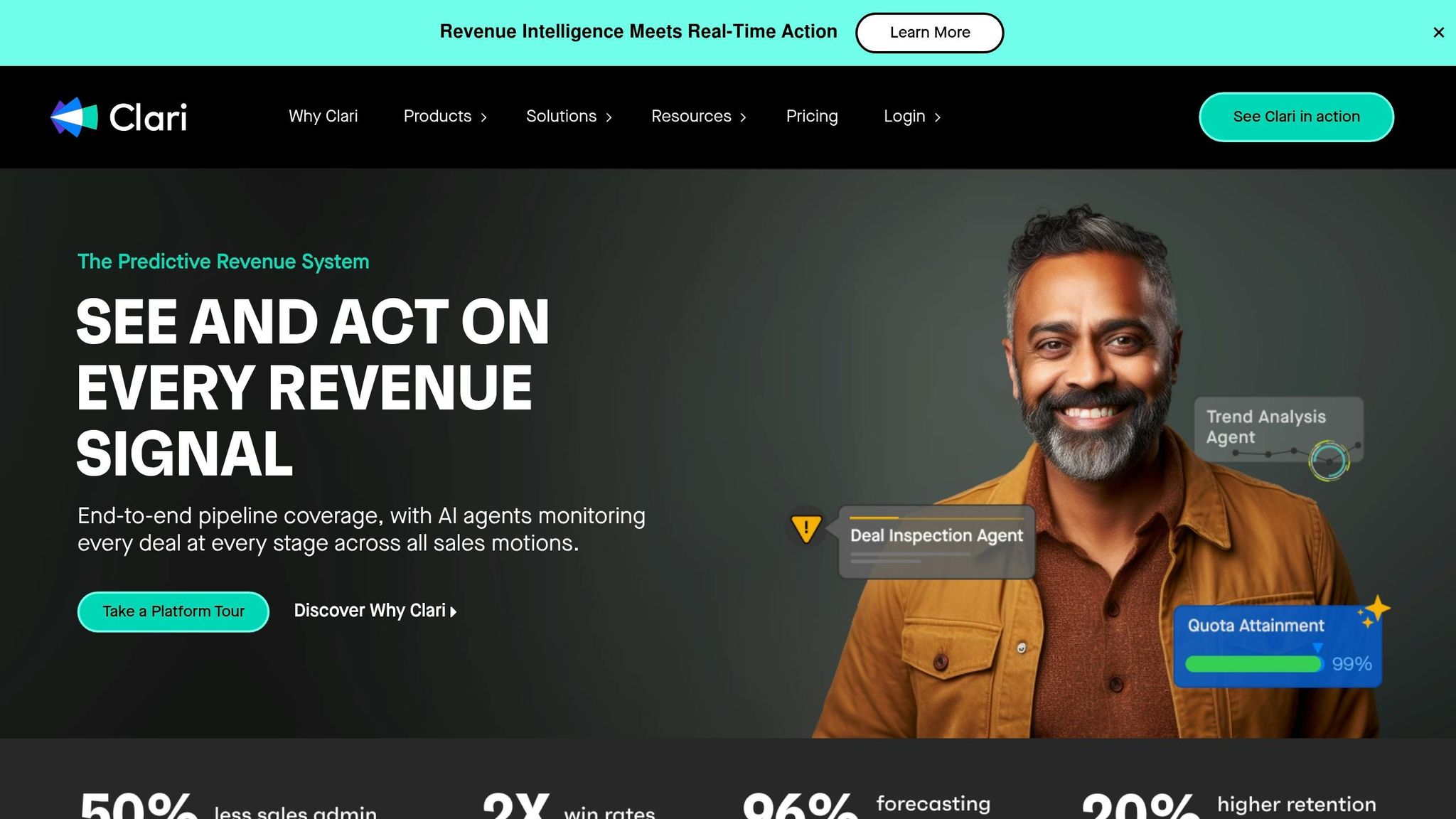
Clari specializes in revenue operations and automating forecasts. It integrates data from your CRM, email, and calendar systems to deliver predictive analytics and automated roll-ups. This gives sales leaders a clear view of pipeline health [10]. The platform keeps forecasts updated in real-time, reflecting changes in deal activity as they happen.
Salesforce Einstein: Smarter Opportunity Scoring
Salesforce Einstein brings AI-powered forecasting directly into the Salesforce ecosystem. Using machine learning, it scores opportunities on a scale from 1 to 99, predicting the likelihood of closing based on historical data [10][1]. Because it works natively within Salesforce, Einstein continuously learns and improves its predictions by analyzing outcomes from past deals.
Gong: Insights Through Conversation Intelligence
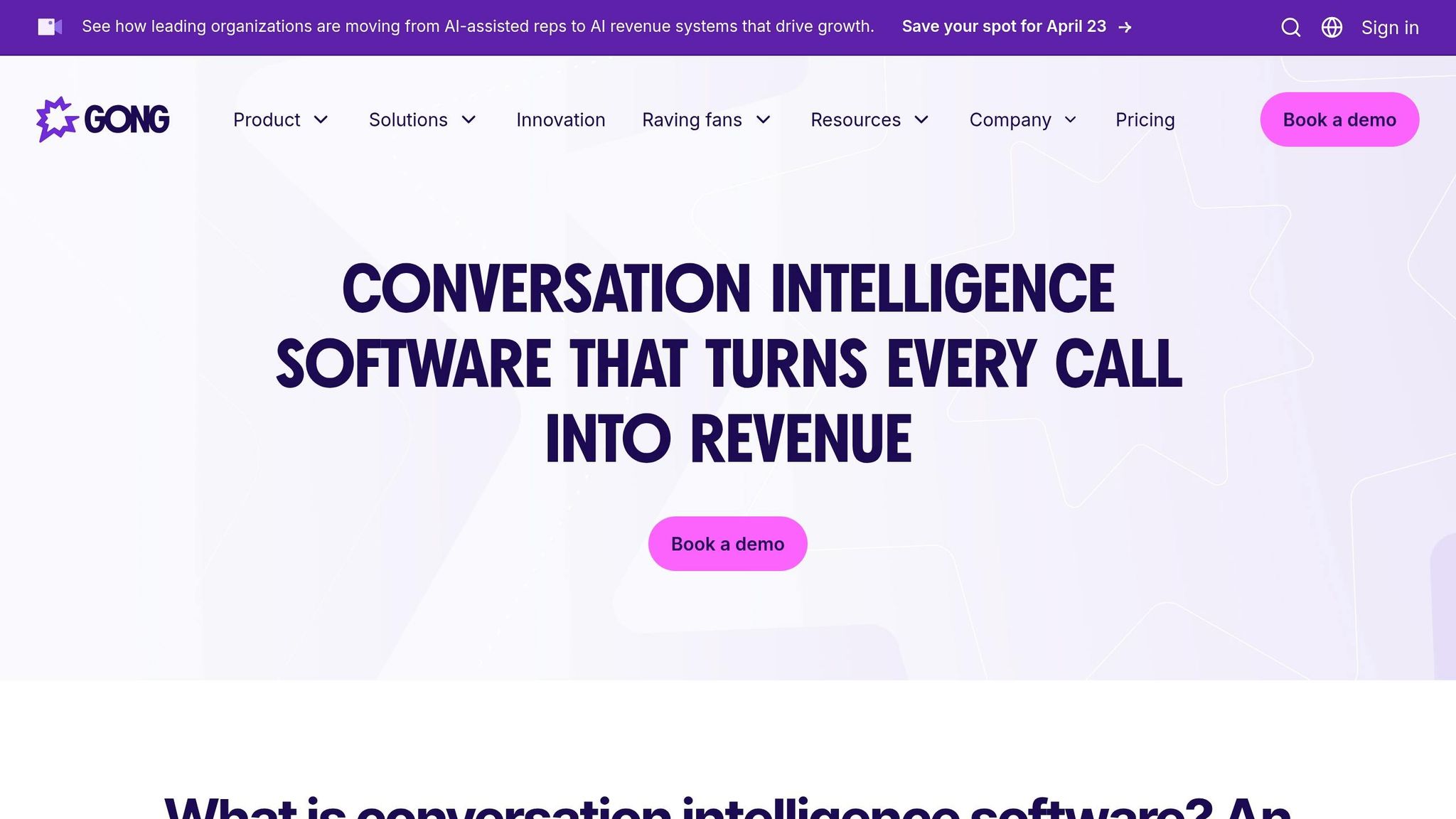
Gong takes a different approach by focusing on customer conversations. It records and transcribes calls and meetings, analyzing them for patterns that could indicate deal risks. This "conversation intelligence" helps sales managers spot potential issues early, allowing them to provide timely coaching and keep deals on track.
Feature Comparison of AI CRM Tools
Comparison Table
To help you evaluate the platforms effectively, here's a table summarizing their standout features, forecasting methods, ideal use cases, and pricing.
Each platform has its strengths, depending on your team's priorities. For example, Salesforce Einstein relies heavily on clean data - 63% of implementations fail due to poor CRM hygiene [14]. Gong, on the other hand, focuses on analyzing conversations to identify risks like competitor mentions or shifts in buyer sentiment. Meanwhile, Clari shines in consolidating forecasts across large, multi-regional teams, though some users report that manual dashboard interpretation is still needed [14].
If cost is a concern, consider this real-world example: a Series C SaaS company managed to save $280K annually while boosting forecast accuracy from 74% to 93% [14].
"We saved $280K annually while improving forecast accuracy from 74% to 93%." – Sarah M., VP of Sales Operations
This breakdown provides a foundation for choosing the tool that aligns with your team's unique requirements. For more sales strategy insights, explore our latest resources.
How to Choose the Right AI CRM Tool
Selecting an AI-powered CRM tool requires a clear understanding of your team's needs and challenges. Here's how to approach the decision-making process effectively.
What to Look for When Evaluating Tools
Start by identifying your current forecasting challenges. Are you dealing with slow processes, limited pipeline visibility, or messy data entry? Pinpointing these issues ensures you focus on tools that solve real problems instead of getting distracted by unnecessary features [13].
Next, consider data quality. AI tools thrive on clean, historical data to make reliable predictions. Ideally, you should have 18 to 24 months of accurate deal data and a minimum of 100 to 200 closed deals [2]. Before moving forward, export 12 months of CRM data and check that null values are below 5% [17]. Poor data costs businesses an average of 31% in annual revenue, and nearly two-thirds of Salesforce Einstein projects fail due to dirty data [14][18].
Look for tools with bi-directional synchronization. These systems don’t just pull data - they also write insights, like risk scores and recommended actions, directly into the CRM fields your team already uses [10]. The best tools analyze multiple data sources, such as email sentiment, call transcripts, calendar activity, and buyer intent signals, rather than relying solely on static CRM fields [10][17]. Achieving forecast accuracy above 90% often depends on clean data, solid platform architecture, and whether your team actually adopts the tool [15].
Another key factor is model transparency. Avoid tools that act as "black boxes." Instead, choose ones that explain why certain scores or predictions are made [10][14]. This clarity helps managers coach their teams more effectively. Also, prioritize tools with automated data-cleaning features, as manual data maintenance can consume 4 to 5 hours of selling time every week [20][14].
Before committing, run a proof-of-concept using historical data. Test the tool against past quarters to see how its predictions compare to actual outcomes [17][15]. If the predictions consistently miss by more than 15% to 20%, it may be time to explore other options [20]. Companies using unified data platforms report a 299% ROI over three years, but only if the tool aligns with their team’s complexity [15].
Once you've identified the right features, ensure the tool is tailored to your team's size and sales cycle.
Adapting Solutions to Your Sales Team
After narrowing down your options, match the tool to your team’s structure and sales cycle. For smaller teams with short cycles (under 30 days), visual pipeline tools with basic scoring are often sufficient. Mid-sized teams with cycles between 30 and 90 days benefit from CRM-native AI or conversation intelligence. Larger enterprise teams with cycles exceeding 90 days typically require full revenue operations platforms [10].
It's essential to standardize your sales stage definitions before activating AI features [19]. A consistent baseline ensures the machine learning model can train effectively. Start with a 30-day pilot focused on one specific goal, such as increasing win rates or shortening sales cycles. Limit the pilot to two AI features, like opportunity scoring and call summaries, to avoid overwhelming your team [19].
While AI provides accurate predictions, allow for manual overrides. Sales leaders often have insights - like a key decision-maker leaving or a sudden budget freeze - that AI can't detect [13][18]. Set clear guidelines for when managers can override AI scores, typically capping overrides at 10% of deals to maintain data integrity [2]. As SAP emphasizes:
"AI sales forecasting software should enhance - not replace - human judgment" [13].
Clearly define your win criteria, such as sales stages or qualification frameworks like MEDDIC, so the AI can identify meaningful trends [13][17]. Integrate the tool with your existing communication platforms - email, calendar, or Slack - via secure APIs to capture real-time engagement signals [16]. Regularly review AI usage during a weekly operations meeting to address friction points and refine the model [19].
For growing teams, scalability is a must. When sales teams exceed five reps, forecast accuracy often drops without dedicated software [20]. Cloud-based AI platforms can automatically scale computing power during peak periods, like the end of a quarter, without requiring manual adjustments [16]. By 2026, 75% of B2B sales organizations are expected to use AI for forecasting, up from just 12% today [17]. Choosing the right tool now can save you from expensive migrations in the future.
Conclusion
AI-powered CRM tools have completely changed the way sales forecasting is done. While traditional methods typically achieve accuracy rates of 60% to 75%, AI-driven platforms can push that precision to an impressive 90% to 98%. This leap in accuracy matters - companies with reliable forecasts are 10% more likely to see year-over-year revenue growth [4][16].
These tools shine because they address specific forecasting challenges with precision. By eliminating biases and relying on real-time, continuously updated signals, they help identify risks early and prevent deals from slipping through the cracks. The benefits are clear: better accuracy, significant time savings, and proactive risk management.
Before diving into an AI CRM tool, take a step back and assess your current challenges. Are you dealing with incomplete or messy data? Limited visibility into your pipeline? Inconsistent sales stage definitions? Your needs might range from basic opportunity scoring to more comprehensive revenue operations capabilities. Factors like team size, sales cycle length, and the quality of your existing data will guide your decision. And remember, AI is there to support human judgment, not replace it [13]. The best results come from blending machine learning insights with the expertise of seasoned sales professionals.
Start by auditing your data. Clean data is essential - after all, poor data quality can drain 31% of a business's annual revenue [18]. If you have at least 12 to 24 months of historical deal data, you're in a strong position to test AI forecasting. Consider running a 30- to 90-day pilot alongside your current process to see how it performs. Each platform offers unique strengths, pricing options, and integration features, so focus on what aligns best with your specific needs instead of chasing every shiny new feature.
With a solid strategy and clean data, your choice of AI tool becomes more than just a tech upgrade - it’s a strategic move. By 2026, 75% of B2B sales organizations are expected to adopt AI for forecasting, compared to just 12% today [17]. Adopting AI-driven forecasting now can help turn your sales pipeline into a reliable engine for revenue growth.
FAQs
What data is needed for AI forecasting to work effectively?
To make AI forecasting work well, collect detailed historical deal data. This includes information like deal stages, win probabilities, deal sizes, and how much time deals spend in each stage. Pay attention to activity patterns - such as the number of calls, emails, and meetings - and engagement signals like response rates and stakeholder involvement. These data points are crucial for training AI models to provide accurate and reliable predictions.
How long does it take to see better forecast accuracy?
Businesses often see better forecast accuracy just months after starting to use AI-powered tools. In fact, noticeable results can often be achieved in as little as six months, provided the implementation is effective and the data being used is of good quality.
How do I keep AI forecasts accurate without losing human judgment?
To keep AI sales forecasts accurate while valuing human judgment, blend AI-driven insights with human expertise. AI can pinpoint patterns and provide valuable support, but it’s crucial to validate its predictions using human review and practical experience. Tools like Coach Pilot incorporate AI coaching directly into workflows, enabling sales teams to align their strategies with execution. This approach ensures forecasts stay dependable and rooted in human intuition.
Related Blog Posts

Remove the guesswork from winning more deals.