B2B Sales
Field Sales Challenges and AI Solutions
Apr 9, 2026
How AI automates admin work, improves CRM data, enforces consistent messaging, optimizes routes, and enables real-time coaching.

Field sales teams lose valuable time to administrative tasks, struggle with incomplete customer data, and face inefficiencies in route planning and training. These issues lead to inconsistent messaging, missed opportunities, and forecasting errors, costing enterprises millions annually. AI tools are transforming sales by automating data entry, providing real-time insights, and optimizing workflows.
Key Takeaways:
Time Efficiency: Reps spend only 38% of their time selling, with the rest lost to admin work. AI-driven tools like voice-first systems reduce this burden.
Data Accuracy: Only 23% of CRM data is complete. AI captures meeting details instantly to prevent memory decay.
Consistent Messaging: AI ensures uniform sales pitches, boosting revenue by up to 20%.
Optimized Routes: AI improves route planning, increasing productivity by up to 40%.
Real-Time Coaching: AI offers ongoing training and guidance, raising win rates by 30%.
Platforms like Coach Pilot integrate AI-driven insights, training, and route planning directly into workflows, helping teams improve efficiency and revenue without adding headcount. As of 2026, 33% of field sales teams still haven’t adopted AI, leaving room for competitive advantage.
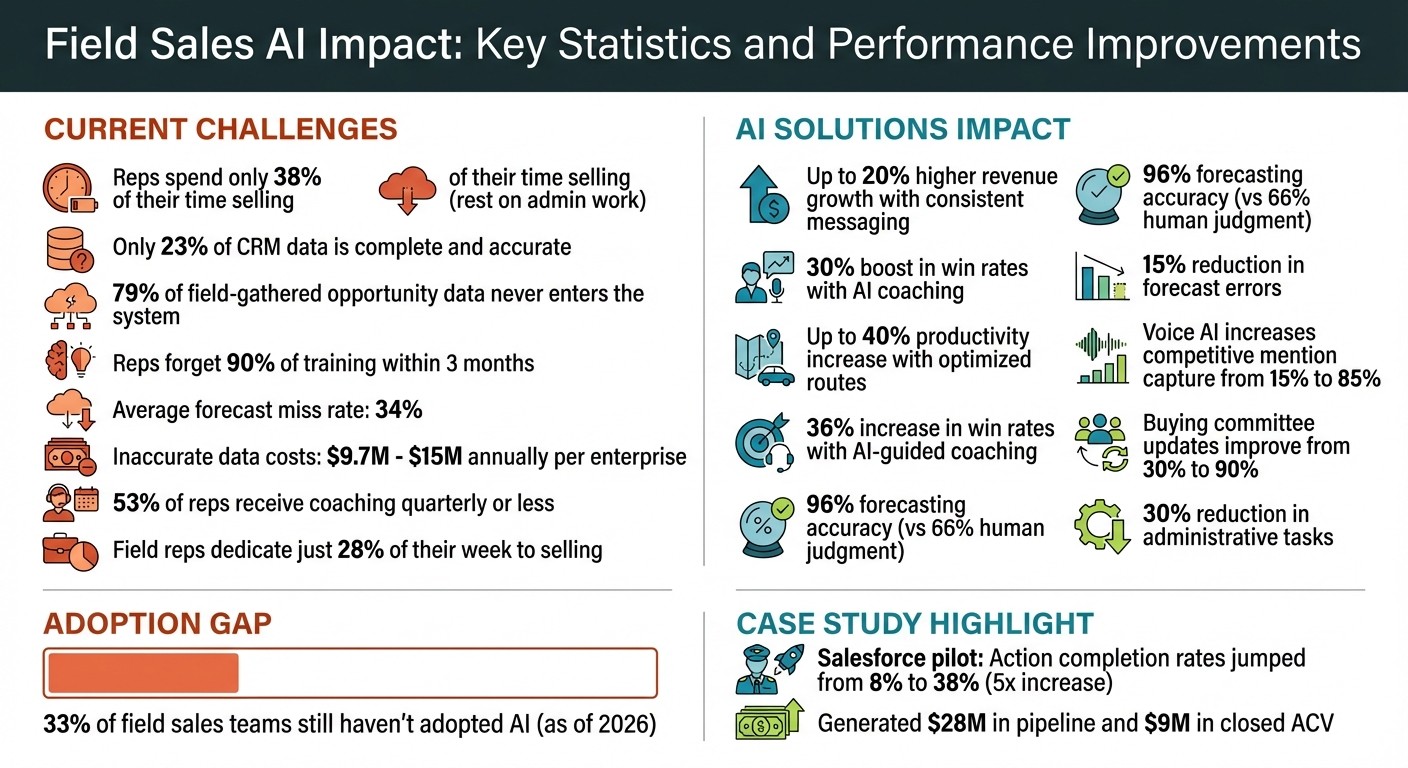
Field Sales AI Impact: Key Statistics and Performance Improvements
AI for Sales (Complete 2026 Guide)
Inconsistent Messaging in Field Sales
When field reps deliver varied messaging across regions, the company’s value proposition becomes muddled. This can confuse prospects and hurt revenue. Research shows that companies with consistent messaging see up to 20% higher revenue growth [5]. Yet, 44% of go-to-market leaders are now prioritizing changes to their sales messaging because static pitches are failing to resonate [6].
What Causes Inconsistent Messaging
The root of inconsistent messaging often lies in outdated tools and ineffective training methods. It’s not necessarily a lack of resources - most companies have plenty of materials. The problem is that simply distributing playbooks and scripts doesn’t mean reps will use them effectively. Legacy systems often store these materials in CRMs or learning platforms, but many reps skim through them at best. Under the pressure of live customer conversations, they end up improvising. Without reinforcement, reps forget 90% of training within three months.
Regional differences also play a big role. Reps often tweak terminology to match local norms, which can lead to a gradual drift away from the company’s core message. Decentralized teams across different time zones add another layer of complexity. Real-time feedback becomes rare, and manual coaching doesn’t scale well, leaving reps without the support they need to stay on message.
AI Solutions for Consistent Messaging
AI offers a way to tackle these challenges by turning static content into real-time, actionable guidance. Instead of forcing reps to dig through lengthy PDFs, AI tools provide the right talk tracks and approved responses exactly when they’re needed. This helps reps avoid going off-message during critical moments.
Take Snowflake as an example. In 2025, the company certified 94% of its 3,000 global reps using AI roleplays in just a few weeks. This saved 1,215 hours of manager grading time per quarter and cut costs by approximately $700,000 annually, all while ensuring consistent messaging across the team [6]. Bureau saw similar success by implementing AI-powered pre-call checklists and personalized coaching. This boosted deal conversions by 30% by improving the consistency of discovery calls [6].
Coach Pilot is another standout example. It integrates dynamic playbooks and real-time coaching directly into sales interactions. Reps get tailored guidance based on their deal stage and buyer persona, helping them stick to the approved core message while adapting to regional needs. The platform also uses spaced reinforcement to combat the natural forgetting curve, ensuring reps stay sharp without overwhelming them with one-off training sessions.
Lack of Real-Time Customer Insights
Field reps often rely on desktop tools that aren’t designed for the realities of mobile work. The result? Only 23% of sales data in enterprise CRM systems is accurate and complete, while 79% of field-gathered opportunity data never even makes it into the system [1]. Reps are frequently forced to choose between documenting important details or preparing for their next appointment. Naturally, revenue-generating activities take priority. This leaves leadership making decisions based on incomplete or outdated information, creating barriers to accessing timely customer insights.
Challenges of Accessing Useful Insights
One of the biggest hurdles is memory decay. Reps typically have short breaks - sometimes as little as 20 minutes - between appointments to log critical details [1]. By the time they update the CRM hours or days later, key nuances like objections, buying signals, or stakeholder concerns are often forgotten, reduced to vague or incomplete notes.
Field conditions add another layer of complexity. Poor lighting, distracting noise, and even bad weather can make manual data entry on mobile devices frustrating [1][2]. On top of that, connectivity issues in rural areas, basements, or underground parking lots can lead to data loss when syncing fails [1][2].
Disconnected systems further compound the problem. Many teams rely on separate tools like spreadsheets, calendars, and email threads, which don’t provide a unified view of the customer [7]. This fragmentation leads to duplicate leads, inconsistent tagging, and broken activity records. The cleanup required by revenue operations teams is time-consuming, and the financial impact is staggering - inaccurate data costs enterprises between $9.7 million and $15 million annually in forecast errors and missed opportunities [1]. These inefficiencies directly undermine strategic sales enablement efforts.
Field reps face another major challenge: balancing their time. On average, they spend only 38% of their time selling, with the rest consumed by administrative tasks [1]. As Gilad Adini, Director of Product at aiOla, puts it:
"Field reps are not bad at their jobs. They're just asked to do two contradictory things at once: spend all day in front of customers, then somehow document every conversation in a system designed for people who never leave their desks." [1]
AI-Driven Analytics for Instant Insights
AI offers a way to address these challenges by processing data immediately. For example, voice-first capture enables reps to debrief verbally right after a meeting - perhaps while walking back to their car. AI then converts their spoken notes into structured CRM data, ensuring that critical details like competitor mentions or stakeholder updates are recorded while they’re still fresh [1]. This eliminates memory decay entirely.
The results speak for themselves. Using voice AI can increase competitive mention capture from 15% to 85% and improve buying committee updates from 30% to 90% [1]. Beyond just transcription, AI uses Natural Language Processing (NLP) to understand the context of sales conversations, identifying buying signals or competitive threats and automatically routing them to the appropriate CRM fields [1].
AI doesn’t stop there. It can also provide real-time pre-call summaries, cutting administrative tasks by up to 30% and allowing reps to focus more on engaging with customers [1][2][3][4].
Platforms like Coach Pilot take this a step further. By embedding AI-driven insights directly into sales workflows, Coach Pilot processes customer data in real time and delivers actionable guidance tailored to each rep’s deal stage and buyer persona. This ensures reps have the context they need to engage effectively without the burden of extensive admin work. Tools like this bridge the gap between the challenges of fieldwork and the need for efficient, data-driven sales execution.
Poor Route Planning and Territory Management
Field reps dedicate just 28% of their week to selling [9][12]. The rest of their time is eaten up by administrative tasks and inefficient travel - a problem that AI can help solve. When territories are divided using outdated tools like spreadsheets or static geographic splits, reps often find themselves zigzagging across regions, revisiting accounts they could have handled earlier. This inefficiency eats into valuable selling time.
How Poor Planning Hurts Sales Efficiency
Traditional territory planning relies heavily on static spreadsheets, which quickly become irrelevant as market conditions shift. Changes like competitor activity, new product rollouts, or evolving customer needs can render these plans outdated in as little as 30 days [8]. This creates hidden imbalances: on paper, territories might seem fair, but in reality, one rep might manage 100 accounts with minimal travel, while another juggles complex renewals, long drives, and multiple meetings.
Ameya Deshmukh from EverWorker highlights the broader consequences:
"When territories are unbalanced, you don't just miss quota - you create churn risk, compensation disputes, uneven pipeline coverage, and rep burnout." [8]
The financial toll is staggering. For example, traffic congestion costs the trucking industry about $74.5 billion annually, translating to $6,500 per vehicle each year [10]. For sales teams, poor route planning leads to wasted fuel, missed opportunities, and fewer customer interactions. In some industries, commission-based teams face churn rates exceeding 40%, driven by the frustrations caused by these inefficiencies [3]. These issues underscore the need for AI-driven solutions to streamline operations.
AI Solutions for Route and Territory Optimization
AI tools bring a new level of precision to territory and route planning. Unlike standard GPS systems that simply find the fastest route between two points, AI considers multiple factors: the most efficient stop sequence, real-time traffic, client priority, appointment windows, buying signals, and past engagement history.
The benefits are clear. For instance, Michelin's AI-driven route planning reduced unplanned downtime by 20%, while DHL's Resilience360 achieved 90-95% arrival accuracy [11][12]. These improvements contributed to a 30% boost in win rates and up to 40% gains in productivity [3]. Modern AI systems don’t just optimize routes - they continuously adapt territories to reflect changing market dynamics.
Unlike traditional annual planning, AI-powered territory management operates as a dynamic system. It doesn’t just balance territories by account numbers; it uses effort-weighted capacity, factoring in travel time, renewal complexity, and required account touches [8]. When conditions change, AI recalculates coverage in real-time, identifying gaps and preventing reps from being overloaded. Tools like Coach Pilot integrate this intelligence directly into sales workflows, providing reps with real-time guidance tailored to their territory, deal stage, and performance needs - without requiring manual adjustments from managers.
Limited Access to Training and Coaching
Field sales representatives face a significant hurdle: the lack of consistent training. Spending most of their time on the road, they rarely get opportunities to refine their skills. Traditional training sessions, held annually or quarterly, often result in a rapid loss of knowledge. Within weeks, reps begin to forget key strategies and messaging, leaving them to rely on improvisation when facing objections or unexpected challenges during customer interactions [14].
Challenges in Delivering Consistent Training
Even though 94% of sales managers claim to provide regular coaching, over half of sales reps - 53% - only receive coaching quarterly or less [14]. This isn't necessarily due to a lack of effort but rather the logistical challenges of managing large, dispersed teams. Sales managers, often responsible for overseeing hundreds or even thousands of reps across different time zones, struggle to catch the subtle moments that can make or break a sale - like an unconvincing response to a pricing objection.
The traditional approach to training forces a tough decision: either pull reps out of the field to focus on skill development or leave them selling with gaps in their performance. Peter Frank, Director of Cardio Renal and Women's Health Franchise Training at Bayer, highlighted the difficulty of balancing these priorities before adopting AI-driven solutions:
"The ability to scale training without sacrificing quality was a game-changer for us" [13].
Without ongoing, targeted practice - such as spaced retrieval exercises - field reps often fail to recall the right techniques under the pressure of a live sales call. This lack of preparation leads to inconsistent messaging and weaker customer engagement [14].
AI-Powered Training and Coaching Solutions
AI is reshaping how training and coaching are delivered to sales teams, making it possible to integrate learning directly into a rep's daily routine. Instead of waiting months for the next workshop, AI provides real-time coaching during customer interactions. It also offers bite-sized microlearning sessions that reps can easily fit into their schedules, even while traveling [14]. The results speak for themselves: companies using AI sales coaching have reported a 36% increase in win rates shortly after implementation, and B2B organizations leveraging AI coaching are 20% more likely to achieve higher revenue growth [15].
AI-powered tools also create realistic roleplay environments where reps can practice handling objections and navigating challenging scenarios in a low-pressure setting. Keenan Stare, Product and Disease Training Manager at Novartis, explained:
"Quantified's AI personas enabled us to scale our training without pulling people out of the field" [13].
One standout tool, Coach Pilot, embeds continuous coaching directly into sales workflows. It offers tailored playbooks and immersive training, addressing those critical moments when reps might otherwise hesitate. The platform provides personalized guidance based on factors like territory, deal stage, and individual performance. A VP of Global Sales and Customer Operations at a Global Tech Company shared:
"This is transforming how we do sales management and coaching. We finally have reps doing roleplays. And the insights are driving significant growth" [13].
Measuring Sales Performance Gaps
When it comes to addressing challenges in training and accessing real-time insights, one major issue stands out: accurately measuring and forecasting sales performance. Sales managers often face incomplete data due to delayed updates and memory lapses, which can compromise their ability to track and predict performance effectively [1][4].
Difficulties in Tracking and Analyzing Metrics
Traditional methods of performance tracking often leave gaps in the data. For example, they might capture a snapshot of activity during a Monday morning call but miss critical deal changes that happen between reporting periods [16]. Managers are left piecing together insights from various signals, such as email sentiment, stakeholder engagement, and deal velocity [16]. The outcome? Forecasts are frequently off the mark, with an average miss rate of 34%. In fact, 67% of sales leaders cite forecasting as their biggest challenge [16].
Another common issue is the tendency to overestimate deal closure probabilities. For instance, a deal might be rated at an 80% likelihood of closing, but the actual chances could be closer to 40% [16]. Without real-time data, coaching often happens after losses occur, relying more on subjective anecdotes than on objective, actionable metrics [18].
AI Performance Analytics for Better Forecasting
AI has emerged as a game-changer for tackling these tracking and forecasting challenges. By analyzing a wide range of variables - like engagement signals, deal velocity, contact depth, and follow-up speed - AI enables evidence-based evaluations rather than relying on intuition. This approach can boost forecasting accuracy to as high as 96%, compared to just 66% with human judgment alone [17]. Companies adopting AI-driven tools have reported a 15% reduction in forecast errors [17].
A standout example is Siemens, which, in February 2026, partnered with Outreach to overhaul its global forecasting processes for more than 4,000 sellers across 190 countries. Thorsten Reichenberger, Head of Revenue Operations, led the initiative, which streamlined opportunity processes and improved pipeline data quality. As a result, forecast submission rates exceeded 70% [19]. Reichenberger noted:
"With Outreach we get increased transparency. Now we are getting much easier, deeper insights into the structure in a way we've never had before" [19].
Coach Pilot takes these analytics a step further by embedding them directly into sales workflows. This platform provides real-time insights into deal health and rep performance, flags stalled or at-risk deals, and offers actionable guidance for next steps. By integrating custom playbooks with AI-driven insights, Coach Pilot enables sales managers to shift from reactive problem-solving to proactive performance management, transforming how teams are coached and revenue is forecasted.
Conclusion
Field sales teams face a range of challenges: inconsistent messaging, limited customer insights, inefficient route planning, and difficulty in measuring performance gaps. These obstacles don’t just affect individual reps - they also drag down win rates, forecast accuracy, and overall revenue growth.
AI-driven tools are stepping in to tackle these issues directly. By providing personalized, context-aware guidance through platforms like CRMs, Slack, or mobile devices, AI helps reps deliver the right message at the right time. Companies using AI to streamline sales workflows are reporting impressive results, with win rates improving by 30% or more [3]. This shift from passive reporting to proactive execution ensures that sales teams are equipped with actionable insights backed by solid data.
The numbers speak for themselves. Salesforce’s internal pilot with agentic AI saw action completion rates jump from 8% to 38%, nearly a 5x increase. This contributed $28 million in generated pipeline and $9 million in closed ACV [20]. As Ali Nahvi, Salesforce’s Director of Product Innovation, explained:
"The challenge wasn't to build more models - it was to operationalize the ones we already had" [20].
Despite these advancements, adoption remains uneven. As of early 2026, 33% of field sales teams still aren’t leveraging AI [2], leaving a huge opportunity for those willing to embrace the technology. Teams that integrate AI into their workflows - embedding coaching, automating admin tasks, and capturing field data in real time - stand to achieve predictable revenue growth without adding headcount.
Coach Pilot offers a comprehensive solution by combining custom playbooks, immersive training, and AI-powered coaching. It helps bridge the gap between strategy and execution, improving forecast accuracy and shortening sales cycles. AI is transforming field sales - now is the time to decide whether your team will lead the charge or risk being left behind. Explore our sales performance insights and start leveraging AI-driven coaching today to revolutionize your results and drive market success.
FAQs
How does AI reduce field sales admin work?
AI takes the hassle out of field sales admin work by automating repetitive tasks like logging calls, updating pipeline information, and organizing customer histories. It can also draft follow-up emails, manage tasks, and generate reports. On top of that, AI sales assistants make workflows smoother by researching potential customers, tailoring outreach efforts, and keeping CRM data updated in real time. By handling these time-consuming chores, AI allows sales reps to concentrate on what they do best - selling - while improving both efficiency and overall productivity.
How can AI improve CRM data quality in the field?
AI improves the quality of CRM data by automating repetitive tasks such as data enrichment, validation, and deduplication. This automation minimizes manual errors and ensures records are accurate. AI can also fill in missing information, update outdated details, and highlight inconsistencies for immediate correction. The result? Cleaner data that enhances lead scoring, improves forecasting, and supports more tailored customer outreach. This not only increases productivity but also sharpens forecast precision and strengthens customer engagement, leading to better sales performance.
How does AI make sales coaching continuous for reps on the road?
AI makes it possible for sales reps on the go to receive real-time, tailored coaching based on live conversations and engagement data. It pinpoints areas needing improvement - like missed discovery questions or ineffective objection handling - right during the sales process, allowing for immediate adjustments. By integrating AI-driven feedback into everyday tasks, sales teams can quickly adapt, stay consistent, and enhance their performance no matter where they are. This approach ensures that coaching becomes a natural, ongoing part of their workflow.
Related Blog Posts

Remove the guesswork from winning more deals.