B2B Sales
AI vs. Manual Sales Content Management
Mar 17, 2026
AI speeds and scales sales content while human strategy preserves nuance—use a hybrid approach to cut waste, boost accuracy, and close more deals.

Sales content chaos is costing your team time and revenue. Sales reps waste up to 30 hours monthly searching for materials, and 65% struggle to find up-to-date resources. The result? Missed opportunities and lost credibility.
AI-driven sales content management offers a solution by delivering the right resources at the right time, directly into workflows. Unlike manual methods, which rely on static repositories and human effort, AI systems automate content discovery, creation, and updates - saving time and boosting productivity.
Here’s a quick breakdown of the key differences:
AI Advantages: Speeds up processes, ensures content accuracy, and scales efficiently. Companies using AI report shorter sales cycles (up to 20%), larger deal sizes, and increased productivity. This shift allows managers to move beyond manual reviews by using AI sales coaching to scale feedback across the entire team.
Manual Benefits: Allows for personalized, nuanced messaging but is time-consuming and harder to scale.
Challenges: AI relies on clean data and human oversight to avoid errors, while manual methods struggle with efficiency and consistency.
Combining AI for repetitive tasks with human expertise for strategy yields the best results, driving faster workflows and higher revenue growth.
AI-Driven Sales Content Management
What AI-Driven Sales Content Management Can Do
AI-powered platforms take the heavy lifting out of content creation. They can generate battlecards, pitch decks, one-pagers, solution briefs, and case studies by pulling from call transcripts and existing materials [4][8][10]. Instead of starting from scratch, your team gets a draft in minutes, ready for fine-tuning and approval.
But it doesn’t stop there. AI also tracks product updates and pricing changes, automatically refreshing materials or alerting your team when updates are needed [10]. This ensures your reps don’t accidentally share outdated information. After sales calls, AI can swiftly turn transcripts into personalized follow-up emails, meeting summaries, or mutual action plans - often within minutes of the conversation [9][10][5].
AI’s capabilities extend to analyzing complex data. It processes content metadata (like product, use case, or deal stage) alongside account data (such as industry or region), using advanced Natural Language Processing to surface the most relevant materials directly in your CRM [11][1]. This combination of automation and intelligence helps teams work faster, smarter, and with fewer errors.
Advantages of Using AI for Content Management
AI dramatically shortens the time it takes to produce training and sales materials. What once took weeks or months can now be done in minutes [8]. For example, Alight, a cloud-based technology provider, implemented Highspot’s AI tools and achieved 9% shorter sales cycles, 11% larger deal sizes, and a 57% increase in active learning among their reps [5]. Similarly, Aetna reported a 62% boost in content governance and an 83% increase in content findability, saving reps countless hours spent searching for materials [5].
These improvements ripple across entire teams. Companies that use AI-driven content recommendations report a 25% increase in rep productivity [1], while AI-powered personalization leads to 60% higher engagement compared to generic messaging [1]. The numbers speak for themselves: AI-enabled sales teams achieve 83% higher revenue growth than those that don’t use AI [5].
Nathan Thompson, Content Manager at Copy.ai, puts it this way:
"AI is a powerful force multiplier, not a replacement for human expertise. It automates repetitive and time-consuming tasks... which frees up your sales enablement team to focus on higher value activities" [4].
Drawbacks and Limitations of AI
Despite its many advantages, AI has its limitations. It’s not a magic fix - it relies on the quality of the data it processes. Bad data leads to bad results. Snyk’s 50-person AE team learned this firsthand. By switching to a verified contact database with a 7-day refresh cycle, they slashed their email bounce rate from 35-40% to under 5% and saw a 180% increase in AE-sourced pipeline [12]. This underscores the importance of clean, reliable data.
AI also amplifies whatever processes are already in place. If your sales methodology has flaws, automation will only make those flaws more apparent. In fact, 26% of AI transformations fail to deliver the expected business value [13]. One common culprit? Tool overload. Too many disconnected AI tools can overwhelm teams, reducing adoption and undermining results.
There are also risks tied to brand consistency and compliance. AI-generated content can feel generic or stray from your company’s voice if it’s not anchored in your messaging. This could even lead to legal or compliance issues. To mitigate this, establish clear oversight processes. Define which AI-generated updates can be published automatically and which require human review [10]. Ground AI tools in approved messaging, ideal customer profiles, and specific proof points to ensure outputs reflect your company’s unique value [10].
Manual Sales Content Management
Benefits of Manual Content Management
Manual content management relies entirely on human effort, which can be a game-changer when you need personalized messaging or emotional depth that automation can't achieve. Sales reps can fine-tune materials to address specific customer needs by aligning with buyer needs or tackle industry-specific challenges that generic, pre-made resources often overlook.
In situations like high-stakes deals or regulated industries, human oversight is indispensable. A manual approach allows marketers to incorporate subtle, audience-specific touches, such as culturally relevant references or emotionally impactful messaging, that automated systems simply can't replicate.
Another strength of manual management is its flexibility. Humans bring the final touch of creativity, ensuring materials align with the brand and meet strategic goals. This transforms basic drafts into polished, impactful assets. As Kevin from Fieldgrade puts it:
"The AI handles what it should, and my team handles what we do best. No confusion about roles, no redundant work. Just better marketing, faster" [14].
That said, these benefits don’t come without challenges, particularly when it comes to efficiency.
Downsides of Manual Methods
Despite its strengths, manual content management has some serious drawbacks. The most obvious one is time. Sales reps can lose up to 30 hours each month searching for or creating content in poorly organized systems [2]. This inefficiency eats into valuable selling time and reduces overall productivity.
Another issue is consistency and scalability. Without automated tools to manage version control, keeping collateral up-to-date becomes a constant struggle, often requiring input from multiple teams. Federico Presicci, an Enablement Advisor, highlights this problem:
"Traditional sales CMS platforms often serve as little more than static repositories – glorified storage spaces that don't integrate well with a sales rep's daily workflow" [3].
This disconnect often results in "rogue content", where sales reps create their own materials when they can’t find what they need. The result? Brand inconsistency and potential compliance risks.
The financial impact of these inefficiencies is substantial. Companies can lose up to $405,000 annually due to disorganized content systems [2]. Even more troubling, two-thirds of sales collateral goes unused because reps either can't locate it or don't trust its relevance [2]. Moreover, 83% of sales leaders say their teams struggle to adapt to evolving customer needs [1], and 82% believe that current enablement content delivery systems need a major overhaul to support revenue goals [1].
AI built for sales: From pipeline generation to proposal creation
AI vs. Manual: Side-by-Side Comparison
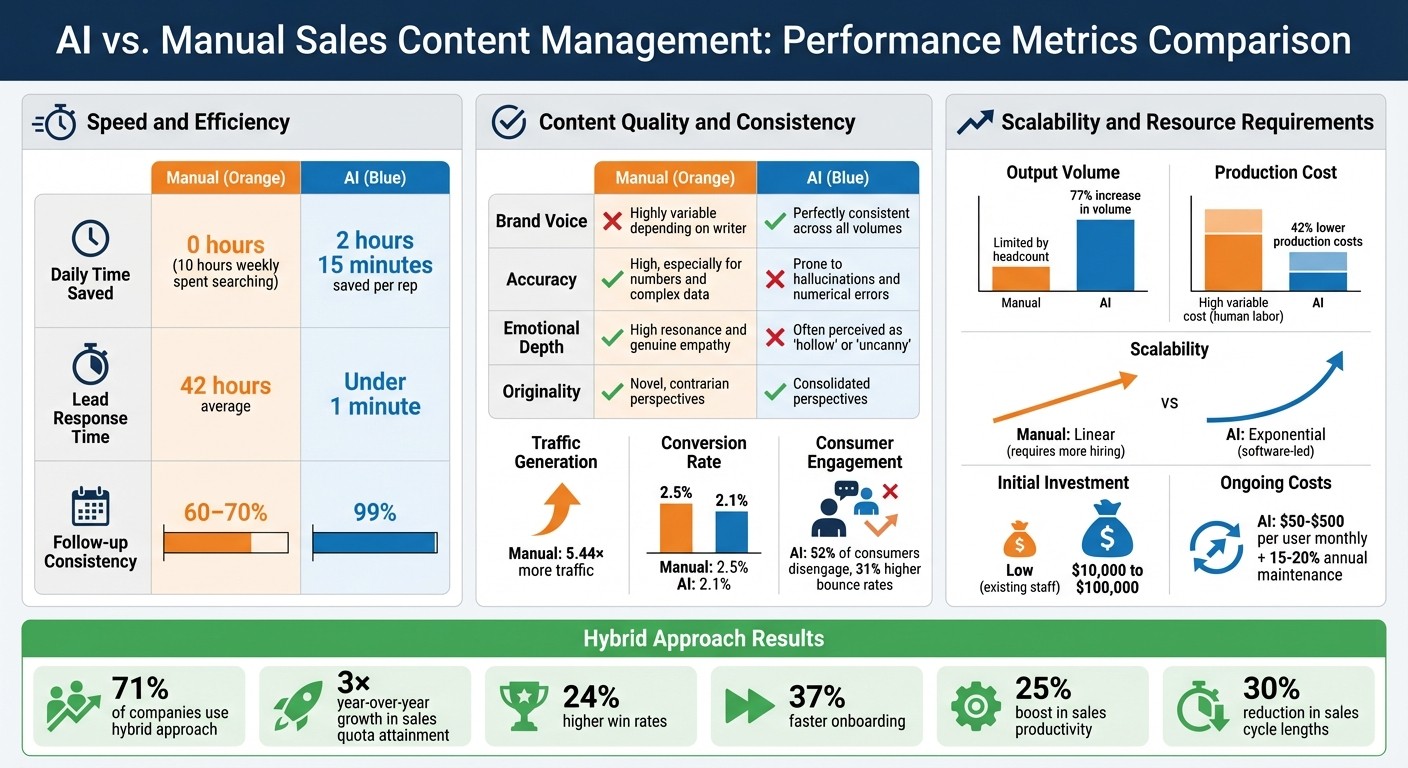
AI vs Manual Sales Content Management: Performance Comparison
This section dives deeper into the performance differences between AI-powered and manual methods, focusing on speed, content quality, and scalability.
Speed and Efficiency Comparison
AI-driven tools integrate seamlessly with CRM systems, delivering relevant content - like battle cards or case studies - without manual effort [1]. This automation saves sales representatives an average of 2 hours and 15 minutes daily on administrative tasks [19]. On the other hand, manual processes demand significantly more time, with reps spending about 10 hours per week searching for information [19].
When it comes to response time, AI systems are lightning-fast, often replying in under a minute. Compare this to the 42-hour average for manual follow-ups [19]. Similarly, AI ensures follow-up reliability at 99%, far surpassing the 60–70% consistency achieved manually [19].
Factor | Manual Method | AI-Driven Method |
|---|---|---|
Daily Time Saved | No time saved (~10 hours weekly searching) [19] | 2 hours 15 minutes per rep [19] |
Lead Response Time | Hours to days (avg. 42 hours) [19] | Minutes (often under 1 minute) [19] |
Follow-up Consistency | 60–70% [19] | 99% [19] |
Content Quality and Consistency Comparison
While speed is critical, content quality and consistency also set AI and manual methods apart. Human-created content often excels in emotional depth and nuance, generating 5.44 times more traffic and slightly better conversion rates (2.5% vs. 2.1%) than AI-generated content [17]. However, AI shines in maintaining a uniform brand voice across large-scale projects [16].
That said, AI isn’t flawless. It can "hallucinate" or produce factual inaccuracies, especially with numerical data. Humans, by contrast, are more reliable when handling complex insights [17][18]. Interestingly, 52% of consumers disengage with content they suspect is AI-generated, and bounce rates for such content are 31% higher than for human-made alternatives [16][17].
"AI content performs comparably to human content when treated as a first draft requiring human refinement, not as a finished product." – Roald, Founder, Fonzy.ai [16]
The emerging best practice is a hybrid "70/30 workflow", where AI handles 70% of structural and data-heavy work, leaving humans to fine-tune emotional depth and ensure accuracy [17].
Feature | AI-Driven Approach | Manual Approach |
|---|---|---|
Brand Voice | Perfectly consistent across all volumes [16] | |
Accuracy | High, especially for numbers and complex data [18] | |
Emotional Depth | Often perceived as "hollow" or "uncanny" [17] | |
Originality | Presents consolidated perspectives [17] | Provides novel, contrarian perspectives [16] |
Scalability and Resource Requirements Comparison
Scalability is where AI truly excels. Manual methods scale linearly - more content requires more staff - while AI scales exponentially with minimal added expense [10]. AI can boost content output by 77% and reduce production costs by 42% [17].
Take SmartRecruiters, for example. In November 2025, they adopted SalesHood's AI-driven sales tools under Caitlin Brannan's leadership. The results? A 4× increase in deal size, 2× higher purchase rates, and a 15% boost in deal velocity [7]. Achieving such outcomes with manual methods alone would be far more resource-intensive.
However, AI systems do require upfront investment. Implementation costs range from $10,000 to $100,000, with licensing fees of $50 to $500 per user monthly [19]. Organizations should also plan for training expenses between $5,000 and $25,000, plus ongoing maintenance costs of 15–20% of annual licensing fees [19]. Despite these initial costs, the ROI can be staggering: for a 10-person sales team, AI adoption can deliver a 650% ROI in the first year through productivity gains and higher conversions [19].
Factor | Manual Method | AI-Driven Method |
|---|---|---|
Output Volume | Limited by headcount | 77% increase in volume [17] |
Production Cost | High variable cost (human labor) | 42% lower production costs [17] |
Scalability | Linear (requires more hiring) | Exponential (software-led) [10] |
Initial Investment | Low (leveraging existing staff) | $10,000 to $100,000 [19] |
Combining AI and Manual Methods
To tackle the chaos that often derails revenue efforts, blending AI's efficiency with human insight is key. The most successful sales teams don’t choose between the two - they harness both. In fact, 71% of companies already use this hybrid approach, leveraging AI's speed and processing power alongside human emotional intelligence [6].
Using AI for Repetitive Tasks
AI shines when it comes to streamlining repetitive tasks that don’t directly drive deal closures. Automating things like prospect research, CRM data entry, content categorization, and email drafting [21] frees up valuable time for sales reps. AI can even verify CRM data accuracy by analyzing buyer language from calls, reducing the risk of overly optimistic manual updates [21].
Take Aerotech as an example: In January 2026, they integrated HubSpot's AI-powered Breeze tool into their sales processes. The result? A 66% increase in win rates and a 50% reduction in deal closing times [22]. By letting AI handle the routine, sales teams can focus on more strategic, human-led tasks.
Using Human Expertise for Strategy
While AI tackles the grunt work, humans take the lead on the nuanced aspects of sales - building relationships, showing empathy during discovery calls, managing complex negotiations, and picking up on subtle social cues [20]. AI can analyze patterns in successful deals, but it’s human intuition that contextualizes these insights within broader market trends [6].
"AI should inform the message, not deliver it entirely." – Callie Werley, Sales Empowerment Group [20]
This is where the "AI writes, human optimizes" approach comes in. AI might draft a sales email or content piece, but it’s up to human reps to fine-tune the message, adding personal touches, anecdotes, and an authentic tone [22].
Results from a Combined Approach
When AI and human expertise work in harmony, the results speak for themselves. Companies that pair AI with human coaching see far better outcomes than those relying on AI alone. Hybrid strategies have been linked to 3× year-over-year growth in sales quota attainment, 24% higher win rates, and 37% faster onboarding for new reps [23].
On average, these approaches lead to a 25% boost in sales productivity and a 30% reduction in sales cycle lengths [6]. Platforms like Coach Pilot illustrate this balance perfectly, combining AI-driven coaching, live human expertise, and custom playbooks into a seamless workflow. While AI scales operations, it’s the human touch that builds trust and closes deals.
Task Category | AI Responsibility | Human Responsibility |
|---|---|---|
Content Creation | Generating first drafts, research, formatting [21] | Adding nuance, brand voice, and emotional intelligence [4] |
Workflow | CRM updates, scheduling, task reminders [21] | Strategic decision-making and relationship building [6] |
Analysis | Predictive lead scoring, content performance tracking [1] | Interpreting signals and adjusting strategies [6] |
Conclusion: Selecting the Right Method for Your Business
There’s no universal solution here - your choice should address your specific sales challenges. For instance, if your team struggles to quickly access content, AI-driven tools can ease that bottleneck. On the other hand, if your messaging feels flat or lacks emotional resonance, a human-driven strategy becomes critical [15].
Before diving into automation, lay a solid foundation. Pinpoint the talk tracks and resources your top performers rely on, and incorporate those into your AI workflows [4]. Without this groundwork, you risk automating subpar processes. This is why many businesses lean toward a hybrid model, combining AI for efficiency with human insight to maintain depth and authenticity.
The numbers back this up. Some companies have seen a 25% boost in rep productivity [1], while hybrid strategies have been shown to shorten sales cycles by up to 30% and make businesses 1.5 times more likely to exceed their sales targets [6]. A great example is Coach Pilot, which blends AI coaching with human oversight through live calls and custom playbooks.
If you’re ready to make the shift, start by targeting areas with the biggest potential impact. Begin small - automate tasks like follow-up sequences or generating use cases - and set up a human review process to ensure brand consistency and accuracy [4]. Regularly audit your content (quarterly works well) to phase out outdated materials and train your AI with only the best resources [15]. To maximize adoption, integrate your tools directly into your CRM and communication systems, avoiding the clutter of disconnected tools, often referred to as "GTM bloat" [3].
The shift is clear: static content repositories are being replaced by dynamic, in-the-moment content systems. As Federico Presicci aptly notes:
"Traditional sales content management systems simply cannot provide [immediate, in-the-flow-of-work content], and they are on their way out" [3].
The real challenge isn’t deciding whether to adapt - it’s determining how quickly you can align your content strategy with the critical moments that drive revenue.
FAQs
When should my team use AI vs. manual content management?
AI-powered content management can streamline workflows, improve personalization, and enable quick decision-making. It handles tasks like locating assets, updating CRM systems, and tailoring outreach efforts. The result? Saved time and increased productivity.
However, manual methods still shine in areas that demand human creativity, intricate storytelling, or strategic judgment - particularly in high-stakes negotiations. Often, the sweet spot lies in a hybrid approach: leveraging AI for efficiency and scale while relying on human expertise for personalized, meaningful connections.
What data is needed before adopting AI for sales content?
To make the most of AI in sales content, start by collecting key data. Focus on details like prospect profiles, patterns from successful past messages, relevant industry trends, and historical sales interactions. This foundation allows AI tools to deliver personalized and automated content that aligns seamlessly with your sales objectives.
How do we prevent AI content from being inaccurate or off-brand?
To keep AI-generated content accurate and aligned with your brand, integrating human oversight is key. AI alone can sometimes produce errors or even fabricate information, which could damage your brand's credibility. By pairing AI's speed with careful human review, you can ensure the content remains high-quality and consistent with your brand's voice.
Related Blog Posts

Remove the guesswork from winning more deals.