B2B Sales
Best Sales Enablement Tools: 2026 Comparison Guide
Feb 8, 2026
Compare top sales enablement platforms by team fit, AI coaching, integrations, and pricing — concise pros, cons, and use-case guidance to pick the right tool.

Struggling to choose the best sales enablement tool for your team? Here's a quick breakdown of the top three platforms in 2026 - Coach Pilot, Salesforce Sales Enablement Cloud, and HubSpot Sales Hub. These tools are designed to streamline workflows, provide real-time coaching, and boost sales performance.
Key highlights:
Coach Pilot: Real-time AI coaching with tailored playbooks. Best for mid-market and enterprise teams.
Salesforce Sales Enablement Cloud: Deeply integrated with Salesforce CRM, ideal for large enterprises with complex needs.
HubSpot Sales Hub: Affordable, user-friendly, and great for small to mid-sized businesses.
Quick Comparison:
Platform | Best For | Starting Price | Key Feature |
|---|---|---|---|
Coach Pilot | Mid-size to enterprise teams | Custom pricing | AI-powered real-time coaching |
Salesforce Sales Enablement Cloud | Large enterprises | Varies by use case | Predictive analytics and deep CRM ties |
HubSpot Sales Hub | Small to mid-sized businesses | $15/month | Simple setup and AI-driven automation |
Each tool addresses unique challenges. Whether you're tackling scattered resources, low quota attainment, or disconnected workflows, this guide will help you find the right solution for your sales team.
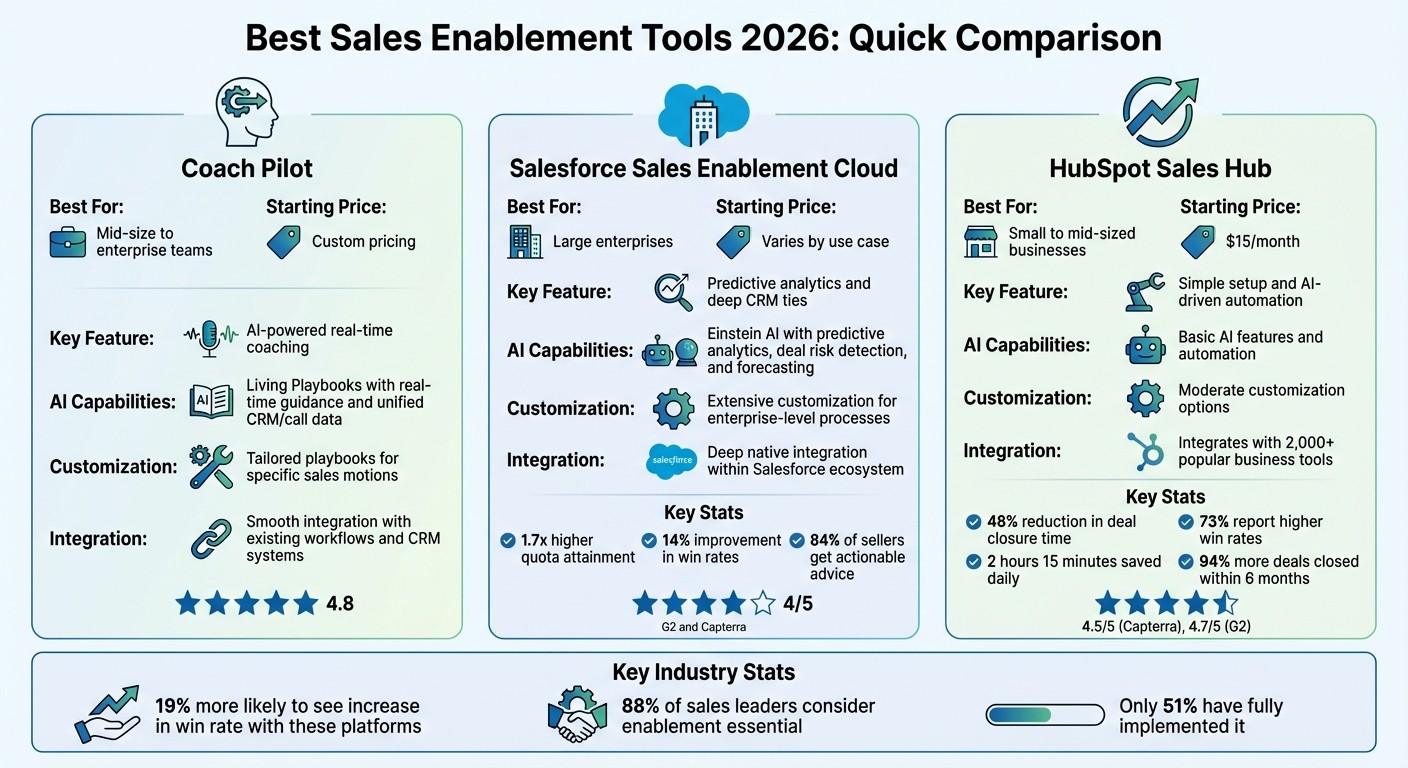
Sales Enablement Tools Comparison 2026: Coach Pilot vs Salesforce vs HubSpot
Build the PERFECT sales enablement tech stack
1. Coach Pilot
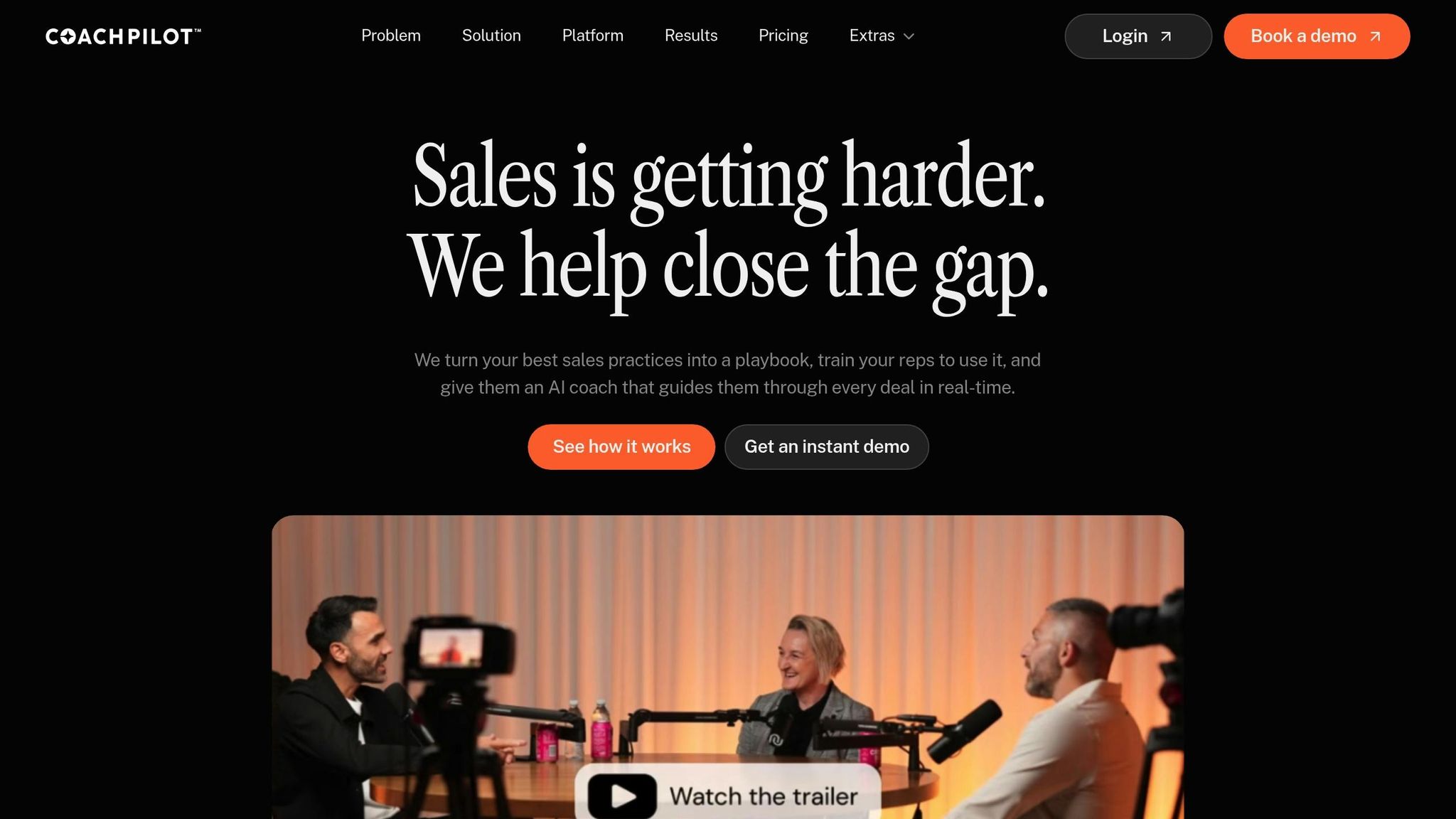
Coach Pilot brings AI-powered coaching directly into your team's daily workflow. Instead of treating training as a one-off event, it acts as a dynamic sales playbook, offering real-time guidance to help sales reps navigate every stage of the process with actionable insights.
AI Capabilities
The platform's AI provides personalized, real-time coaching tailored to your team's ongoing activities. By aligning with established sales methodologies, it ensures every interaction is backed by data-driven insights, helping your team stay informed and adaptable.
Customization Options
Coach Pilot allows you to create custom sales playbooks designed to fit your unique sales process, industry, and buyer personas. The platform evolves with your team's selling style, reinforcing best practices through live workshops and weekly coaching sessions. These sessions fine-tune strategies based on actual deal outcomes, making the tool highly adaptable to your needs.
Integration Features
Coach Pilot integrates smoothly with your existing tools, ensuring your team can work within familiar platforms. The system also includes sales performance analytics to monitor crucial metrics like win rates, sales cycle duration, and forecast accuracy, giving leadership clear insights into team performance.
Pricing
Coach Pilot offers three pricing tiers, each tailored to different team needs:
Starter Package: Perfect for small teams, this includes sales playbook creation, basic training, and AI integration.
Advanced Package: Designed for teams with complex sales processes, it adds refined playbook customization, advanced training, and tailored AI features.
Enterprise Plan: Built for large organizations, this plan includes the full range of features, such as compliance support and advanced analytics.
For detailed pricing based on your team's size and requirements, contact Coach Pilot directly.
2. Salesforce Sales Enablement Cloud
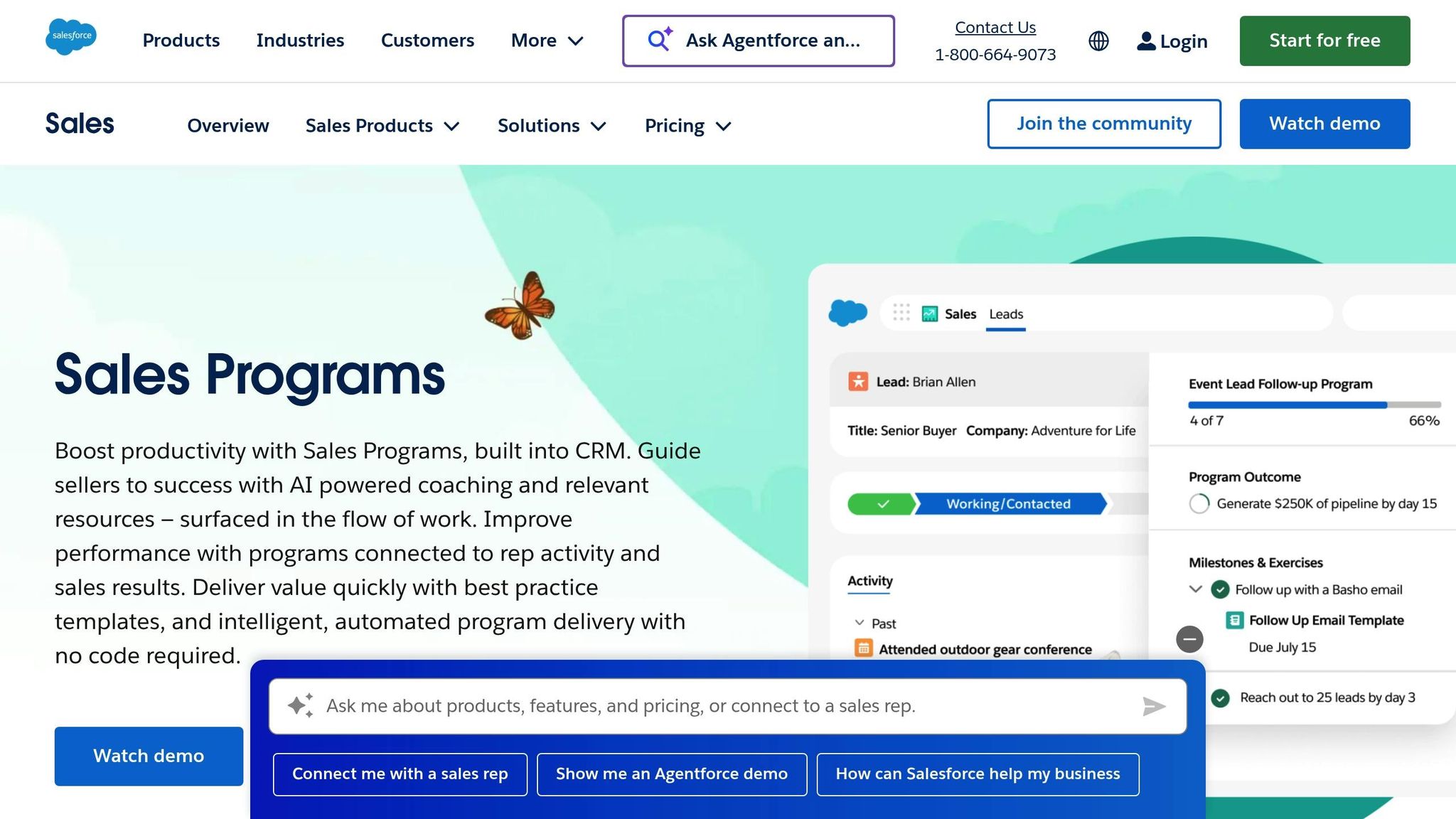
Salesforce Sales Enablement Cloud takes the hassle out of switching between platforms by embedding training and coaching directly into the Sales Cloud CRM. This streamlined approach makes a difference - sales reps in smoother workflows achieve 1.7x higher quota attainment compared to those juggling multiple tools [6]. The platform also links enablement activities directly to revenue metrics, tracking how specific training modules influence pipeline growth and win rates.
AI Capabilities
With the Agentforce Sales Coach, an AI agent, sales reps can practice pitches and roleplay scenarios using real deal data [6][7]. The platform’s Conversation Insights feature records and transcribes calls, analyzing keywords, competitive mentions, and talk-to-listen ratios to uncover coaching opportunities [7]. Teams that embraced AI-driven coaching tools reported a 14% improvement in win rates, as structured AI feedback replaced informal critiques [6]. Additionally, the system provides personalized onboarding journeys tailored to each rep’s role and career milestones [7].
Customization Options
The platform’s no-code program builder empowers enablement managers to create custom sales plays, scripts, and templates without needing technical expertise [7]. Training programs can target specific goals like cross-selling or expanding product adoption. It also intelligently suggests relevant content - such as case studies, pricing tools, or whitepapers - based on deal stages and pipeline signals [6]. Built-in analytics go beyond tracking completion rates, offering insights into which resources directly contribute to revenue growth.
Integration Features
Because it’s built into Sales Cloud, Salesforce Sales Enablement integrates effortlessly with your existing Salesforce tools. It also connects with Slack, delivering real-time alerts and AI insights directly where sales teams communicate [6]. The platform ties into every step of the revenue lifecycle, from quotes to contracts and billing. This integration ensures that 84% of sellers feel their systems provide actionable advice for their next steps with prospects [6]. For those using third-party enablement tools, the platform supports external integrations while keeping all sales activities centralized.
Pricing
Salesforce offers a 30-day free trial of Sales Cloud, which includes enablement features, without requiring a credit card or installation [6][7]. It consistently earns a 4/5-star rating or higher on platforms like G2 and Capterra, with users praising its ability to consolidate lead tracking, contact management, and reporting into one customizable interface [7]. Pricing varies based on organizational size and feature needs, so reaching out to Salesforce directly is the best way to get a tailored quote.
3. HubSpot Sales Hub

HubSpot Sales Hub tackles modern sales challenges with its Breeze AI Suite, which streamlines lead identification and automates personalized outreach. The AI Meeting Assistant simplifies preparation by pulling data like sales activity history, emails, and call logs, giving reps instant context without manual effort. These tools help reduce deal closure time by 48%, and 95% of professionals report spending less time on administrative tasks [11][12].
AI Capabilities
HubSpot Sales Hub comes packed with AI-driven tools designed to make sales teams more effective. For instance, its AI analyzes calls to identify key topics and generates playbooks with industry-specific questions to improve lead qualification and sales coaching. Predictive scoring, powered by machine learning, ranks leads and deals based on their likelihood to convert. The platform saves users an average of 2 hours and 15 minutes per day through automation, and 73% of professionals using it report higher win rates [9][11].
"AI keeps tabs on buyer intent and engagement for sales teams so reps can strike when a lead is in the perfect stage of their journey. It's a game-changer for boosting productivity." - Reilly James Renwick, CMO, Pragmatic Mortgage Lending [8]
Customization Options
For businesses with more complex needs, HubSpot’s Enterprise tier offers advanced customization options. Users can create custom objects, defining their properties and associations to meet unique requirements. The platform also enables the creation of tailored deal pipelines, automated lead segmentation with custom workflows, and branded quote templates (CPQ). Another standout feature is digital sales rooms - private, personalized online spaces for buyers that auto-populate with CRM data. Additionally, custom playbooks, scripts, and competitor guides equip sales teams with flexible strategies tailored to their specific workflows as they prepare for the future of sales enablement [13][14].
Integration Features
Built on the HubSpot Smart CRM, Sales Hub ensures seamless collaboration across marketing, sales, and service teams by unifying data. The platform offers over 2,000 integrations, including native connections to Salesforce, NetSuite, and SAP. Its bi-directional syncing ensures external databases and marketing tools stay updated and audit-ready. Users leveraging these integrations close 94% more deals within six months [10][13].
Pricing
HubSpot offers a free version with basic CRM and sales tools, while its paid plans cater to varying needs:
Starter plan: $15–$20 per seat/month, offering essential sales enablement features.
Professional plan: Around $100 per seat/month, including AI-powered forecasting.
Enterprise plan: Starting at $150 per seat/month, unlocking advanced features like predictive lead scoring, conversation intelligence, and custom objects.
The platform holds a 4.5/5 rating on Capterra and a 4.7/5 rating on G2, with users frequently praising its user-friendly interface and seamless integration between sales and marketing [11][14].
These capabilities set the foundation for a closer examination of the platform's strengths and areas for improvement in the next section.
Pros and Cons
After diving into the key features, here’s a quick breakdown of what each tool brings to the table - both the perks and the drawbacks.
Each platform has its strengths, and knowing where they fall short can help you decide which one fits your needs best.
Coach Pilot stands out with its "Living Playbooks", which combine CRM and call data to deliver timely, motion-specific insights for go-to-market strategies[3]. This feature helps bridge the gap between planning and execution without overwhelming sales teams with static documents. On the downside, the pricing is only available through custom quotes, which might be a deal-breaker for teams looking for upfront and transparent costs.
Salesforce Sales Enablement Cloud caters to large enterprises with complex requirements. Its deep integration with Einstein AI offers predictive analytics, detects deal risks, and helps teams focus on high-probability opportunities[5][1]. However, its high and variable pricing - dependent on use case and user count - makes it less approachable for smaller organizations.
HubSpot Sales Hub is known for its simplicity and accessibility. It offers a free tier with basic CRM features and paid plans starting at $15 for the Starter package and $20 per user for advanced tiers[4][2]. Its intuitive interface makes it quick to deploy and easy to use. That said, businesses with more intricate sales processes may find its customization options somewhat limited.
Here’s a side-by-side comparison to help you evaluate these tools across key features:
Feature | Coach Pilot | Salesforce Sales Enablement Cloud | HubSpot Sales Hub |
|---|---|---|---|
AI Capabilities | Living Playbooks with real-time guidance and unified CRM/call data | Einstein AI with predictive analytics, deal risk detection, and forecasting | Basic AI features and automation |
Customization | Tailored playbooks for specific sales motions | Extensive customization for enterprise-level processes | Moderate customization options |
Integration | Smooth integration with existing workflows and CRM systems | Deep native integration within the Salesforce ecosystem | Integrates with many popular business tools |
Pricing | Custom quotes only | Varies by use case and user count; positioned as a premium solution | Free tier available; paid plans start at $15 or $20/user |
Best For | Teams needing actionable, motion-specific insights | Large enterprises with complex sales needs | Small to mid-sized businesses prioritizing ease of use |
This table highlights how these tools address different operational needs and enhance sales performance in their own way.
Conclusion
Choosing the right tool starts with understanding your team’s size, needs, and priorities. Research shows that companies using these platforms are 19% more likely to see an increase in their win rate [1]. Yet, despite 88% of sales leaders considering enablement essential, only 51% have fully implemented it [5]. That gap is a clear opportunity to improve.
Each platform meets different sales challenges in unique ways:
HubSpot Sales Hub: Perfect for small businesses and startups, it offers a free tier and a $15/month entry plan, making it accessible without financial strain. Its user-friendly design eliminates the need for a dedicated admin team, and it scales easily as your business grows. If you’re just beginning with enablement and need a straightforward, ready-to-use solution, HubSpot is a great choice.
Salesforce Sales Enablement Cloud: Designed for large enterprises with complex processes, this platform excels with advanced features like Einstein AI for lead scoring, conversation intelligence, and revenue forecasting [1]. While its cost and setup complexity cater to organizations needing high-level customization, its capabilities are unmatched for enterprise-scale needs.
Coach Pilot: This platform focuses on connecting planning with execution. Its Living Playbooks feature integrates CRM and call data to provide reps with motion-specific guidance in real time [3]. For teams that already have foundational playbooks and want to enhance daily coaching, Coach Pilot delivers targeted solutions. With custom pricing, it’s an excellent option for mid-market and enterprise teams looking for actionable insights.
Pinpoint your team’s specific challenges - whether they’re low adoption rates, scattered content, or missed quotas - and align them with the strengths of these platforms. By focusing on what your team needs most, you’ll be better equipped to drive success.
FAQs
How does Coach Pilot compare to Salesforce Sales Enablement Cloud and HubSpot Sales Hub?
Coach Pilot, Salesforce Sales Enablement Cloud, and HubSpot Sales Hub each bring something distinct to the table when it comes to sales enablement.
Coach Pilot shines with its focus on personalized coaching, microlearning, and skill-building. It emphasizes adaptive learning and real-time performance analytics, making it a great choice for teams looking to boost individual and group development.
Salesforce Sales Enablement Cloud offers a powerful all-in-one platform. It seamlessly integrates sales, marketing, and customer success. With features like digital content management, engagement analytics, and AI-driven insights, it’s designed to optimize revenue from start to finish.
On the other hand, HubSpot Sales Hub prioritizes user-friendly tools and workflow automation. It provides solutions for CRM management, email sequencing, and pipeline tracking while focusing on inbound sales and marketing alignment.
In short, Coach Pilot is ideal for tailored coaching and skill-building, Salesforce delivers a comprehensive approach to revenue management, and HubSpot simplifies sales processes with its automation tools.
How does AI coaching with Coach Pilot boost sales performance?
AI coaching through Coach Pilot enhances sales performance by offering real-time, personalized feedback based on actual sales conversations. By leveraging advanced AI, the platform evaluates interactions, pinpoints areas where skills need improvement, and delivers targeted coaching to help sales reps excel in key areas like communication, handling objections, and overall effectiveness.
Additionally, Coach Pilot includes features such as simulated role-playing scenarios and emotional intelligence assessments. These tools allow sales reps to continuously sharpen their abilities. This data-driven approach tailors coaching to each individual, aligning with specific sales objectives and ultimately driving stronger results and increased revenue.
What should businesses look for when selecting a sales enablement tool?
When choosing a sales enablement tool, it's essential to focus on factors that match your business goals and workflows. Start by looking at the features and capabilities. Does the tool handle key tasks like content management, sales coaching, analytics, and integration with your current systems, such as your CRM? Smooth integration is key - it keeps workflows efficient and ensures real-time data sharing.
The ease of use is just as important. A tool that's simple and intuitive encourages your team to actually use it, which is critical for success. Think about scalability and customization too. Your business will grow, and your sales strategies might shift, so the tool should be flexible enough to adapt. Strong analytics and reporting features are another must-have - they help you track performance, measure success, and pinpoint where improvements are needed. Finally, check the cost and support services. The tool should fit your budget while providing dependable support when issues arise.
By considering these factors, you'll be better equipped to select a tool that streamlines workflows, improves sales efforts, and contributes to revenue growth.
Related Blog Posts

Remove the guesswork from winning more deals.