B2B Sales
Sales Methodology Questions Answered by Revenue Leaders
Feb 9, 2026
Clear frameworks, playbooks, and AI coaching to pick, implement, and sustain the right sales methodology for your team and buyers.

Sales methodologies are the backbone of successful, predictable sales processes. Companies using structured frameworks see up to a 21% increase in quota attainment and an 18% boost in revenue. These methodologies provide clear tactics for every stage of the sales process, ensuring consistency, better forecasting, and higher win rates.
Key Takeaways:
65% of top-performing sales teams use a formal methodology.
Common frameworks include MEDDIC, Challenger, SPIN Selling, Sandler, and BANT.
The right methodology depends on deal complexity, team skill level, and buyer needs.
Combining or tailoring methodologies can address specific challenges.
AI tools and clear playbooks significantly improve adoption and execution.
By aligning your sales approach with buyer needs and decision-making processes, you can create a repeatable system that drives growth and improves team performance.
Sales Methodologies: How to Choose the Right One
How to Choose the Right Sales Methodology
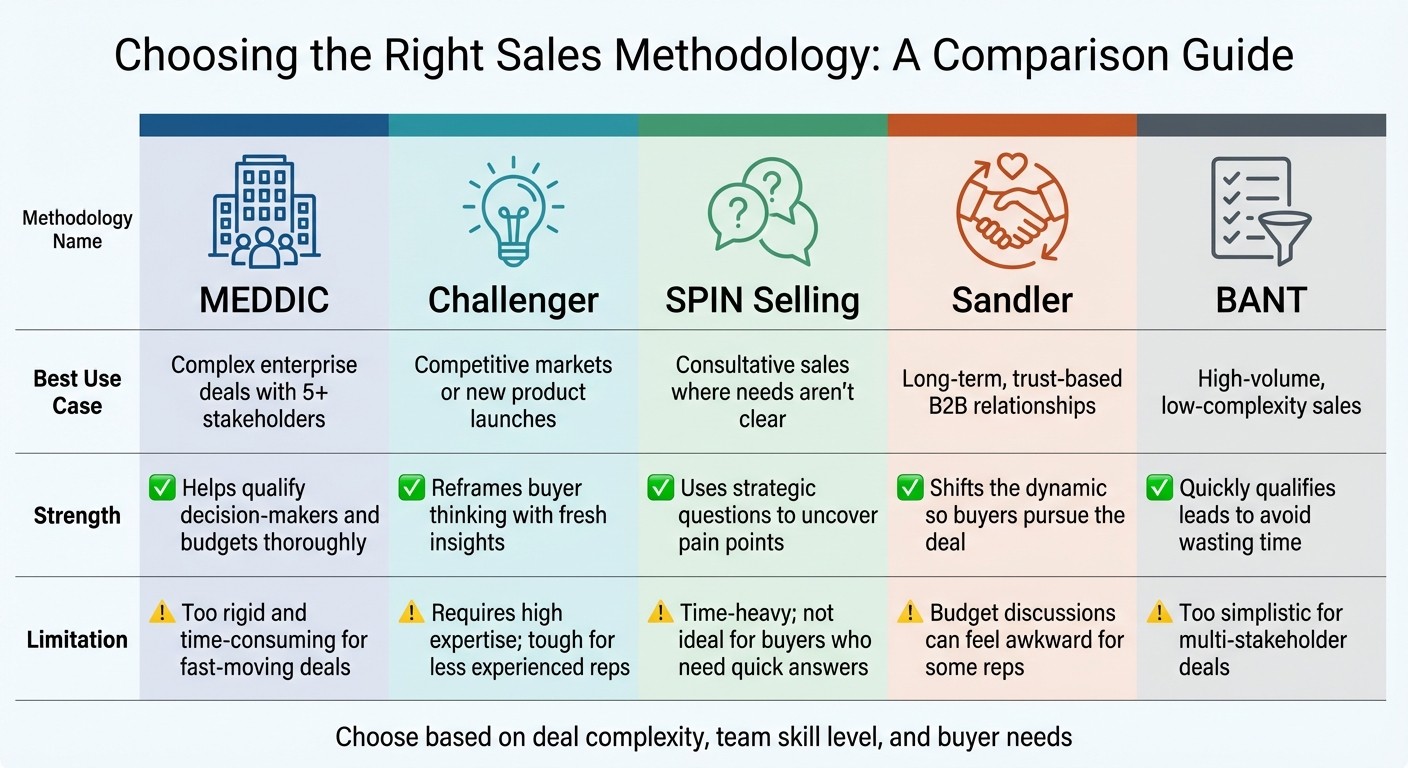
Sales Methodology Comparison: Best Use Cases, Strengths and Limitations
Picking the right sales methodology is all about finding a system that fits both your team's strengths and your customer's buying process. Factors like your company's stage of growth, the complexity of deals, team expertise, buyer profiles, and product intricacies all play a role. For instance, a method that works for quick, low-value deals under $25,000 won't cut it for enterprise-level deals over $100,000 that can stretch across 6–18 months [1]. Understanding where your team struggles is the first step to selecting a methodology that works.
Assessing Team Needs and Deal Complexity
Start by identifying where deals stall in your pipeline. If deals get stuck during technical evaluations, a discovery-focused approach like SPIN Selling might help. On the other hand, if procurement delays are the issue, a framework like MEDDPICC, which emphasizes the "Paper Process", could be the answer [6]. Deal size also matters - a method like MEDDIC is suited for complex enterprise deals, while BANT is better for straightforward, high-volume transactions [1].
Your team's skill level is just as important. For example, The Challenger Sale requires reps to have deep industry knowledge and the confidence to challenge buyers' assumptions. This makes it unsuitable for junior reps who may lack experience [5][1]. It's worth noting that 64% of salespeople missed their last quota, often because they're using methods that don't align with their skills or deal types [1]. Before adopting any system, gather data on your current conversion rates, deal sizes, and sales cycle lengths. This will help you measure the impact of the new approach and ensure it aligns with both your team's capabilities and the buyer's journey.
Comparing Common Sales Methodologies
Different sales methodologies tackle different challenges. Here's a quick breakdown of some popular frameworks:
Methodology | Best Use Case | Strength | Limitation |
|---|---|---|---|
MEDDIC | Complex enterprise deals with 5+ stakeholders | Helps qualify decision-makers and budgets thoroughly [6] | Too rigid and time-consuming for fast-moving deals [6] |
Challenger | Competitive markets or new product launches | Reframes buyer thinking with fresh insights [4] | Requires high expertise; tough for less experienced reps [5] |
SPIN Selling | Consultative sales where needs aren't clear | Uses strategic questions to uncover pain points [5] | Time-heavy; not ideal for buyers who need quick answers [4] |
Sandler | Long-term, trust-based B2B relationships | Shifts the dynamic so buyers pursue the deal [5] | Budget discussions can feel awkward for some reps [4] |
BANT | High-volume, low-complexity sales | Quickly qualifies leads to avoid wasting time [4] | Too simplistic for multi-stakeholder deals [4] |
Take the example of Parametric Technology Corporation (PTC). In 1996, they adopted MEDDIC under the leadership of John McMahon, Dick Dunkel, and Jack Napoli. By integrating the methodology into their training and onboarding, PTC grew its sales from $300 million to $1 billion [6]. This shows how a well-chosen framework can drive major results when applied correctly.
Adapting Frameworks for Specific Sales Challenges
Sometimes, combining methodologies is the best way to handle unique challenges. For example, if your team struggles with discovery, you might pair SPIN Selling with MEDDIC to improve qualification [3][2]. If your goal is aggressive growth, a prospecting-heavy approach like Challenger could be a better fit. For teams with limited resources, early qualification methods like MEDDIC are ideal, while retention-focused strategies may call for relationship-driven methods like Sandler [1].
"The skill that matters isn't mastering a particular sales methodology. It's knowing which sales process to apply to which situation (and how to successfully deploy it across your organization)." - Chris Orlob, Content Author, Gong [5]
Keep in mind, your methodology should evolve as your company grows. What works in the early stages might not suit a mature organization [5]. To test new frameworks, start small with a pilot group, especially involving team members who are skeptical. This allows you to demonstrate the approach's effectiveness [1]. Tools like Coach Pilot's AI-driven coaching can also track whether reps are using the methodology's language during calls, ensuring the new system is actually being implemented and not just discussed in training [5].
How to Implement Sales Methodologies
Turning a sales methodology from a static document into a practical system takes more than good intentions. It requires weaving the framework into everyday workflows and using technology to ensure consistent execution. Success often boils down to how effectively you onboard your team, integrate the methodology into their routines, and use tools to reinforce its application [8].
Getting Team Buy-In for New Methodologies
Change isn't easy - 42% of salespeople resist it [14]. The best way to overcome this is by demonstrating how the new approach helps them hit their targets and earn more commissions. Start by involving your top performers early in the process. Interview them to uncover what works in successful deals, and use those insights to shape your playbook [8][10]. When reps see their proven strategies reflected in the system, they're more likely to adopt it.
Test the waters with a small, diverse pilot group that includes both supporters and skeptics. Gather feedback and share weekly success stories from those who close deals using the new methodology [8]. This builds momentum and shows the system’s real-world value. Sales managers who actively coach their teams on these behaviors can boost win rates by 14% [9]. To make this work, equip managers with "Coach the Coach" training so they can reinforce the methodology during role-plays and deal reviews [8].
Getting your team on board is the first step toward creating structured playbooks that guide every stage of the sales process.
Using Sales Playbooks for Consistency
Companies with clear sales playbooks are 33% more likely to excel [7][14]. But a playbook only works if your team actually uses it. To ensure this, align the playbook's stages with your CRM and include guided selling questions at each step. This helps reps know exactly what to ask and when, keeping deals on track and avoiding delays caused by missing details [8].
For example, Coach Pilot helps teams create custom sales playbooks that seamlessly integrate into existing workflows. In May 2024, Naum Sekulovski, a Business Development Manager at Food By Us, implemented a new playbook. Over nine weeks, he secured 13 new contracts, driving a 45% increase in sales revenue [10]. Similarly, Rebecca Veksler, Co-Founder of Four Rooms, revamped their sales process with Coach Pilot. Within eight weeks, her company tripled monthly sales and closed 14 new deals [10]. These examples highlight how embedding a playbook into daily operations can lead to measurable success.
Using AI-Driven Sales Coaching
Once playbooks are in place, AI-driven coaching takes execution to the next level by offering real-time, actionable insights. Traditional rollouts of sales methodologies can take up to 180 days to reach around 40% adoption. AI tools can cut this down to just 30 days while achieving 90% or better sustained adherence [12][13]. The difference? AI doesn’t just analyze past performance - it tells reps what to do next. For instance, it might prompt a rep to follow up with a CFO using a tailored value proposition by a specific date [10].
Coach Pilot’s AI-driven coaching integrates with frameworks like MEDDIC, GAP Selling, and SPICED, offering feedback that’s both actionable and precise [11][12]. It even automates CRM updates from call transcripts, eliminating the administrative work that 60-70% of reps tend to avoid [12][13]. In June 2024, Connor Bell, a Business Development Manager at HubSpot, used Coach Pilot’s strategies over 11 weeks. The result? He created 50% more new opportunities and closed 12 deals, boosting quarterly sales revenue by 38% [10]. The platform also identifies specific gaps, such as missed discovery questions or unquantified business impacts, allowing managers to coach with pinpoint accuracy [11][12].
"The tool's AI-driven coaching feedback also gives managers tremendous insight and direction on their team's performance, giving them the ability to have greater impact across their teams." - Susan Hopper, VP Sales Enablement, HireRight [11]
Aligning Sales Methodologies with Customer Buying Processes
Even the most effective sales methodology can fall short if it doesn’t align with how customers make decisions. Consider this: 77% of B2B buyers describe their most recent purchase as "difficult" or "very complex" [4]. To succeed, your sales approach must align with the buyer's journey - addressing their priorities, tailoring your message to their needs, and involving the right stakeholders at the right moments.
Mapping Sales Strategies to Buyer Journeys
Every sales methodology has its strengths, and each works best at different stages of the buyer's journey. For example:
SPIN Selling is ideal for the early stages, helping uncover hidden pain points through thoughtful discovery questions [5].
MEDDIC is most effective mid-to-late cycle, especially for qualifying deals in complex decision-making environments [6][4].
Challenger works well in the early stages by reshaping how buyers perceive their problems - even before introducing your solution [5][4].
Other methodologies, like Miller Heiman Strategic Selling, offer tools such as the "Blue Sheet" to map buyer objectives, identify key stakeholders, and flag potential obstacles [15]. This approach also categorizes buyers into four modes:
Growth Mode (eager to scale),
Trouble Mode (urgently seeking a fix),
Even Keel (content with the status quo),
Overconfident (unaware of underlying issues) [15].
Understanding which mode your buyer is in enables you to adjust your strategy and messaging accordingly, ensuring your sales efforts resonate with their specific situation.
Tailoring Messaging to Customer Needs
Once you’ve mapped the buyer journey, crafting personalized messaging becomes critical. A generic pitch won’t cut it - 88% of buyers will only purchase if they see the salesperson as a "trusted advisor" [4]. This means shifting the conversation from product features to measurable business outcomes [16].
For example, instead of vague promises like "we’ll improve productivity", offer specifics: "We’ll reduce processing time by 40%, adding $90,000 in annual revenue" [16]. This level of detail builds credibility and satisfies the Economic Buyer’s need for clear ROI while addressing the concerns of technical evaluators.
"Instead of just pushing for a sale, focus on educating potential clients, addressing their pain points, and positioning your solution as essential to their success."
Magda Paslaru, Managing Director, RainbowIdea [17]
Co-creating a business case with your buyer’s team - especially champions or finance stakeholders - can accelerate internal approvals. When buyers see their own metrics reflected in your ROI model, they’re more likely to advocate for your solution internally [16].
Engaging Decision-Makers and Stakeholders
Tailored messaging is just one piece of the puzzle. To move deals forward, you must engage all key decision-makers. On average, B2B sales cycles involve five decision-makers, and 63% of purchases involve more than four stakeholders [15][4][19]. Each of these roles comes with unique concerns:
The Economic Buyer is focused on ROI and overall business impact.
The Technical Buyer prioritizes compliance and integration.
The User Buyer cares about how the solution improves daily workflows.
The Champion seeks internal success and wants to advocate for the solution confidently [18][19].
Frameworks like MEDDIC and Miller Heiman can help you identify these roles and craft messaging tailored to each stakeholder [18][21]. Avoid relying on a single contact - 67% of lost sales stem from poor lead qualification [4]. Identifying the Economic Buyer early and developing a strategic coach within the organization can provide invaluable insight into internal dynamics and potential roadblocks [6][18].
Additionally, map the "Paper Process" - those legal and procurement steps that often delay deals at the last minute [6][20]. Addressing these requirements early ensures a smoother path to closing. Tools like Coach Pilot’s AI-driven coaching can help pinpoint gaps in your strategy, such as missing stakeholders or unaddressed business impacts, allowing you to adapt before it’s too late.
Stakeholder Role | Primary Focus | Key Concern |
|---|---|---|
Economic Buyer | ROI and Business Impact | "Will this save/make us money?" |
User Buyer | Daily Workflow and Usability | "Will this make my job easier?" |
Technical Buyer | Compliance and Integration | "Does this meet our security standards?" |
Champion/Coach | Internal Success and Advocacy | "How can I help this deal get approved?" |
Key Takeaways for Sales Success
Making a sales methodology part of your daily operations is a long-term commitment, not a one-time event. The real difference between companies that thrive and those that falter lies in how deeply the methodology is embedded into everyday workflows. Instead of treating it like a training session, successful companies integrate it into their processes. In fact, businesses with well-documented sales methodology playbooks are 33% more likely to be high performers [7]. Plus, adopting a formal methodology can lead to a 15% increase in win rates and a 21% boost in quota attainment [2]. These numbers highlight how crucial it is to weave the methodology into your sales strategy.
Practical Steps for Improving Sales Processes
To strengthen your sales processes, start by tailoring your methodology to align with your Ideal Customer Profile. A one-size-fits-all approach won’t resonate with buyers facing specific challenges [22]. Keep a centralized, digital playbook that evolves with market trends, competitor updates, and new techniques [22]. This playbook should be a core part of onboarding and performance reviews to ensure the team stays aligned.
Focus on tracking behavioral metrics, like the quality of discovery calls and adherence to the methodology, instead of only looking at revenue numbers [2]. These indicators help you identify coaching opportunities and predict future success.
AI tools can make a big difference in maintaining adherence. Without them, adherence to methodologies tends to drop by 40-50% within six months [23]. AI-driven solutions, like Coach Pilot, can push adherence rates beyond 90% by offering real-time coaching and automatically capturing key data. These tools help prevent sales reps from slipping back into old habits.
How Leadership Sustains Methodology Success
Leadership plays a pivotal role in keeping the momentum going and ensuring continuous improvement. The best-performing sales organizations - 50% of them, to be exact - have methodologies that are "closely monitored, strictly enforced, or automated" [22]. This level of discipline starts with leaders who not only model the methodology but also provide ongoing training and resources, embedding it into the company’s culture [22][2]. By focusing on scalable systems rather than relying on individual star performers, organizations can achieve sustainable growth.
Establish a regular coaching rhythm that aligns with each stage of the sales cycle [22]. Use tools like call recordings and analytics to give precise, actionable feedback based on real buyer interactions. Companies with mature coaching practices experience a 15% rise in win rates and a 14% improvement in quota attainment [2].
To ensure alignment across teams, make sure Marketing, Product, and Customer Success teams all use the same messaging and frameworks. This creates a seamless experience for customers [22]. Finally, conduct quarterly reviews to keep your methodology in tune with market changes [3]. These steps, when combined, help build a sales process that’s both adaptable and effective.
FAQs
How can I choose the right sales methodology for my team?
Choosing the right sales methodology means taking a close look at your company’s specific needs, goals, and the environment in which your team operates. Think about factors like your team’s strengths, the target market you’re addressing, and how complex your sales process is. Instead of locking into one rigid approach, aim for a methodology that fits your current circumstances and has the flexibility to grow alongside your business.
Popular frameworks like Challenger, MEDDIC, or Sandler might suit certain sales stages or customer profiles better than others. To make the right choice, analyze your team’s workflow and how your buyers behave. After picking a methodology, set your team up for success by offering structured training, creating clear playbooks, and using tools that track progress effectively. The ultimate goal is to choose a methodology that complements your team’s abilities and aligns with your business goals over the long term.
How does AI help sales teams adopt and improve their sales methodologies?
AI plays a key role in making sales methodologies easier to adopt by simplifying tasks, aligning teams, and enabling decisions based on data. It can help sales teams by drafting call scripts, developing opportunity plans, and simulating deal reviews, which streamlines operations and saves time. The true strength of AI shines when it works hand-in-hand with a structured sales methodology, ensuring consistent language, better coordination, and clear performance tracking.
AI also aids adoption by offering tools like playbooks and scorecards that track progress and build confidence in the data. These tools give sales leaders a clear view of how well their teams are implementing methodologies, making coaching more targeted and effective. By blending human expertise with AI-powered insights, sales teams can work smarter, move faster, and connect with clients on a deeper level, making structured sales processes easier to embrace.
How can sales teams align their methodologies with the way customers buy today?
To keep up with modern buying processes, sales teams need to be flexible and deeply understand customer behavior. The old, linear sales models often miss the mark because today’s buyers navigate more complex journeys, involve multiple decision-makers, and lean toward smaller, incremental purchases. A more dynamic approach - one that adjusts to real-time buyer signals and feedback - is key.
Top-performing organizations fine-tune their sales methods to match specific customer needs and stages in the buying process. For example, methodologies like Challenger, MEDDIC, or SPICED can be applied as the situation demands. This adaptability helps sales reps connect with buyers on a deeper level, boost engagement, and close more deals. Using tools like AI and sales enablement platforms can further sharpen these strategies, keeping them in sync with changing customer behaviors.
Related Blog Posts

Remove the guesswork from winning more deals.