B2B Sales
Custom Sales Playbooks vs. Generic Templates
Apr 13, 2026
Compare custom sales playbooks and generic templates — pros, cons, metrics, and when to use each for better win rates.

Custom sales playbooks and generic templates serve different purposes for sales teams. Generic templates provide a quick, standardized framework for communication and processes, making them ideal for startups or teams with limited resources. In contrast, custom sales playbooks are tailored to a company’s specific needs, offering targeted strategies, buyer personas, and real-time guidance. While generic templates are easy to implement, they often lack the depth and precision needed for complex sales scenarios. Custom playbooks, though more resource-intensive to create, drive higher adoption rates, faster onboarding, and improved win rates by addressing unique business challenges.
Key Takeaways:
Generic Templates: Quick to deploy, cost-effective, and promote consistency but lack personalization and can become outdated.
Custom Sales Playbooks: Tailored to specific needs, improve sales performance, but require more time and effort to develop and maintain.
Quick Comparison:
Custom playbooks clearly outperform generic templates in driving sales success, but they require commitment to continuous updates and integration into workflows. This evolution is a core part of the future of sales enablement, where agility and AI-driven insights become standard.
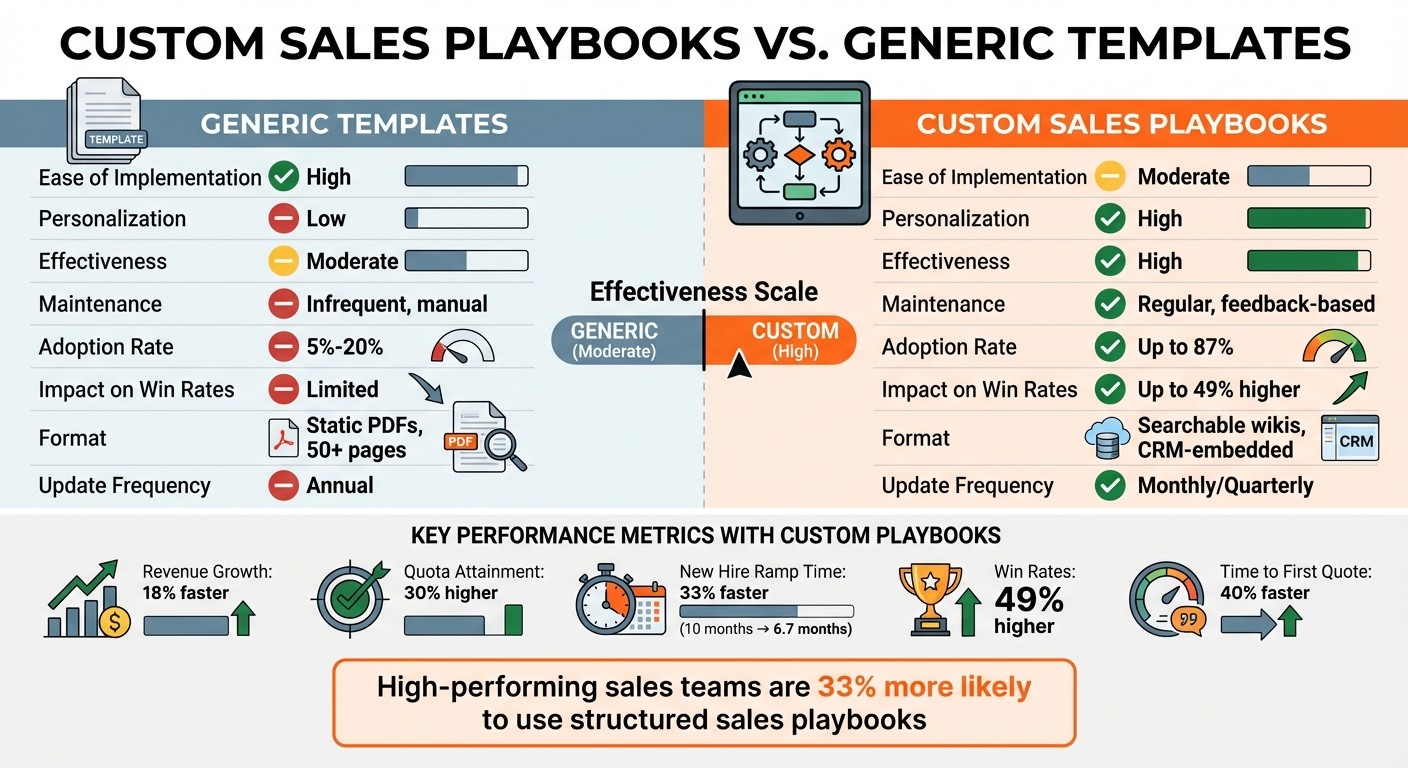
Custom Sales Playbooks vs Generic Templates: Performance Metrics Comparison
How To Build A Customized Sales Playbook For Your Business by Dany Capodieci | The Midday Connect
What Are Generic Templates?
Generic sales templates are standardized frameworks designed to streamline proposals, communications, and sales interactions [5]. Instead of starting from scratch, sales teams can plug in details like prospect names, company info, and product specifics [5].
These templates cover a range of tools, including email scripts, call outlines, elevator pitches, LinkedIn outreach messaging, and proposal formats [2][6]. They provide general structures and talk tracks, ensuring consistency across the sales team [2][4]. As Salesforce puts it, they act as a "starting point" for teams that haven't yet developed a fully customized playbook [2].
The numbers back up their effectiveness: 76% of companies using sales enablement tools (which often house these templates) report sales increases between 6% and 20% [6]. Additionally, 68% of sales managers dedicate significant time to training and coaching, a process made faster with standardized templates that simplify onboarding [6].
What Generic Templates Include
Generic templates are packed with predefined scripts and frameworks for common sales scenarios. These typically include communication scripts for cold emails, follow-up sequences, and LinkedIn connection requests. Call outlines provide guidance for cold calls, discovery calls, and voicemails, often featuring opening lines and key discovery questions.
You’ll also find messaging frameworks like elevator pitches and value propositions, objection-handling scripts (using methods like LAER: Listen, Acknowledge, Explore, Respond), and qualification frameworks such as MEDDIC (Metrics, Economic Buyer, Decision Criteria, Decision Process, Identify Pain, Champion). Sales cadences - timing patterns for outreach, like a 14-day, 7-touch sequence using email, phone, and social media - are commonly included [8].
However, there’s a catch: templates are built for broad use cases, not tailored to your specific business.
"Traditional playbooks... collect dust in a shared drive, filled with generic talk tracks and outdated competitive positioning."
- Semir Jahic, CEO & Co-Founder of Salesmotion [4]
When to Use Generic Templates
Generic templates are ideal for situations where speed and consistency take priority over deep customization. They’re especially useful for startups and growing businesses that need to establish basic sales strategies quickly [2]. For teams with limited resources, these frameworks provide systematic processes without the expense or time commitment of custom development [2][8].
They’re also invaluable for onboarding new sales reps. Templates give new hires clear guidance, product insights, and proven talk tracks. Companies using documented templates and playbooks report 50% faster onboarding for new team members [8]. Additionally, businesses with formal sales processes see 18% higher revenue growth compared to those without them [9].
"A sales playbook isn't just a reference manual. It's a training tool for onboarding new reps, a coaching resource for managers, and a continuous improvement guide."
- Kyle Coleman, CMO of Copy.ai [6]
Generic templates are most effective when used as a starting point. Over time, you can refine them based on performance data and insights from win/loss analyses [2][8].
Next, we’ll dive into how custom sales playbooks take these frameworks to the next level with tailored strategies.
What Are Custom Sales Playbooks?
Custom sales playbooks are tailored guides designed to align perfectly with your company's tools, customer base, product offerings, and overall value. Unlike generic templates that provide broad guidelines, these playbooks are built specifically for your market, buyer personas, and sales strategies. By focusing on your unique business needs, they avoid the limitations of one-size-fits-all solutions.
"Because every business is different, sales teams need playbooks that are tailored to their technology, customer base, product offering, and unique value proposition."
Jess, Huble
These playbooks preserve "tribal knowledge", capturing the strategies that make your top performers successful. Instead of relying on guesswork, they provide clear, actionable steps based on real-world results from your team.
The benefits are real and measurable. For example, a sales team that concentrated on just three key sections of their playbook saw a 12% boost in win rates [3].
Now, let’s break down what makes custom playbooks stand out.
What Custom Sales Playbooks Include
Custom playbooks go way beyond basic sales scripts. They feature tailored messaging and value propositions that address the specific challenges and goals of different buyer personas. Rather than asking generic questions like "What are your pain points?", these playbooks suggest diagnostic questions that directly relate to your product's impact, such as "How much time does it cost when [specific problem] occurs?" [3].
Here’s a closer look at the core elements of custom sales playbooks:
Additionally, these playbooks provide role-specific strategies, offering tailored guidance for SDRs versus AEs, outlining individual responsibilities, and detailing commission structures. They also include instructions for leveraging your tech stack, from CRM workflows to AI tools and sales enablement platforms.
"The best playbooks are not documents. They are systems embedded in your workflow - accessible in your CRM, searchable by keyword, and updated continuously."
When to Use Custom Sales Playbooks
Custom playbooks are particularly useful in complex B2B sales, industries with specific regulatory requirements, or when launching a new product that requires precise market positioning. They’re indispensable for sales cycles that deviate from standard patterns - for instance, software sales typically range from 2 to 6 months [11].
These playbooks excel when targeting distinct stakeholders like Economic Buyers, Technical Buyers, and User Champions, each with unique concerns and goals [11][2]. They’re also effective in leveraging industry-specific triggers, such as a company’s recent funding, tech upgrades, or leadership changes [11].
To create a custom playbook, involve stakeholders from sales, marketing, and customer success teams. Map out the entire sales process, identify any gaps, and treat the playbook as a living document that evolves with quarterly updates based on win/loss data and feedback from your top reps. Most importantly, integrate the playbook into your CRM, ensuring sales reps can access critical information in under 30 seconds during live interactions [3].
How Generic Templates and Custom Sales Playbooks Differ
When it comes to personalization in sales strategies, generic templates and custom playbooks stand on opposite ends of the spectrum. Understanding their differences in structure, maintenance, and usability highlights why tailoring your approach can make all the difference.
Generic templates are often static documents - think lengthy PDFs or paper binders that can stretch over 50 pages. These are usually linear, narrative-heavy, and a challenge to navigate quickly during a live call [3]. On the flip side, custom playbooks are dynamic and interactive. They’re typically built as searchable wikis or integrated directly into CRM systems, enabling sales reps to locate the exact information they need in under 30 seconds [3].
The content also sets them apart. Generic templates offer broad categories like "mid-market companies" and standard elevator pitches. Meanwhile, custom playbooks go deeper, specifying precise firmographics such as "Series B SaaS companies with 50-200 employees using Salesforce." They also include modular, persona- and industry-specific value propositions. For example, instead of asking vague questions like "What are your pain points?", custom playbooks provide targeted diagnostic questions tailored to the prospect [3][14].
As Dipesh Kothari, Senior Director at Procol, puts it:
"Reps often mix up messages for the target market. Using the wrong material impacts credibility... without a targeted and personalized approach, customers don't connect."
Dipesh Kothari [14]
Another critical difference lies in how these tools are maintained. Generic templates are prone to becoming outdated, as they rely on infrequent, manual updates [3]. Custom playbooks, however, are designed to evolve. They are treated as "living documents", with dedicated owners who update the content monthly based on win/loss data and feedback from top-performing reps. This ensures they stay relevant and effective, achieving usage rates of over 70% through contextual delivery [12].
Comparison Table: Structure and Content
This breakdown makes it clear why custom playbooks are a game-changer for modern sales teams. By providing reps with targeted, up-to-date, and easily accessible tools, they can deliver a more personalized and impactful sales experience.
Pros and Cons of Each Approach
Benefits of Generic Templates
Generic templates are a convenient starting point for sales teams, offering pre-designed frameworks like cold email scripts, elevator pitches, and call guides. These tools help teams get up and running quickly, especially when resources are tight [2][7]. They also promote consistency across the team by ensuring everyone communicates the same brand message. Instead of spending time creating new materials, sales reps can rely on proven methods, which is a big advantage considering modern sales reps dedicate just 36% of their time to revenue-generating activities [7]. While these benefits are appealing, they do come with some trade-offs.
Drawbacks of Generic Templates
The main downside of generic templates is their lack of adaptability. A one-size-fits-all approach often fails to address specific products, customer needs, or the real-world challenges sales teams face, which can make the communication feel impersonal [15]. Studies show that 80% of customers prefer personalized experiences, something generic templates simply can't provide [15]. Additionally, these templates often miss important details like regional differences, role-specific nuances, and complex product information, potentially frustrating both sales teams and customers [15]. Another issue is their tendency to become outdated as markets shift and competitors evolve, leaving sales reps without the most current information during critical moments like live calls [3].
Benefits of Custom Sales Playbooks
Custom sales playbooks, on the other hand, offer a tailored approach that addresses the unique challenges faced by your team. They provide clarity, ensure consistent messaging, and act as a go-to resource for sales and marketing teams [2][1]. By aligning content with specific buyer personas, technology stacks, and value propositions, custom playbooks enable sales reps to deliver the personalized experiences that customers now expect. For example, a healthcare coverage provider saw an 85% improvement in relationship-building skills and a 1,219% return on investment after implementing a custom sales training program in October 2025 [15]. Similarly, an electronic design software company reported that 88% of its team anticipated better job performance after adopting custom training focused on consultative selling and buyer personas [15]. Despite these advantages, custom playbooks are not without challenges.
Drawbacks of Custom Sales Playbooks
Creating a custom playbook can be time-consuming and resource-intensive. These playbooks often range from 50 to 80 pages, requiring a significant investment of effort upfront [2]. In some cases, companies may need to hire outside consultants to ensure the playbook is effective [1]. Regular updates are another challenge - custom playbooks need consistent maintenance, typically every quarter, to stay relevant with new win/loss data and market dynamics [1][3]. Without clear ownership from teams like Sales, Marketing, and RevOps, even the most well-designed playbook risks being forgotten or outdated. Additionally, if the playbook lacks a logical structure due to inexperience in crafting detailed sales content, its overall usefulness can be significantly reduced [1].
Performance Comparison: Key Metrics
When it comes to performance, custom sales playbooks clearly outperform generic templates. High-performing sales teams are 33% more likely to use a B2B sales playbook compared to their lower-performing peers [9]. Companies that adopt a formal sales process experience 18% faster revenue growth than those that don’t [9]. Additionally, organizations that consistently reinforce their sales methodologies through tailored playbooks achieve 30% higher quota attainment [9]. Let’s break down the numbers.
One of the most striking advantages is in ramp time for new hires. On average, it takes about 10 months for a new sales rep to reach baseline productivity [12]. However, with structured onboarding supported by custom playbooks, this time can be reduced by roughly a third - to just 6.7 months [12]. Even better, using a ramp scorecard aligned with a custom playbook can result in a 40% faster time to first quote [12]. Without these tools, sales reps spend 440 hours each year recreating content that should be readily available [12].
Win rates also see a dramatic improvement. Teams with formal enablement programs and structured playbooks report 49% higher win rates [12]. In one case, refining a playbook to focus on high-impact sections boosted win rates by 12% [3]. Conversely, relying on generic templates can backfire. For instance, using the phrase "list price" in standard templates has been shown to increase the sales cycle length by 19% [13].
Adoption rates between generic and custom approaches further emphasize the difference. A bulky, 60-page PDF playbook might only see 5% usage among reps. In contrast, a searchable, custom wiki featuring bite-sized content - like short videos - can achieve 87% adoption [3]. Sarah Chen, VP of Sales Enablement, shared her experience:
"We had a 60-page playbook that nobody opened. We rebuilt it as a searchable wiki with 2-minute videos. Usage went from 5% to 87% of reps."
[3]
Comparison Table: Performance Metrics
Why Choose Custom Sales Playbooks with Coach Pilot
Custom sales playbooks can drive real results, but the real hurdle is bridging the gap between what your team knows and how they perform in real-world scenarios. That’s where Coach Pilot steps in. By taking the benefits of tailored playbooks and embedding them directly into your sales process, Coach Pilot ensures strategies don’t just stay on paper - they come to life.
What Coach Pilot Brings to the Table
Coach Pilot turns your sales strategy into a real-time, interactive system. Forget static PDFs that collect dust - this platform integrates your custom playbook into tools your team already uses, like Microsoft Teams and ChatGPT [17][18]. What makes it even better? The AI coach is trained specifically on your business, so it fully understands your messaging, target audience, and deal stages [17].
Unlike generic AI solutions that offer surface-level advice, Coach Pilot provides actionable, step-by-step guidance. Need the right talking points for a CFO? Done. Wondering when to follow up or how to handle objections? It’s covered. The platform pulls insights from top-performing reps, helping your team know when to involve leadership, navigate complex buying committees, and more [17].
On top of that, Coach Pilot automates deal data capture, freeing up roughly 19½ hours per week that reps usually spend on CRM admin tasks. And with weekly live coaching calls, teams can tackle real-world challenges with tailored solutions in real time [17].
The Power of Customization in Boosting Sales
The numbers speak for themselves. Businesses using Coach Pilot have seen transformative results:
In May 2024, Rebecca Veksler, Co-Founder of Four Rooms, revealed her team tripled monthly sales and closed 14 new deals in just 8 weeks after adopting Coach Pilot’s strategies [17].
During the same timeframe, Naum Sekulovski, BDM at Food By Us, secured 13 new contracts in 9 weeks, driving a 45% growth in sales revenue[17].
By June 2024, Connor Bell, BDM at Hubspot, achieved a 50% increase in net new opportunities and closed 12 new deals in 11 weeks, leading to a 38% boost in quarterly sales revenue[17].
Stephen Luxmoore, Founder & CEO of Your HR Team, reported a 32% rise in new client acquisitions, with 8 contracts signed in 9 weeks[17].
On average, teams using Coach Pilot see 7.8x pipeline growth in under 90 days. Plus, AI coaching lifts quota attainment by 39%, thanks to its ability to replace generic outreach with personalized, value-driven messaging [17]. Beyond individual wins, Coach Pilot creates a cohesive system that drives predictable revenue and ensures consistent performance across the entire sales team.
Conclusion
The choice between generic templates and personalized sales playbooks can have a direct impact on closing deals and driving revenue. While generic templates might fail to address specific objections, varied buyer personas, and competitive challenges, personalized sales playbooks offer the precision and relevance needed to handle these complexities. They help your team disqualify poor-fit leads more effectively, maintain consistent messaging, and confidently manage intricate deals.
But here’s the catch: creating a playbook isn’t enough - it’s about making sure your team actually uses it. As Sarah Chen, VP of Sales Enablement, explains:
"A playbook only works if reps use it in live deals. Treat your playbook as an enablement system that drives consistent execution across pipeline stages."
Real-time guidance during discovery calls, objection handling, and deal reviews is essential for adoption and results. This approach ensures your strategy translates into actionable steps that your team can implement.
Coach Pilot takes this concept even further by embedding your personalized playbook directly into your CRM, email, and other sales tools. Instead of relying on static documents, it delivers persona-specific messaging, real-time coaching, and automated updates, making the playbook an operational system that evolves with your team’s needs.
To create a playbook that truly works, build it around what drives success in your market. Continuously refine it using win/loss data, align it with your team’s workflows, and integrate it into their daily tools. Solutions like Coach Pilot help transform static strategies into dynamic systems, offering predictable revenue and consistent performance. Personalized playbooks, when operationalized effectively, become the foundation for measurable growth.
FAQs
When should I use generic templates vs. a custom sales playbook?
When it comes to sales strategies, generic sales templates are perfect for handling standardized, repetitive processes. These templates work well across multiple clients or straightforward sales cycles, ensuring everything runs smoothly and consistently while saving time.
On the other hand, a custom sales playbook is your go-to for more complex situations. These are designed to tackle unique customer needs, incorporate specific strategies, and adjust to changing sales approaches. By using a tailored playbook, sales teams can connect more effectively with clients and drive stronger outcomes.
What should a custom sales playbook include for my ICP and personas?
A custom sales playbook needs to outline your ideal customer profile (ICP) and detailed buyer personas. Why? Because these elements ensure your messaging hits the mark with the right audience.
Your playbook should also include strategies for key areas like prospecting, qualification, objection handling, and closing deals. The key is tailoring these strategies to align with your ICP and personas. This approach helps your sales team address the specific needs of your audience, leading to better engagement and stronger results.
How do I keep a sales playbook updated and used by reps?
To keep your sales playbook effective and relevant, think of it as a dynamic resource rather than a static document. Make it an integral part of your team's workflows by embedding it into daily processes and ensuring it's easily accessible through your CRM. Regular updates are crucial - use real-time data, feedback from your sales reps, and win/loss analyses to refine strategies. Incorporating AI-driven tools can also help streamline and enhance its application. This way, your playbook stays practical, up-to-date, and closely aligned with your sales objectives.
Related Blog Posts

Remove the guesswork from winning more deals.