B2B Sales
AI-Driven Coaching for Sales Retention
Apr 25, 2026
AI coaching provides real-time feedback, automates admin work, and improves win rates, sales cycles, and rep retention.
Here’s what the numbers show:
Replacing a B2B sales rep costs $100,000–$300,000, and for enterprise roles, it can hit $450,000.
Sales turnover has surged to 36%, with 69% of reps missing quotas and 64% actively job hunting.
By 2024, quota attainment dropped to just 43.14%.
What’s causing this?
Inconsistent coaching: 73% of reps report poor coaching, and 76% feel unsupported.
Delayed feedback: Managers review only 9% of sales calls, often weeks after they happen.
Limited career growth: Reps feel stuck, with 70% of their time spent on admin tasks instead of selling with a living playbook.
The solution? AI-driven coaching.
AI provides real-time, personalized feedback, automates routine tasks, and integrates directly into tools reps already use. This creates a continuous improvement loop, boosting performance and retention.
Key results from companies using AI coaching:
Win rates up by 36%.
Sales cycles shortened by 19%.
Voluntary turnover reduced by 58%.
Sales teams that adopt AI coaching see better outcomes, happier reps, and stronger retention. Can your team afford to ignore this shift?
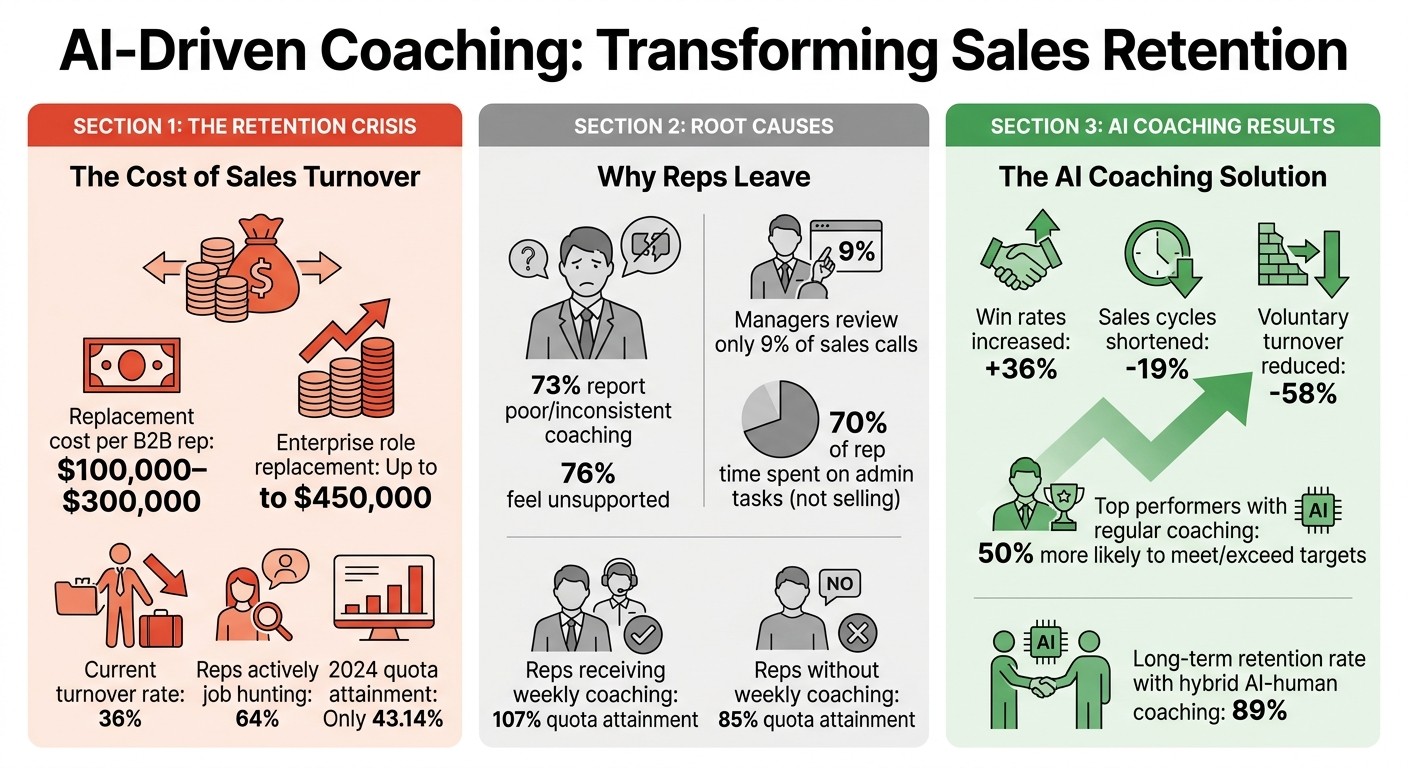
AI Coaching Impact on Sales Performance and Retention Statistics
How teach-back sales training, AI coaching and culture drive real sales performance | OnBase podcast
Why Sales Teams Struggle with Retention
Sales turnover often stems from deeper systemic issues. When sales professionals lack the necessary support to grow and succeed, they eventually seek opportunities elsewhere. Two major culprits behind this challenge are insufficient coaching and feedback that comes too late to make a difference.
Limited Coaching and Career Growth
A staggering 73% of sales reps report inconsistent coaching, while 76% say they don't receive enough support [6]. On the other side, 55% of sales managers admit they struggle with coaching effectively [6]. The reason? Many managers were promoted based on their selling skills, not their ability to nurture and develop others. Julie Thomas, President and CEO of ValueSelling Associates, highlights this issue:
Sales coaching often falls through the cracks. Sales managers are stretched thin overseeing direct reports, forecasting revenue and closing deals, all while trying to hit their number. This leaves little time for the kind of personalized, in-the-moment coaching that drives real behavior change [6].
Adding to the problem is the lack of clear career pathways. Without visible opportunities for advancement, sales reps often feel stuck [7]. To make matters worse, they spend up to 70% of their day on administrative tasks, leaving them drained and unable to focus on what they do best - selling [8].
These gaps in coaching and growth naturally lead to feedback that is both delayed and inadequate.
Uneven and Delayed Performance Feedback
Even when feedback is provided, it often misses the mark. Managers only review about 9% of sales calls [4]. With 8–12 direct reports, most managers only evaluate 2–3 calls per rep each month [1]. This limited sample size forces managers to rely on recency bias rather than identifying consistent performance trends.
The timing of feedback is another issue. Traditional reviews often happen days or even weeks after a sales call, by which time the details are fuzzy, and the moment to act has passed. Taylor Galbraith, Co-Founder of Parlay, puts it bluntly:
Before AI coaching, our 1:1s were basically vibes. A manager would say 'you need to ask more open-ended questions' and the rep would say 'okay' [1].
The difference timely feedback makes is undeniable. Sales reps who receive weekly coaching achieve 107% of their quota, compared to just 85% for those who don’t [4]. Additionally, organizations that adopt a dynamic coaching approach see win rates that are 13.4 percentage points higher than those relying on sporadic feedback [4].
These systemic challenges highlight the growing need for solutions like AI-driven coaching to address these gaps effectively.
How AI Coaching Addresses Retention Problems
AI-powered coaching tackles sales retention challenges by offering personalized, real-time guidance and feedback exactly when it's most needed. Instead of waiting days for insights, sales reps receive actionable advice within minutes, transforming coaching into an ongoing process. This approach allows for precise, individualized performance improvements.
Tailored Coaching Based on Individual Performance
AI uses detailed analysis of every interaction to deliver coaching tailored to each rep's performance. By identifying specific strengths and areas for improvement, it provides precise, timestamped feedback. For example, AI might highlight how a rep effectively addressed a pricing concern during a call [9]. This level of detail helps reps connect their actions directly to outcomes.
By eliminating traditional coaching delays, AI ensures that every rep gets timely, high-quality feedback. As Nilansh Gupta, Co-founder & CEO of Nimitai, puts it:
Great sales coaching isn't about hearing every call. It's about hearing the right moment in every call [9].
Immediate Feedback and Ongoing Development
Timing is everything. AI offers real-time prompts during calls, like suggesting, "Ask: What's the cost of not solving this?" to help reps adjust their approach while deals are still in play [4]. Beyond that, it automates tasks like call summaries and CRM updates, freeing reps to focus on selling [5][2].
This reduction in administrative workload not only eases frustration but also supports consistent growth. Weekly coaching agendas, for instance, spotlight the top three moments for improvement, ensuring reps continuously develop their skills [2].
Embedding AI Coaching into Daily Sales Work
One of the biggest challenges to adopting coaching programs is the added complexity they often bring. But when AI coaching is seamlessly integrated into the tools sales reps already rely on, it naturally becomes part of their routine. This eliminates the need for juggling multiple systems, saving time and reducing the mental strain of switching between tasks. In fact, this type of integration can cut down the time spent on administrative work, which typically eats up as much as 70% of a salesperson’s day. The result? Coaching that’s not only more accessible but also more relevant to every sales interaction.
AI Integration with Existing Sales Tools
For AI coaching to be truly effective, it needs to work hand-in-hand with platforms like CRMs, video conferencing tools (e.g., Microsoft Teams), and messaging apps like Slack. This connection allows AI systems to gather the context they need to provide tailored guidance. For instance, AI can automatically sync coaching tasks, assign deadlines, and flag high-risk behaviors for quick action [11]. By automating tasks like updating the CRM and capturing deal insights, sales reps can spend less time on busywork and more time selling. Tools like Coach Pilot make this possible by embedding AI-powered coaching directly into the systems sales teams already use every day.
AI also helps reps prepare for calls by surfacing relevant deal history and CRM insights tied to the current sales stage [5]. This ensures that every interaction is informed and purposeful, leading to better outcomes and a more effective B2B sales playbook. By automating these processes, AI not only simplifies workflows but also encourages reps to engage in coaching on a daily basis.
Building Habits Through Daily Coaching
Daily coaching is far more effective at building lasting skills than sporadic training sessions. AI can pinpoint two or three key coaching moments from a rep’s calls each day, providing managers with evidence-based clips and actionable feedback [2]. This creates a continuous improvement cycle where AI detects skill gaps during calls and automatically enrolls reps in targeted microlearning sessions tailored to their needs [4][2].
The results speak for themselves. Companies using AI-driven sales coaching have seen win rates climb by 36% shortly after implementation [10][11]. For example, Bureau boosted deal conversions by 30% between 2024 and 2025 by using automation and coaching to improve discovery calls [5]. Plus, the judgment-free practice environment AI creates encourages reps to rehearse more often, accelerating their progress. These daily coaching practices not only sharpen skills but also improve performance and knowledge retention over the long term.
Measuring AI Coaching Results on Retention
The impact of AI coaching comes to life through clear, measurable results. By tracking how coaching influences both individual development and team performance, organizations can better justify their investment while keeping top talent engaged. AI platforms stand out by analyzing 100% of sales interactions, a stark contrast to the 5–10% typically reviewed manually [3]. This comprehensive approach provides a full-spectrum view of performance, enabling more actionable insights into growth.
Monitoring Skill Growth and Career Paths
With AI tools, managers can go beyond evaluating where a sales rep currently stands - they can monitor how quickly each rep is improving. One key metric, Score Improvement Velocity, tracks the pace of skill development over 30-day periods, making it easier to identify who is responding most effectively to coaching [12]. This is crucial, as reps who receive high-quality coaching are 50% more likely to meet or exceed their targets [13].
Another valuable metric is the Coaching Adherence Rate, which measures whether reps are applying feedback in real-world scenarios. For instance, if a manager advises a rep to use more open-ended questions, AI tools can analyze future calls to confirm if that behavior has been adopted. These insights allow managers to make objective decisions about promotions and professional development. Moreover, regular coaching sessions have been linked to 58% lower voluntary turnover among top-performing reps [14].
While individual progress is vital, the broader impact on team performance highlights the true value of AI coaching.
Improved Team Performance Indicators
AI coaching doesn’t just drive individual improvements - it also delivers significant team-level results. For example, a Salesforce pilot in early 2025 tested AI coaching across 14 sales motions. The initiative provided 24,000 personalized recommendations via Slack, boosting action completion rates from 8% to 38% and generating $37 million in pipeline and revenue impact. Similarly, TechFlow Solutions - a team of 24 reps - achieved a 32% increase in close rates (from 22% to 29%) and reduced their sales cycle by 19% (from 47 days to 38 days) within just 90 days in early 2026 [15][3].
These outcomes - higher win rates, faster sales cycles, and improved forecast accuracy - show how AI coaching supports the future of sales enablement and long-term retention by fostering continuous performance growth. Tools like Coach Pilot empower sales leaders to turn strategic coaching into actionable steps, ensuring teams not only improve but also retain their top talent consistently.
Conclusion: Connecting Strategy to Execution
Sales retention thrives in an environment where reps are encouraged to grow and improve consistently. AI-driven coaching tackles major retention hurdles by offering tailored feedback at scale and aligning leadership goals with individual performance. While 90% of leaders believe they coach monthly, only 38% of reps say they receive such support regularly. AI bridges this gap by ensuring 100% call coverage, providing consistent, actionable insights [13]. This approach lays the groundwork for a hybrid coaching model that blends AI-driven data with human leadership.
The hybrid model of AI-human coaching not only boosts retention but also enhances team satisfaction. Managers can focus on strategic development rather than repetitive tasks, resulting in 89% long-term retention rates and an 8.4/10 satisfaction score - outperforming approaches that rely solely on humans or AI [16]. By automating routine aspects, managers have more time to invest in meaningful coaching and career growth for their teams [16][4].
Organizations that adopt AI coaching report tangible benefits: faster sales cycles, higher close rates, better forecast accuracy, and improved retention of top-performing reps. Consistent, actionable feedback ensures that reps not only hit their targets but often exceed them. This shift from sporadic check-ins to real-time, embedded support transforms performance and fosters long-term success.
Platforms like Coach Pilot empower sales leaders to turn coaching strategies into actionable daily practices. By integrating AI guidance directly into workflows, every interaction becomes an opportunity to learn and improve. This approach directly addresses common challenges like limited coaching, delayed feedback, and a lack of career development discussed throughout this article. The real question is: Can your organization afford to compete without AI coaching in today’s fast-paced market?
FAQs
What should AI sales coaching analyze from my reps’ calls?
AI-driven sales coaching focuses on analyzing critical call behaviors to enhance performance. These include talk-to-listen ratios, the number of questions asked, how effectively objections are handled, and identifying signals of buyer interest or concerns. By evaluating these aspects, it becomes easier to pinpoint skill gaps and offer precise, real-time feedback that helps sales teams improve their results.
How do we roll out AI coaching without disrupting workflows?
Integrating AI coaching into your workflow should feel natural and seamless. By embedding it as a continuous, supportive tool, AI can evaluate sales interactions in real-time, delivering tailored, data-backed insights without the need for manual intervention. Starting with a phased rollout - like testing with pilot groups - gives teams time to adjust gradually. This approach ensures AI coaching becomes a regular part of the process, improving performance while keeping disruptions to a minimum.
How can we prove AI coaching is improving retention?
AI coaching delivers measurable performance and engagement boosts. For instance, it can lead to a 32% increase in win rates and 83% revenue growth for teams using AI tools. When AI is paired with human coaching, win rates climb even higher - by 37%. It also streamlines onboarding, cutting the time needed by up to 42%, while enhancing sales productivity by 40%. These numbers clearly highlight the transformative effects of AI coaching on team success.
Related Blog Posts

Remove the guesswork from winning more deals.