B2B Sales
AI Coaching ROI: Impact on Sales Win Rates
Apr 13, 2026
How AI coaching raises win rates, shortens deal cycles, and links behavior change to measurable revenue gains.

AI coaching is transforming sales by directly linking coaching efforts to measurable outcomes, like improved win rates and revenue growth. Unlike traditional methods, which review only a small fraction of sales calls and rely on subjective feedback, AI analyzes 100% of interactions. This approach identifies behaviors that drive success and connects them to financial results.
Key insights:
AI coaching improves win rates by an average of 27.9% for forecasted deals.
Reps using AI-driven recommendations see 19.7% higher conversion rates than those relying on manager-led coaching.
Companies report up to 28% higher win rates with AI coaching compared to outdated methods.
AI reduces ramp times and enhances team performance without increasing headcount.
Challenges include proving ROI due to lagging indicators like win rates and the lack of baseline data before implementation. However, tracking metrics like call quality, adoption rates, and revenue attribution helps tie coaching to business outcomes.
AI tools like Coach Pilot streamline coaching, offering personalized feedback, actionable insights, and measurable results. Sales teams that embrace AI coaching see faster deal cycles, improved quota attainment, and substantial revenue growth.
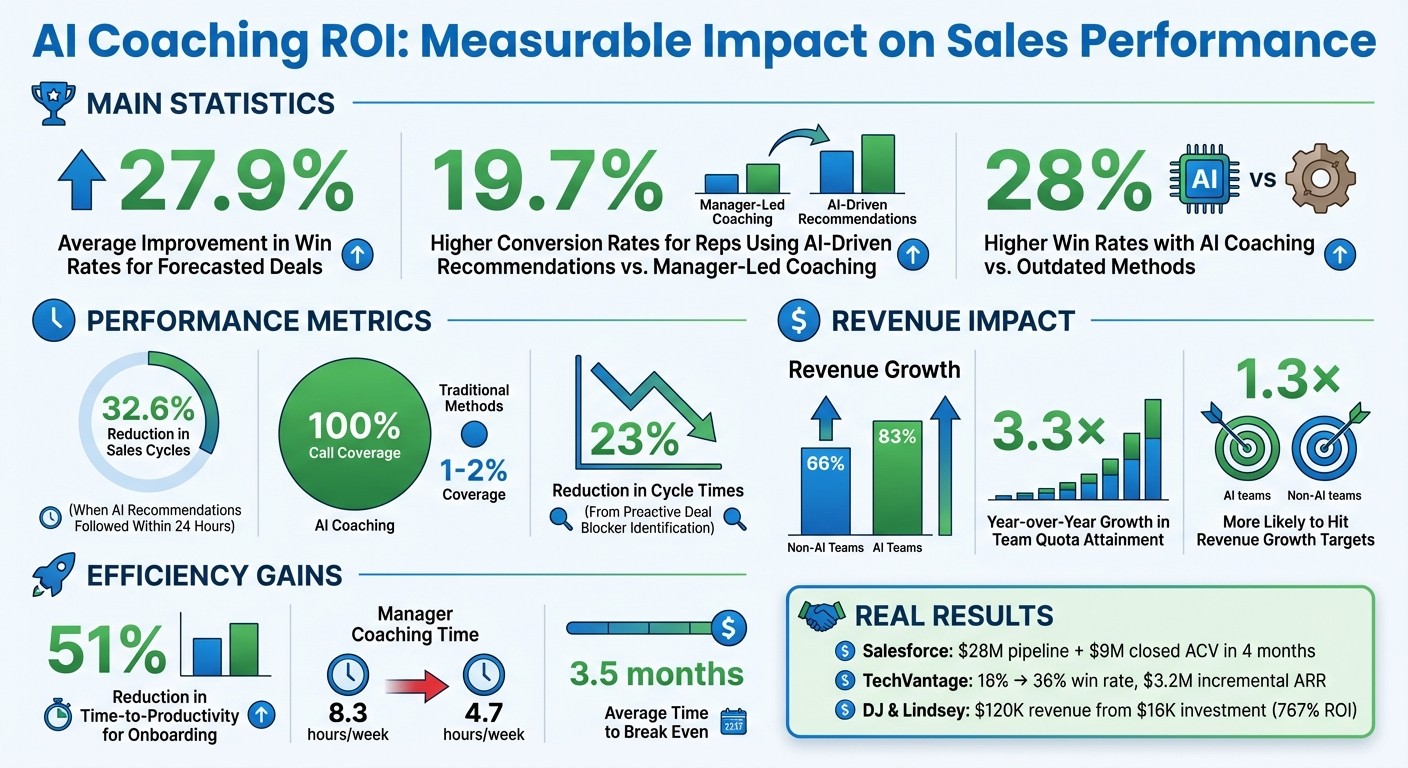
AI Coaching ROI Statistics: Win Rates, Conversion Rates, and Revenue Impact
Spent $50K on AI Sales Software - Here's the REAL ROI Results
The ROI Challenge: Why Measuring AI Coaching Impact is Difficult
Even though AI coaching has immense potential, proving its value remains a tough task for many sales leaders. While AI coaching clearly works, traditional ways of measuring return on investment (ROI) often fall short. This creates a disconnect between the positive changes sales teams experience and the hard data finance teams rely on.
Traditional ROI Metrics vs. AI Coaching Impact
Standard ROI methods focus on straightforward comparisons, like dollars spent versus time saved. But the value AI coaching offers goes beyond simple automation. Traditional metrics often emphasize activity volume - such as the number of calls made or emails sent - without considering the quality of those interactions or the behavioral changes that actually lead to closing deals [5].
Another issue is the difference between one-off training sessions and the ongoing support AI coaching offers. Research shows that 87% of skills taught in traditional sales training are forgotten within 30 days [6]. Yet ROI models still treat training as a one-time event with a fixed return. AI coaching, on the other hand, provides continuous, personalized feedback that builds momentum over time. Trying to measure this with frameworks designed for a two-day workshop simply doesn’t work [5][6].
Sampling size is another major limitation. Traditional methods often analyze just 1–2% of sales calls, while AI systems can review 100% of conversations [1][2]. Metrics based on such small samples lack reliability. Frederick Meiners from Demodesk sums it up perfectly:
Sales coaching without proper measurement resembles driving without a destination - activity occurs, but progress remains uncertain [4].
These gaps in traditional measurement make it difficult to link AI coaching directly to improved sales outcomes.
Attribution Challenges in Sales Performance
Even when win rates improve, tying that success directly to AI coaching can be tricky. Win rates are lagging indicators - they take months to show up, making it hard to connect them to specific coaching sessions that happened weeks earlier [4]. For instance, was a deal closed because of AI-driven coaching during discovery, or was it due to external factors like a product update or market conditions?
The problem is often compounded by the lack of baseline performance data. Many organizations don’t have clear records of metrics like close rates, average deal sizes, or ramp times before implementing AI coaching. Without this data, it’s hard to measure the incremental gains AI coaching provides [4][1].
On top of that, there’s the issue of data overload. Sales teams generate a ton of metrics, but instead of clarifying the impact of coaching, too much data can make things murky. Leaders often end up relying on intuition rather than hard evidence [4]. And since traditional coaching lacks consistent documentation - feedback quality varies widely between managers - it becomes nearly impossible to prove direct causation [1].
How Poor Measurement Limits Investment
Without clear ROI, AI coaching programs face an uphill battle for funding. Gartner predicts that by 2025, 30% of AI projects will be abandoned after the proof-of-concept phase because organizations struggle to show measurable results [5]. The technology works, but outdated measurement methods fail to convince decision-makers.
This is a costly problem. Companies with effective coaching programs see up to 28% higher win rates than their competitors [4]. Yet 44% of sales managers admit they don’t have enough time to coach using traditional methods [2]. AI coaching addresses this time crunch, but without clear attribution models, budget approvals often stall. As a result, sales teams are left with inconsistent, low-coverage coaching while proven AI solutions sit on the sidelines due to inadequate measurement frameworks.
How AI Coaching Improves Sales Win Rates
AI coaching is proving to be a game-changer for sales teams, driving measurable improvements in win rates. It’s not just theory - real-world results across industries and team sizes show how effective it can be.
Creating Consistency Across Sales Teams
One of the standout benefits of AI coaching is its ability to bring consistency to sales teams. Traditionally, top-performing reps have relied on their own unique approaches to excel. AI changes the game by analyzing what works best and turning those insights into actionable coaching moments for the entire team. This approach helps lift the middle 60% of performers by spreading strategies that have already been proven successful[9][1][8].
The results speak for themselves. Teams that followed AI-driven recommendations within 24 hours saw their sales cycles shrink by an average of 32.6%[3]. By automating coaching tasks like call reviews and scorecards, managers can shift their focus to more strategic coaching efforts[9][3]. This kind of data-driven standardization helps create objective, actionable insights that improve outcomes across the board.
Better Deal Outcomes with Data-Driven Coaching
Traditional coaching often relies on gut feelings or subjective observations. AI flips the script with data-backed insights that directly impact deal outcomes. For example, an analysis of 47,832 deals showed that proactively identifying deal blockers reduced cycle times by an additional 23%[3]. AI tools can track key indicators like adherence to sales methodologies and conversation quality, helping managers zero in on behaviors that drive success, such as effective discovery, clear next steps, and strong stakeholder engagement[9][1].
Salesforce’s internal pilot program offers a powerful example of how this works in practice. Between February and May 2025, the company used its Agentforce Sales Coach to deliver 24,000 personalized recommendations via Slack. The result? A 38% action completion rate - compared to just 8% for traditional dashboard-based requests[8]. Ali Nahvi, Salesforce’s Director of Product Innovation, summed it up perfectly:
We have augmented [sales leaders] by giving them a way to be in the room with every seller, on every deal to guide them towards the next best action and best outcome.[8]
This initiative generated $28 million in pipeline and $9 million in closed ACV in just four months, showcasing the real-world impact of AI coaching[8].
Case Studies: AI Coaching in Action
Several companies have already seen impressive results from AI coaching:
TechVantage: This 50-rep B2B SaaS company used AI coaching from July 2024 to January 2025. Their win rate jumped from 18% to 36%, the average deal cycle dropped from 60 to 47 days, and they generated $3.2 million in incremental ARR. VP of Sales Rebecca Martinez described the transformation:
We didn't hire a single new rep, but our output looked like we added 22 reps.[10]
DJ & Lindsey Real Estate: This 79-agent brokerage in Florida implemented AI-powered call coaching between October 2024 and April 2025. By analyzing every call, they boosted outbound call volume by 119%, improved conversation quality by 22%, and closed 119 deals from 3,020 early-stage leads. This effort generated $120,000 in incremental revenue from just a $16,000 investment[7].
Bureau: By using AI coaching to enhance call summaries and reinforce specific selling behaviors in real-time, Bureau saw a 30% increase in deal conversions. They attributed this improvement directly to AI-driven coaching[11].
Across the board, companies incorporating AI into their sales training have achieved 3.3× year-over-year growth in team quota attainment[12] and are 1.3 times more likely to hit revenue growth targets[11]. These results clearly tie AI coaching to improved win rates, making it a must-have tool for modern sales teams.
Measuring ROI: Linking Coaching to Business Outcomes
Proving the financial impact of AI coaching can be tricky, especially when sales leaders need to connect coaching efforts directly to revenue instead of relying on engagement metrics alone.
Key Metrics to Track
To link AI coaching to measurable revenue outcomes, it’s essential to define metrics that tie activities to results. The best approach combines leading indicators (which predict success) with lagging indicators (which measure actual results).
Leading indicators include metrics like call quality scores, talk-to-listen ratios, question frequency, and adherence to sales methodologies. These factors often signal future success. For instance, sales reps with call scores consistently above 80% achieve 23% higher close rates[4].
Lagging indicators, on the other hand, measure outcomes such as win rates, average deal size, pipeline velocity, and quota attainment. But tracking behavioral changes is just as important. It’s not enough to know coaching was delivered - you need to measure whether reps apply the feedback in their next calls. Studies show that without reinforcement, reps forget over 80% of coaching feedback within a week[13].
Another useful metric is Score Improvement Velocity, which tracks how quickly a salesperson’s performance improves over 30-day periods. This metric helps identify which team members respond best to coaching and uncovers patterns that can benefit the entire organization. Companies with strong coaching programs report win rates up to 28% higher than their competitors[4].
Revenue Attribution Models
To directly connect coaching to closed deals, structured attribution models are key. A/B testing is one effective way to isolate revenue gains from AI coaching compared to baseline performance[5].
Another approach is adoption-level segmentation. By grouping sales reps based on how much they use AI tools, you can often see that top adopters generate 2–3 times more revenue than low adopters[5]. For board-level reporting, consider using a composite ROI framework weighted as follows: Revenue Velocity (40%), Productivity (30%), Strategic Effectiveness (20%), and Organizational Learning (10%)[5]. This method offers a well-rounded view of ROI beyond just revenue figures.
Here’s a real-world example: a 45-person sales team at an industrial equipment manufacturer replaced inconsistent quarterly workshops with AI coaching. Over 12 months, their cold call conversion rates jumped from 2.1% to 5.2%, and new hire ramp time dropped from 4.5 months to 2.8 months. The financial results? A $581,000 total benefit, including $380,000 from improved conversions and $156,000 from faster onboarding - against a $67,000 investment. That’s a 767% ROI[6].
ROI Benchmarks for High-Performing Teams
Understanding industry benchmarks is critical for setting realistic ROI expectations. Most teams break even within 3.5 months of implementing AI coaching[3]. AI-coached reps also see conversion rates nearly 20% higher than those who only receive traditional manager coaching[3].
Efficiency gains are another major advantage. AI coaching increases coverage from just 1–2% of calls (via manual review) to 100% of conversations[1]. At the same time, managers spend less time coaching - dropping from an average of 8.3 hours per week to just 4.7 hours[3]. Companies using AI for onboarding report cutting time-to-productivity by up to 51%[14].
For revenue projections, use the ramp time multiplier. Estimate the monthly revenue a fully ramped rep generates, then multiply that by the number of months saved during onboarding. For example, if a rep generates $50,000 per month and ramp time is reduced by two months, that’s an additional $100,000 in revenue per new hire.
"The question isn't whether AI sales coaching delivers ROI - it's how much you're leaving on the table without it."
Teams leveraging AI report 83% revenue growth compared to 66% for non-AI teams[15]. Even a modest two-percentage-point improvement in win rates across a 50-person sales team can add millions in annual revenue[14]. These benchmarks provide a clear foundation for calculating ROI and making a strong case for investment.
Conclusion: Getting ROI from AI Coaching in Sales
Tackling measurement challenges is the first step to unlocking ROI from AI coaching. By refining strategies, speeding up onboarding, and closing deals more efficiently, AI coaching can significantly boost revenue. The real difference between success and struggle lies in disciplined measurement and consistent execution.
Key Takeaways for Sales Leaders
To demonstrate ROI effectively, establish benchmarks like win rates, deal sizes, ramp times, and coaching hours before introducing AI tools [1][16]. These metrics become your evidence when budget discussions roll around.
Pay attention to leading indicators - early behavioral changes often signal future revenue growth before close rates shift [1][9]. Teams that move from manually reviewing just 1–2% of calls to leveraging AI for full coverage ensure no opportunity or rep is overlooked [1][9].
Roll out AI coaching tools over 30–60 days: start by defining scorecards, test in shadow mode, and then fully integrate [9]. Build a consistent coaching rhythm by using AI to auto-generate personalized 1:1 agendas and highlight the top three coaching opportunities per rep. This systematic approach ensures coaching becomes part of the workflow [9].
These strategies form the foundation for tools like Coach Pilot to thrive.
The Role of Tools Like Coach Pilot
Coach Pilot bridges the gap between strategy and execution by transforming static sales playbooks into dynamic, real-time guidance. It analyzes every interaction to connect behavior changes with revenue growth [1].
With features like custom playbooks, immersive training, and AI-powered coaching integrated directly into sales processes, Coach Pilot helps track both leading indicators (like adherence to methodologies and behavior change scores) and lagging indicators (such as win rates and deal sizes). This dual focus helps sales leaders justify ROI and create coaching programs that drive long-term growth [1][16].
When coaching becomes systematic, calls improve, quarters stabilize, and results compound.
Ameya Deshmukh, EverWorker[9]
FAQs
What’s the fastest way to prove AI coaching ROI?
The fastest way to show the return on investment (ROI) for AI coaching is by focusing on data-driven metrics. For instance, win rates can improve by as much as 36%. Beyond that, you can measure its effect on revenue growth by tracking outcomes like improved sales productivity, quicker deal cycles, and better quota achievement rates.
Which leading indicators best predict higher win rates?
Leading indicators of better sales outcomes often include metrics like score improvement velocity - which measures how fast sales reps enhance their call performance. Other key indicators are speed-to-lead (how quickly reps respond to new leads), meetings set, and data quality. These metrics focus on tracking activities and refining processes, offering actionable insights that directly influence sales performance.
How do you attribute revenue gains to AI coaching?
Revenue growth from AI coaching is linked to measurable improvements in critical metrics. For example, conversion rates can increase by up to 19.7%, sales cycles may shorten by 32.6%, and overall sales productivity sees noticeable boosts. These results stem from AI-powered insights and real-time guidance, enabling sales teams to implement strategies more efficiently and deliver tangible outcomes.
Related Blog Posts

Remove the guesswork from winning more deals.