B2B Sales
Sales Enablement Checklist: 12 Must-Have Elements
Feb 6, 2026
12 essential sales enablement elements—goals, KPIs, playbooks, AI coaching, content, automation, analytics—to align teams and drive measurable revenue.

Want to supercharge your sales team? A well-structured sales enablement strategy can drive revenue growth, improve win rates, and streamline your sales process. Here's a quick look at the 12 elements every sales enablement program needs to succeed:
Clear Goals: Set specific, measurable targets tied to revenue growth.
Performance Metrics: Use KPIs like win rates, quota attainment, and lead conversion to track progress.
Sales Playbooks: Provide a step-by-step guide with buyer personas, messaging, and objection-handling strategies.
AI Skill Gap Analysis: Identify and address individual reps' weaknesses using AI insights.
AI-Powered Training: Replace one-time workshops with personalized, continuous learning.
Real-Time AI Coaching: Offer live feedback during sales calls to improve performance instantly.
Content Aligned to Buyer Stages: Deliver the right materials at the right time to move deals forward.
Sales Scripts and Battlecards: Equip reps with conversation guides and competitive insights.
ROI Calculators: Show prospects clear financial benefits to build stronger business cases.
Workflow Automation: Free up reps' time by automating repetitive tasks like CRM updates.
Analytics Dashboards: Track enablement ROI, pipeline health, and rep performance in real time.
Cross-Functional Collaboration: Align sales, marketing, and RevOps for consistent messaging and results.
These elements work together to transform your sales team into a revenue-driving powerhouse. Let’s dive into the details of how each can elevate your strategy.
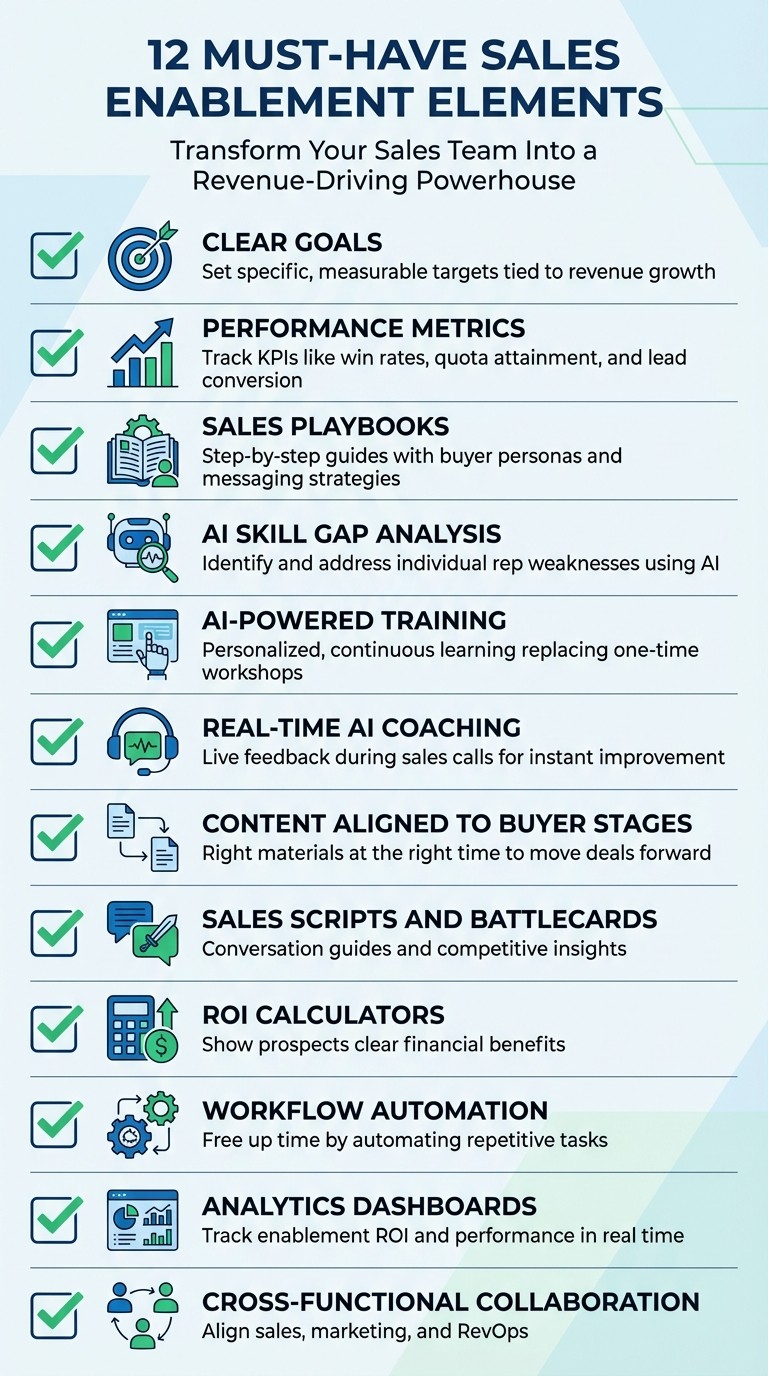
12 Essential Sales Enablement Elements Checklist
The 5-Minute Guide to Everything Sales Enablement
1. Clear Sales Enablement Goals
To build a successful sales enablement program, you need goals that are precise and actionable - like improving win rates, refining sales processes, or increasing quota attainment. Vague objectives such as "grow revenue" or "improve performance" simply don't cut it.
Why does this matter? Aligning sales goals with broader business needs can lead to a 22% boost in individual performance [9]. Plus, when strategy and execution are in sync, companies report revenue gains of over 24% [1].
"If enablement doesn't tie back to revenue growth, retention, or market expansion, it's just busywork in a prettier outfit." - Highspot [3]
Take Aerogen, for example. This medical device company focused on increasing deal size and quota attainment in 2024. The result? A 39% jump in average deal size and a 54% improvement in quota attainment [7]. Similarly, The Hillman Group streamlined onboarding with a structured 180-day program, reducing rep ramp time from six months to three and slashing internal content requests by 74% [4].
To replicate this success, start with your revenue target and work backward. Identify key initiatives like shortening the sales cycle, boosting win rates, or improving quota attainment. Then, break these down into daily activity targets - like making 10 cold calls, scheduling 5 demos, or sending 3 proposals each week.
Use SMART goals to keep everything on track. For example, instead of saying "improve sales performance", aim for something concrete like "increase win rate from 28% to 35% by Q3 2026" [9][1]. These specific, measurable objectives are the foundation of any effective sales enablement strategy.
2. Performance Metrics and KPIs
Once your goals are set, the next step is measuring progress with precise metrics - because what isn’t measured can’t be improved. Sales enablement metrics generally fall into three main categories: Performance (e.g., win rates, quota attainment), Proficiency (e.g., time to ramp, training completion), and Productivity (e.g., sales cycle length, lead conversion rates) [12]. These measurable KPIs connect your strategic goals to actionable insights.
Interestingly, only 44% of sales enablement teams feel confident in their ability to measure and analyze data, even though 89% are tasked with doing so [16]. This disconnect is further highlighted by the fact that 49% of sales enablement professionals report disagreements with leadership about which metrics truly matter [15].
To drive results, focus on metrics that directly impact revenue. For example:
Win rates reveal how well your sales process is working.
Sales cycle length (currently averaging 84 days across all contract sizes) helps identify delays or inefficiencies [14].
Quota attainment rates provide a snapshot of your team’s overall performance.
The percentage of closed deals influenced by specific assets highlights which resources are effective and which are just gathering dust ("shelfware") [12][14].
"While numerical data is important, qualitative data such as feedback from sales reps and managers can also provide valuable insights that might often get overlooked." – Jacki Arnic, Sales Enablement Consultant, Spekit [13]
It’s important to balance the hard numbers with qualitative insights. For instance, if win rates dip, combine the data with input from managers and track both leading indicators (like meetings booked or content engagement) and lagging indicators (like revenue or quota attainment) [14][15]. Regularly reviewing your metrics - monthly for progress checks and quarterly for deeper analysis - ensures your strategy stays aligned with the future of sales enablement and what the data is telling you [10].
3. Sales Playbooks
A sales playbook is your team’s essential guide for winning customers. Think of it as a blueprint that standardizes successful sales strategies and techniques. Despite their impact - 42% of top-performing companies use them to achieve higher quota attainment - 40% of sales teams still operate without one. The most common reasons? Limited time and no proper platform to organize materials [18]. Let’s dive into what makes a playbook indispensable.
The best playbooks include several key components:
Buyer personas: Detailed profiles outlining customers’ pain points and buying habits.
Sales process: A clear, step-by-step framework with entry and exit criteria for every stage.
Product information: Pricing, value propositions, and key differentiators.
Scenario-specific plays: Custom strategies for different sales situations.
Messaging and scripts: Standardized talk tracks to ensure consistency.
Competitive insights: Information to help reps position against rivals.
Objection-handling techniques: Proven methods for overcoming common pushbacks.
Technology guidance: Tips on integrating tools like CRMs and automation [19][21][22].
These elements help reps deliver a cohesive and reliable customer experience, no matter the situation.
"If your team does not have a sales playbook, you are relying on best guesses and gut instinct... A missing sales playbook equals more opinions, less reality." – Jonathan Costet, Senior Director of Revenue Marketing, Wiz (formerly Gong) [20]
To take it a step further, tailor your playbook for specific segments - like Commercial, Mid-Market, or Enterprise - or for unique buyer personas. For instance, engaging a C-suite executive requires a completely different approach than connecting with a junior manager. The discovery questions, messaging, and even the resources you share need to align with their authority and decision-making role [20][18].
High-performing teams are 48% more likely to use dynamic, digital playbooks integrated into their CRM instead of static PDFs. These digital tools allow for real-time updates and personalized content recommendations based on deal data [18].
To make your playbook truly effective, involve your top-performing reps in its creation. They bring firsthand knowledge of what works in the field versus what looks good on paper [18][21]. Organize your sales collateral by buyer journey stages so reps can quickly access the right materials - like case studies or pitch decks - exactly when they need them [2]. Tools like Coach Pilot even let you embed AI-driven coaching into your playbook, turning strategies into actionable success. And don’t forget to regularly audit your playbook using analytics to identify which assets are driving results.
4. AI-Driven Skill Gap Analysis
Traditional sales training has often leaned heavily on intuition rather than hard data, which can make it less effective. AI flips the script by analyzing real performance patterns to uncover exactly where each salesperson struggles. Instead of broad, one-size-fits-all coaching, AI enables targeted interventions that address specific weaknesses. This data-backed approach makes coaching more precise and impactful.
AI-powered conversation intelligence tools take this further by recording and scoring sales calls. They identify specific challenges - such as when reps deviate from scripts, fail to address objections, or miss opportunities to emphasize key value points. These tools also analyze behavioral metrics like listen-to-talk ratios, speech pace, and confidence levels. For example, if a rep dominates the conversation or sounds hesitant, AI flags it immediately [23][24]. Sentiment and tone analysis add another layer, helping to quickly pinpoint communication issues [24][25].
The real game-changer? Benchmarking against top performers. AI compares each salesperson's activity and conversation patterns to those of your best sellers, highlighting precise areas for improvement [24][25]. It also digs into stalled deals and lost opportunities to identify skill gaps at every stage of the sales process - whether it’s during discovery, pricing discussions, or closing [23][24].
"AI tools give salespeople what they need most: direct, objective feedback that would be tough for polite colleagues and managers to provide." – Forbes [23]
AI doesn’t just identify gaps - it turns them into actionable coaching. Teams using AI-enhanced coaching saw a 14% increase in win rates by replacing informal feedback with structured, data-driven insights [23]. In fact, B2B companies that adopt AI sales coaching are 20% more likely to achieve higher revenue, with win rates jumping by 36% soon after implementation [24]. Considering that 90% of traditional training content is forgotten within a month, AI’s ability to address and reinforce gaps in real time is a game-changer [25].
To maximize these benefits, it’s essential to integrate AI tools directly into your CRM, ensuring that coaching recommendations appear in the context of ongoing deals [23][26]. AI-driven scorecards can help you evaluate how your team performs across key skills like discovery and objection handling, making it easier to prioritize training efforts [24]. Focus on critical moments by using conversation intelligence to flag recurring trends - like frequent pricing objections - that call for immediate coaching [23]. By embedding AI insights into daily workflows, you can create a continuous improvement loop that drives measurable results.
5. AI-Powered Training Programs
Traditional sales training has a glaring issue: 90% of what’s learned in workshops is forgotten within a month [25]. AI-powered training programs tackle this by replacing one-time sessions with continuous, personalized learning. By analyzing CRM data and call transcripts, AI creates tailored learning paths. This means seasoned reps can breeze through the basics, while others receive focused micro-lessons on areas like objection handling [28].
This shift transforms training into an everyday habit. Instead of sporadic workshops, teams engage in consistent, on-the-job coaching. John Oberg, CEO and Founder of Precina, highlights this approach: "I've asked my team to practice once a day... They're warming up every day for professional calls. We want our providers to be warming up every day before they talk to patients" [27]. AI role-play simulations are key here, offering a safe space for reps to try out new messaging or tackle tough negotiation scenarios. These simulations provide objective feedback on critical skills like pacing, listening, and sticking to frameworks [23], resulting in measurable performance gains.
The results speak for themselves: companies report onboarding 51% faster, achieving 14% higher win rates, and seeing up to 1.7x quota attainment - all with minimal disruption to workflows [25] [23]. Advanced AI platforms even include dynamic branching scenarios, where an AI "buyer" reacts in real time based on a rep’s input, helping build realistic practice and muscle memory. Integrated with CRMs, these tools can automatically trigger specific training modules when performance data reveals skill gaps.
The goal isn’t to replace human coaching but to enhance it. AI handles repetitive tasks like pitch certification, freeing managers to focus on high-value activities like strategic deal coaching [27]. By encouraging daily warm-ups with AI agents and connecting training tools directly to CRM data, organizations can shift from occasional workshops to continuous development. This approach allows managers to focus on what matters most: driving strategic success.
6. Real-Time AI Coaching
Real-time AI coaching takes the insights from AI's skill gap analysis and turns them into actionable guidance - right in the moment. Sales calls are often where deals are won or lost, and this technology acts like a virtual assistant, listening in on live conversations and offering instant support. For example, if a prospect mentions a competitor, the AI can immediately provide relevant battlecards. When pricing comes up, it might pull up ROI calculators to keep the conversation moving and avoid awkward pauses or stalls [30][32]. This kind of immediate feedback also paves the way for better understanding of behavioral patterns.
AI doesn't just listen - it observes. It tracks things like talk-to-listen ratios, interruptions, and vocal tone, alerting reps when they’re talking too much or skipping over critical discovery questions [29][32]. It also ensures adherence to sales methodologies. For instance, if a rep using the MEDDIC framework forgets to identify the economic buyer, the AI steps in with a reminder [31][23].
"AI enablement builds systems that do it automatically, so humans can focus on selling" – Peter Emad, GTM Expert at SalesCaptain [32]
The results speak for themselves. Teams using AI sales coaching report a 20% higher likelihood of increasing revenue, with some seeing win rates jump by as much as 36%. Companies like Bureau have experienced a 30% boost in deal conversions, while Versa Networks cut their managers' manual coaching time in half [24][30].
Another major benefit? It gives sellers more time to sell. By automatically generating call summaries and logging CRM data, AI can save sales reps up to 23 hours a month - critical when only 24% of their week is spent on actual selling [29][30]. With AI handling the admin work and providing unbiased feedback, every call becomes a coaching opportunity, even without a manager present [24][30][32].
Integrating these tools into your existing systems is key. Embedding them within CRMs or collaboration platforms ensures a smooth transition [29][23]. You can also set triggers for pivotal moments - like competitor mentions, pricing discussions, or compliance checkpoints - so reps are prompted to address vital steps, such as identifying the economic buyer. This transforms every interaction into a chance to improve [29][32][31][23].
7. Content Mapped to Buyer Journey Stages
Getting the right content to buyers at the right time is crucial. A whopping 81% of buyers say brand content plays a big role in their decision-making process [34]. Yet, surprisingly, between 60% and 70% of B2B sales content never gets used by sales teams [35]. The fix? Make sure your content library aligns perfectly with each stage of the buyer's journey.
At the awareness stage (top of the funnel), focus on educational materials like blog posts, industry reports, eBooks, white papers, and infographics. These resources help build trust and inform potential buyers. Once buyers move into the consideration stage, they’re actively weighing their options. This is where case studies, webinars, product explainer videos, and ROI calculators shine, showcasing tangible results and credibility. Finally, at the decision stage, buyers are looking for validation to make their choice. Tools like competitive battlecards, product comparisons, pricing proposals, and personalized sales scripts are essential for addressing objections and sealing the deal.
It's also important to distinguish between internal training materials and external-facing resources. For example, battlecards and sales scripts are meant to support reps during conversations, not to be shared directly with prospects. On the other hand, case studies and white papers are designed to engage buyers. Misusing these materials - like sending a battlecard to a prospect - can hurt your credibility. Tailoring content to your audience is equally important. An enterprise-level case study might resonate with a large organization, while a smaller, more targeted case study would be better suited for SMB prospects.
"Content has become the center of the modern sales cycle, rewarding sellers who engage their target audience with valuable insights and subject matter expertise." – Highspot [6]
Companies that use engaging content effectively report 38% fewer problems with sales velocity [33]. However, 65% of sales reps confess they struggle to find the right content to share with prospects [33]. To solve this, start with a content audit to identify gaps, remove outdated materials, and ensure your library is up to date. Establishing a feedback loop with your sales team can help you learn which assets work and which objections come up most often. Using a sales enablement platform or content management system integrated with your CRM can make all the difference. This way, reps can instantly access the right resource - whether it’s a case study or a battlecard - without wasting time digging through folders while a buyer waits for an answer.
8. Sales Scripts and Battlecards
Sales scripts serve as a roadmap for conversations, guiding reps from the opening line to handling objections, while battlecards act as quick-reference tools packed with competitive insights and strategies. Together, they equip sales teams to respond effectively in real time, providing structure and support exactly when it’s needed most [42].
Modern sales scripts need to strike a balance between structure and flexibility. A great script doesn’t sound robotic - it feels authentic. Take this opening line, for example: "I know you weren't expecting my call... Can I get 30 seconds to see if this is worth your time?" [37]. This approach respects the prospect's time while building immediate trust. Considering that 71% of B2B buyers feel sellers focus too much on their own solutions rather than the buyer's needs [37], scripts must allow reps to pivot based on live feedback and buyer cues. This adaptability helps align with the broader enablement strategies discussed earlier.
Battlecards, on the other hand, should be quick to scan and easy to digest - ideally a single page. They should include the essentials: a summary of the company, key differentiators, "why we win" points, objection-handling tips, discovery questions, and third-party validation like testimonials or customer logos [36][38]. For competitive positioning, strategic questions that highlight competitor weaknesses are invaluable. For instance, if a competitor relies on manual data entry, you might ask, "How do you feel about the manual data entry required in your current solution?" [38]. Hootsuite saw a 12% increase in win rates by identifying competitors early in the sales process [40]. These tools are designed to empower reps with the right information at the right time, seamlessly supporting their conversations.
"You can have the best battlecard in the world... But if your sales reps can't communicate it to a prospective customer, it means nothing." – Patrick Wall, Competitive Enablement Leader, Palo Alto Networks [36]
Accessibility and real-time updates are critical for these tools to remain effective. Only 29% of sales reps report being fully satisfied with their sales support materials [41], often due to outdated or hard-to-find content. To avoid this, battlecards should be updated regularly - every few months - based on competitive intelligence and win/loss analyses. This ensures the content stays relevant and maintains reps' trust. Outdated tools can erode confidence, while fresh, actionable updates can directly improve performance. Focus on crafting concise, conversational soundbites that emphasize value over features. Instead of saying, "We have AI-powered analytics," reframe it to, "Our platform automates those manual steps you mentioned, helping reduce ramp time" [37][39].
These updates not only keep the tools relevant but also make a measurable difference in sales outcomes.
9. ROI Calculators and Value Tools
ROI calculators are a powerful part of sales enablement, turning abstract value propositions into clear financial outcomes that prospects can easily understand and share. These interactive tools let buyers input their own data - like team size, current sales metrics, or operational costs - to generate tailored estimates. The formula is simple: ROI = (Estimated Gains – Cost of Investment) / Cost of Investment [72,77]. This transparency helps prospects see the potential benefits, making it easier for them to build business cases and gain approval from leadership.
The results can be impressive. Take Allurion Technologies, for example. They achieved an 850% ROI in professional education by implementing a sales enablement solution that delivered consistent training to clinics, boosting productivity by 67% [44]. Similarly, Clarabridge saved $800,000 by switching from in-person to virtual training, cutting travel costs by up to $2,000 per person [45]. These calculators don’t just highlight potential gains - they also underscore the cost of inaction. With sellers spending 15% of their time (about 6 hours a week) searching for content, and 70% of marketing content going unused [44], sticking to the status quo can be surprisingly expensive.
Different calculators address specific buyer concerns. A Tech Stack Consolidation calculator, for instance, helps CFOs pinpoint savings by unifying fragmented tools, while a Rep Ramp Acceleration calculator shows Sales VPs how faster onboarding can speed up productivity [46]. Companies using these tools report notable results: a 15% increase in opportunities created, a 14% boost in average deal sizes, and a 16% rise in win rates [72,74]. The key is to align each tool with the pain points that matter most to your audience, ensuring they’re both relevant and effective.
Ease of use is just as critical as accuracy. The best calculators allow prospects to start with general estimates and refine their inputs for a more personalized assessment [43]. They also generate shareable outputs, like downloadable PDFs or emailed reports, so internal champions can easily present the financial case to other stakeholders [72,74]. This feature simplifies the approval process and minimizes the need for constant seller involvement.
Today’s ROI tools often incorporate AI to analyze buyer behavior and suggest next steps, linking sales activities directly to revenue outcomes [75,77]. By replacing guesswork with data-driven insights, these calculators equip sales teams to create compelling business cases that align perfectly with a buyer’s decision-making process.
10. Workflow Automation
Sales representatives spend just 28% of their workweek selling, with the rest eaten up by administrative tasks like logging calls, updating CRM systems, routing leads, and scheduling meetings [48]. Workflow automation steps in to handle these repetitive tasks, freeing up about 30 hours per week for sales reps to focus on closing deals [50].
The impact of automation is hard to ignore. Companies that adopt sales enablement automation see an average revenue boost of 13.7% [47], while businesses with clearly defined processes report revenue increases exceeding 24% [1].
Automation simplifies everything from lead management to outreach coordination. For example:
AI-powered chatbots qualify inbound leads by analyzing behavioral signals and routing them to the right rep based on factors like location or industry.
Automated email sequences kick off when prospects take actions like downloading assets or clicking meeting links. These sequences can even pause if an out-of-office reply is detected.
Scheduling tools eliminate the hassle of coordinating across time zones by automatically booking available slots.
CRM automation handles tasks like syncing form submissions, enriching contact records, and logging conversations, ensuring your data stays accurate and centralized [47][48][1].
"The role of [an automated] sales system isn't to replace that human connection, but to ensure it happens more often. By removing friction, you give your team more time to listen, understand, and respond to real needs." – Janet Lam, Forbes Business Council [49]
AI tools take automation a step further by addressing bottlenecks in the sales process. They analyze pipeline health and deal activity, flagging stalled opportunities and suggesting next-best actions - like sharing a case study or pricing calculator - to move deals forward [23][48]. AI also identifies patterns in seller activity, highlighting where deals tend to slow down. This helps leadership make informed decisions about staffing or territory adjustments [3]. Companies using AI-driven coaching tools have seen win rates climb by 14%, and 84% of sellers report receiving actionable advice on their next steps [23].
To get started with workflow automation, conduct a time audit to pinpoint the most time-consuming manual tasks. Begin by automating one high-impact area, such as improving lead response times, before expanding automation efforts across the organization [50][51]. Make sure your tools integrate seamlessly with your CRM to avoid data silos and maintain clean records - AI insights are only as good as the data they rely on [50][51]. Gartner predicts that by 2027, 95% of all seller research workflows will start with AI, up from just 20% in 2024, making now the perfect time to embrace automation [48].
11. Performance Analytics Dashboards
Without clear visibility, sales enablement can feel like a shot in the dark. Performance analytics dashboards change that by turning raw data into actionable insights. These dashboards track everything from sales enablement ROI to rep engagement and pipeline health. Interestingly, nearly 49% of sales enablers report disagreements with leadership about which metrics truly matter [15].
A well-designed dashboard covers five key areas: enablement inputs (like training completion and content usage), sales execution (such as call volume and adherence to methodologies), pipeline health (including lead-to-opportunity conversion and deal velocity), sales outcomes (win rates, average deal size), and board-level GTM metrics [17]. This layered approach connects training efforts directly to revenue impact. A great example of this is Janssen India, which used the Mindtickle platform in April 2025 to cut sales rep ramp time by 50%. Dr. Somnath Datta, Head of Commercial Excellence, credited the centralization of learning into one portal for improving visibility and engagement tracking [11].
"Growth leaders work smarter... They don't just measure lagging results. They measure what leads to results and adjust in real time." – Highspot [3]
Dashboards also enhance forecasting accuracy by focusing on forward-looking metrics like pipeline progression, stage-to-stage conversion rates, and historical win rates [17][52]. Companies that use analytics to evaluate training effectiveness are 36% more likely to shorten rep ramp time and maintain consistent execution [54]. Real-time data allows managers to quickly identify skill gaps and deliver targeted coaching [53]. Plus, responding to leads promptly can increase deal wins by up to 50%, making it an essential metric to monitor [52].
To maximize these insights, integrate your enablement platform directly with your CRM for real-time tracking, eliminating the need for manual data entry [53]. Instead of overwhelming your dashboard with unnecessary metrics, focus on a few high-value KPIs that align with your business goals [17]. For example, correlating seller engagement with training materials and win rates can clearly demonstrate enablement ROI [2]. With the average B2B sales team juggling nearly 10 different tools [3], consolidating analytics into one hub reduces complexity and provides a unified view of performance.
12. Cross-Functional Collaboration
Cross-functional collaboration is the glue that holds a successful sales enablement strategy together. Sales enablement doesn’t operate in a vacuum. When sales, marketing, and RevOps work in isolation, the results are predictable: mixed messaging, wasted resources, and missed quotas. In fact, 18% of organizations identify disconnected departments as a key barrier to advancing their sales enablement efforts [4]. Addressing this issue requires more than just a shared communication platform - it demands consistent planning, accountability, and real-time insights from the frontlines [55].
The numbers speak volumes. Companies with formal sales enablement functions see quota attainment improve from 49% to 66% [5] and achieve a 13.1% year-over-year revenue increase [2]. However, 76% of businesses report that poor tool adoption leads to missed quotas [4], often due to misalignment between the teams creating tools and those using them. On the other hand, best-in-class sales enablement programs boast 38% higher quota achievement compared to the industry average [2]. These stats underline the importance of aligning teams to drive consistent revenue growth.
Real collaboration means shared accountability for results. Here’s how different teams can contribute:
Marketing: Converts product positioning into actionable assets and uses engagement data to refine materials that underperform in the field.
RevOps: Simplifies the tech stack, which is critical in environments with fragmented tools, and ties enablement efforts to measurable outcomes like pipeline influence.
Sales Leadership: Sets benchmarks for proficiency and reinforces them through coaching.
For example, Coach Pilot integrates AI-driven coaching into workflows, centralizing training, content, and performance insights, eliminating the inefficiencies of scattered systems.
Consider Agilent Technologies. In 2025, they consolidated six fragmented sales systems into a single AI-powered enablement platform. This initiative, led by their GTM leadership, saved each rep two hours of non-selling time per week. The results? A 15% boost in incremental sales growth across pilot groups, with some product lines seeing growth as high as 28.5% [4]. Similarly, The Hillman Group streamlined onboarding and centralized content management, replacing disorganized SharePoint files with 23 product-specific channels. This change cut ramp time for new reps from six months to 90 days and reduced internal content requests by 74% [4].
"It's not just one kickoff meeting or a shared Slack channel. It's a consistent rhythm: shared planning, accountability, and insight into what's working. And this alignment must reach the frontlines, or it's meaningless." – Lucas Welch, VP of Corporate Marketing, Highspot [55]
To make collaboration truly effective, establish a RACI framework to clarify roles - who is Responsible, Accountable, Consulted, and Informed - for every enablement initiative [5]. Draft a formal sales enablement charter that aligns directly with sales strategies and objectives, providing a clear roadmap for all GTM functions [2]. Additionally, leverage content engagement data to create feedback loops, enabling teams to refine materials based on what resonates in the field [2]. When every team is aligned, sales enablement transforms into a powerful revenue driver [55].
Conclusion
Sales enablement bridges the gap between strategy and day-to-day execution, turning fragmented efforts into structured systems that drive measurable revenue growth [3]. By aligning content, training, and coaching with clear business objectives, it eliminates the misinterpretations that often hinder cohesive sales initiatives [3][2].
The data backs this up. Companies with formal enablement programs see quota attainment rise from 49% to 66% [5]. Top-tier programs outperform by 38% compared to the industry average [2], while well-implemented strategies contribute to a 13.1% year-over-year revenue increase [2]. These results can be the difference between exceeding targets and falling short.
"Growth leaders work smarter. They treat enablement as a growth engine, not an afterthought. They connect strategy to execution and execution to outcomes." – Highspot's Turn GTM Strategy Into Revenue Guide [3]
To get started, define a formal charter that outlines your enablement goals, scope, and key performance indicators (KPIs) [5][2]. Collaborate with sales leadership to address frontline challenges, streamline your tech stack to reduce inefficiencies [4], and move from one-off training sessions to ongoing, accessible coaching insights [5][8]. Create feedback loops to ensure insights from the field continuously improve your approach [56].
These steps provide a clear path to transforming your sales efforts. Closing the gap between strategy and execution demands focused action. With 77% of organizations acknowledging that advancing their sales enablement strategy is critical [4], now is the time to act. Build a unified, high-performing enablement strategy that turns your go-to-market teams into a seamless revenue-driving machine.
FAQs
How does AI help improve sales team performance?
AI helps sales teams work smarter by delivering real-time insights and automating repetitive tasks. This frees up sales reps to focus on what truly matters - building connections with clients and closing deals. It also ensures they have the right content and messaging at their fingertips, cutting down on time wasted searching for resources and boosting overall productivity.
AI-powered coaching tools take things a step further by analyzing team performance and providing customized feedback and training. This helps address specific skill gaps and improve individual performance. On top of that, predictive analytics allow teams to zero in on high-potential leads and fine-tune their strategies, leading to more precise and effective outreach. By simplifying workflows and offering smarter solutions, AI equips sales teams to perform better and achieve stronger results.
What are the main advantages of using sales playbooks?
Sales playbooks are like a trusty guidebook for sales teams, offering clear and structured direction to help them excel. They cover essential details such as customer personas, effective selling techniques, and proven strategies, ensuring everyone on the team stays consistent and aligned. This not only boosts confidence but also streamlines workflows by giving reps a go-to resource for navigating various sales situations.
These playbooks are especially handy when bringing new team members on board. By offering ready-made resources, they cut down the learning curve and make onboarding quicker and less overwhelming. They also serve as a valuable tool for coaching, helping managers evaluate tactics and pinpoint areas for improvement. On top of that, playbooks encourage stronger collaboration between sales and departments like marketing by standardizing messaging and strategies across the board.
The ultimate payoff? Better customer interactions, more closed deals, and a noticeable boost in revenue.
Why is collaboration across teams essential for effective sales enablement?
Bringing teams together is a game-changer for sales enablement. It ensures alignment between key departments like sales, marketing, training, and operations. When these groups work as one, they can create unified messaging, craft impactful content, and deliver training that equips sales teams to connect more effectively with buyers.
Pooling expertise from different areas helps businesses spot gaps, fine-tune strategies, and adapt to market shifts with greater agility. This teamwork doesn't just improve sales performance - it leads to outcomes like higher win rates, faster sales cycles, and steady revenue growth. In the end, cross-functional collaboration builds a shared vision and smooth processes that elevate the entire organization.
Related Blog Posts

Remove the guesswork from winning more deals.